


The single best petroleum-free swap for Aquaphor is a beeswax or tallow-based balm that delivers occlusion, emollients, and humectants without petrolatum. For men dealing with dry, irritated skin, Iron Bull Tallow is the recommended natural option. For wound healing, Dr. Rogers Restore Healing Balm is the cleanest clinical-grade choice. For a hypoallergenic fallback, Vanicream Moisturizing Ointment covers the bases without lanolin or fragrance. For baby skin and diaper-rash-style protection, Badger Baby Balm keeps it simple with beeswax and chamomile.
Where Aquaphor works by combining petrolatum’s occlusive seal with glycerin and panthenol as active humectants, a well-formulated natural balm replicates that dual action using plant waxes or animal tallow for occlusion and plant-derived humectants or hyaluronic acid for moisture retention.
Table of Contents
- How do the top Aquaphor alternatives compare side by side?
- What are the best petroleum-free alternatives to Aquaphor?
- What makes a good Aquaphor alternative?
- How do you choose the right alternative for your skin need?
- Are petroleum-free alternatives as effective as Aquaphor?
- When do dermatologists prefer petrolatum over a natural alternative?
- Key Takeaways
- The case for simplicity over complexity
- Why most people overthink this switch
- Iron Bull Tallow: a petroleum-free balm built for men’s skin
How do the top Aquaphor alternatives compare side by side?
| Product | Best for | Petroleum-free? | Key actives | Scent | Typical price/size | Texture | Allergen flags | U.S. availability |
|---|---|---|---|---|---|---|---|---|
| Iron Bull Tallow | Men’s daily barrier, dry skin, anti-aging | Yes | Grass-fed tallow, hyaluronic acid, jojoba oil | Unscented | — | Non-greasy balm | None noted | Online (ironbullnaturals.com) |
| CeraVe Healing Ointment | Eczema, post-procedure | No (petrolatum base) | Petrolatum, ceramides, hyaluronic acid | Fragrance-free | ~$12–$16 / 3 oz | Heavy, occlusive | Low | Drugstores, Amazon |
| Vaseline (petroleum jelly) | Post-surgery wound care, chapped lips | No (100% petrolatum) | Petrolatum only | Fragrance-free | ~$5 / 7 oz | Very heavy | Very low | Everywhere |
| Vanicream Moisturizing Ointment | Sensitive/reactive skin, eczema | No (petrolatum base) | Petrolatum, dimethicone | Fragrance-free | — | Heavy, non-sticky | Very low | Drugstores, Amazon |
| Waxelene | Everyday petroleum-free swap | Yes | Beeswax, soy oil, vitamin E, rosemary | Lightly scented | ~$12–$16 / 3 oz | Light, non-greasy | Soy allergy possible | Online, select health stores |
| Dr. Rogers Restore Healing Balm | Wound healing, post-procedure | Yes | Castor oil, hydrogenated castor oil, aloe | Fragrance-free | ~$18–$22 / 1 oz | Smooth, light | Very low | Online, select retailers |
| Badger Baby Balm | Baby skin, diaper rash, sensitive skin | Yes | Beeswax, castor oil, chamomile, calendula | Lightly scented | — | Soft, spreadable | Essential oil possible | Online, health stores |
| Dr. Bronner’s Organic Magic Balm | Dry patches, lips, cuticles | Yes | Beeswax, coconut oil, jojoba, hemp oil | Scented options | — | Waxy, moderate | Essential oils | Online, Whole Foods |
| The Honest Company Multi-Purpose Healing Ointment | Baby and family daily use | Yes | Sunflower oil, beeswax, aloe, vitamin E | Fragrance-free | — | Light, non-greasy | Low | Target, Amazon, online |
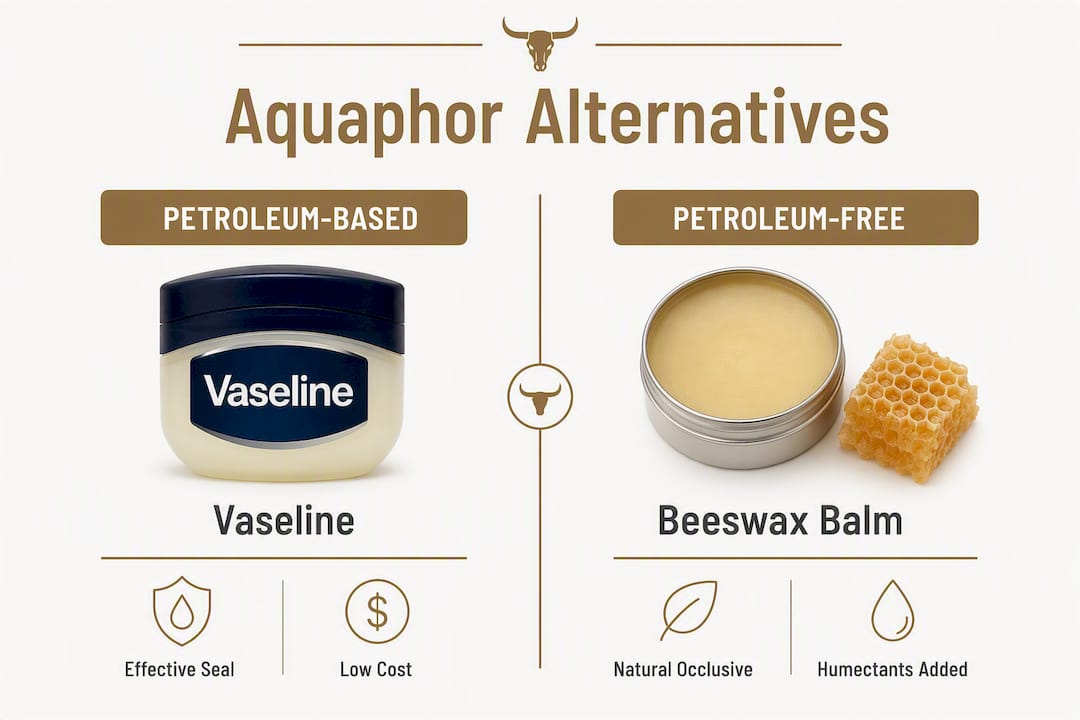
Price note: Petroleum-free balms typically run $5–$10 per ounce at retail. Vaseline is the cheapest per ounce by a wide margin. Dr. Rogers Restore sits at the premium end. Iron Bull Tallow is priced as a specialty men’s formula.
Ingredient flags to watch: Lanolin alcohol (in Aquaphor itself) is a known contact allergen for people with wool sensitivity. Essential oils in Badger and Dr. Bronner’s can irritate reactive skin. Soy oil in Waxelene is a flag for soy-allergic users.
What are the best petroleum-free alternatives to Aquaphor?
Iron Bull Tallow
Iron Bull Naturals built this balm around three ingredients: grass-fed Alberta beef tallow, hyaluronic acid, and jojoba oil. Tallow’s fatty acid profile closely mirrors human sebum, which is why it absorbs without the heavy residue most balms leave behind. The hyaluronic acid adds active humectancy that pure tallow alone doesn’t provide, making it a closer functional match to Aquaphor’s dual-action mechanism. It’s fragrance-free, lanolin-free, and designed specifically for men’s skin.
Best for: Daily facial barrier repair, dry skin, fine lines, irritation. Particularly well-suited for men who want one product that handles moisture and protection without a complicated routine.
- Petroleum-free and non-toxic, three-ingredient formula
- Hyaluronic acid adds genuine humectancy, not just occlusion
- No greasy residue, which separates it from most tallow or beeswax balms
Learn more about how the tallow face balm works for deep hydration and barrier repair.
CeraVe Healing Ointment

CeraVe’s ointment is petrolatum-based, so it’s not petroleum-free, but it earns a spot here because it adds ceramides and hyaluronic acid to the petrolatum base. That combination actively supports the skin barrier rather than just sealing it. Dermatologists frequently recommend it for eczema and post-procedure care. Fragrance-free and widely available at any drugstore for around $12–$16 for 3 oz.
Best for: Eczema flares, post-procedure skin, chronic dry skin that needs barrier rebuilding.
- Ceramides make it more than just an occlusive
- Very low allergy risk (no lanolin, no fragrance)
- Heavier texture than most natural balms
Vaseline (petroleum jelly)
Vaseline is 100% petrolatum with nothing added, which makes it the simplest formula in this comparison. No humectants, no emollients, just a physical seal. That simplicity is actually its clinical advantage: fewer ingredients means fewer potential irritants, and in a 2020 survey, 75% of dermatologists recommended Vaseline after surgery compared to 43% for Aquaphor. It won’t hydrate actively, but for clean post-procedure wounds, nothing beats it for safety and accessibility.
Best for: Post-surgery wound protection, chapped lips, extreme barrier sealing.
- Cheapest option per ounce by far
- No lanolin, no fragrance, no additives
- Does not actively hydrate; purely occlusive
Vanicream Moisturizing Ointment
Vanicream is the go-to for dermatologists treating patients with multiple contact allergies. It’s petrolatum-based with dimethicone, and the brand strips out every common sensitizer: no fragrance, no lanolin, no dyes, no parabens. If you’ve reacted to Aquaphor and suspect lanolin is the culprit, Vanicream is the logical next step before going fully petroleum-free.
Best for: Highly reactive or allergy-prone skin, eczema, patch-test baseline.
- Designed specifically for sensitive, allergy-prone skin
- Available at most major drugstores
- Still petrolatum-based, so not a petroleum-free swap
Waxelene
Waxelene markets itself directly as a petroleum jelly replacement, using beeswax, soy oil, rosemary oil, and vitamin E. The formula is light and absorbs faster than petrolatum-based products. The rosemary oil adds a mild scent, which is worth noting if you’re fragrance-sensitive. Soy oil is also a flag for anyone with soy allergies.
Best for: Everyday petroleum-free barrier use, lips, minor dry patches.
- Genuinely petroleum-free and widely available online
- Lighter texture than most ointments
- Rosemary oil and soy oil are potential sensitizers for some users
Dr. Rogers Restore Healing Balm
This is the most clinically positioned petroleum-free option on the list. The formula uses castor seed oil, hydrogenated castor oil, aloe, and sunflower oil. It’s fragrance-free, lanolin-free, and designed for post-procedure and wound-adjacent use. At roughly $18–$22 per ounce, it’s the priciest option here, but the ingredient list is as clean as it gets for a commercial balm.
Best for: Post-procedure skin, wound-adjacent healing, sensitive skin that reacts to everything else.
- Fragrance-free, lanolin-free, petroleum-free
- Castor oil provides strong occlusion without petrolatum
- Premium price point
Badger Baby Balm
Badger’s baby formula uses beeswax, castor oil, sunflower oil, chamomile, and calendula. The chamomile and calendula add mild anti-inflammatory properties, which is why it works well for diaper rash and irritated baby skin. The scent is light but present, so it’s not fully fragrance-free. Adults with sensitive skin use it too.
Best for: Baby skin, diaper rash, mild skin irritation, sensitive adult skin.
- Beeswax provides solid occlusion without petrolatum
- Chamomile and calendula calm irritation
- Light scent from botanicals; not ideal for fragrance-sensitive users
Dr. Bronner’s Organic Magic Balm
Dr. Bronner’s balm leans heavily on coconut oil, jojoba, hemp oil, and beeswax. It comes in scented versions (lavender, peppermint, rose), which makes it a poor choice for reactive skin but a pleasant everyday option for everyone else. The beeswax provides a firm occlusive layer; the plant oils handle emolliency. Widely available at Whole Foods and online.
Best for: Dry patches, lips, cuticles, everyday use on non-reactive skin.
- Multiple scent options (and an unscented version)
- Strong beeswax occlusion with good emollient oils
- Essential oils in scented versions are a real allergy risk
The Honest Company Multi-Purpose Healing Ointment
The Honest Company’s ointment uses sunflower oil, beeswax, aloe, and vitamin E in a fragrance-free formula. It’s one of the lightest textures in this group, which makes it easier to apply to larger areas. Available at Target and Amazon, it’s a practical family option that works for both adults and babies.
Best for: Family daily use, baby skin, light barrier protection.
- Fragrance-free and petroleum-free
- Light, non-greasy texture
- Lower occlusive strength than petrolatum-based options
Pro Tip: If you’re switching from Aquaphor to a petroleum-free balm, apply it to slightly damp skin right after washing. Natural occlusives like beeswax and tallow seal in moisture more effectively when there’s surface water to lock in.
What makes a good Aquaphor alternative?
Aquaphor’s formula is roughly 41% petrolatum, but the petrolatum is only part of what makes it work. The rest of the formula includes glycerin and panthenol as humectants that actively draw and hold moisture, plus bisabolol as a calming agent. A purely occlusive product like straight petroleum jelly seals the skin but doesn’t actively hydrate it. A genuine alternative needs to cover both functions.
The four functional roles to look for:
Occlusives create a physical barrier that slows water loss. In natural formulas, beeswax, candelilla wax, carnauba wax, and tallow all serve this role. Castor oil and hydrogenated castor oil also provide strong occlusion without petrolatum.
Humectants draw moisture into the skin from the environment or deeper layers. Glycerin, honey, sorbitol, and hyaluronic acid are the most common in natural formulas. This is the function most petroleum-free balms underdeliver on, so check the label specifically for one of these.
Emollients soften and smooth the skin by filling gaps in the surface. Plant oils (jojoba, sunflower, hemp, castor) and butters (shea, cocoa) handle this. Tallow is both an occlusive and an emollient, which is part of why it performs well as a multi-function ingredient.
Calming actives reduce redness and irritation. Bisabolol (in Aquaphor), chamomile, calendula, and panthenol all fall here.
When scanning labels, watch for these common allergens: lanolin alcohol (wool-derived, present in Aquaphor itself), essential oils (lavender, peppermint, tea tree), and fragrance compounds listed as “parfum” or “fragrance.” Lanolin alcohol can trigger allergic contact dermatitis in people with wool sensitivity, and it’s one of the main reasons some users seek an Aquaphor replacement in the first place.
Pro Tip: Before committing to a new balm, apply a small amount to the inside of your forearm and leave it for 24 hours. If you see redness, itching, or swelling, skip it. This is especially worth doing with any formula that contains essential oils or botanical extracts.
How do you choose the right alternative for your skin need?
Start with your primary use-case, because the right product for post-procedure wound care is not the same as the right product for daily facial moisture.
Wound healing (clean, closed wounds): Petrolatum-based products still have the strongest clinical backing here. Vaseline or CeraVe Healing Ointment are the safest choices for the first 24–48 hours. If you want petroleum-free, Dr. Rogers Restore is the most defensible option.
Chronic dry skin and eczema: You need both occlusion and active humectancy. CeraVe Healing Ointment (ceramides + hyaluronic acid) or Iron Bull Tallow (tallow + hyaluronic acid) both deliver this combination. Vanicream is the right call if you have multiple sensitivities.

Diaper rash and baby skin: Badger Baby Balm and The Honest Company ointment are both petroleum-free, fragrance-free (or lightly scented), and gentle enough for infant skin. Avoid anything with essential oils on open diaper rash.
Daily facial barrier (especially for men): Iron Bull Tallow is built for this. The tallow-hyaluronic acid combination handles both sealing and active hydration without leaving a greasy film, which matters when you’re applying it to your face before heading out.
Here’s a practical selection checklist:
- Check petrolatum status. Decide whether petroleum-free is a priority for you. If it is, filter out anything with petrolatum or mineral oil in the first three ingredients.
- Scan for lanolin. If you’ve reacted to Aquaphor before, lanolin alcohol is the most likely culprit. Eliminate it first.
- Confirm fragrance-free. For any use on broken, reactive, or baby skin, fragrance-free is non-negotiable. “Natural fragrance” still counts as fragrance.
- Check for a humectant. Look for glycerin, hyaluronic acid, honey, or sorbitol. A balm with only wax and oil will seal but won’t actively hydrate.
- Patch-test for 24 hours before applying to your face or any large area.
- Scale up gradually. Start with a thin layer once daily. Heavier application (slugging) on acne-prone skin can trap bacteria and worsen breakouts.
Red flags: Avoid applying any balm, petroleum-based or natural, to open, unclean wounds without medical guidance. Essential oils on broken skin can cause chemical irritation. Coconut oil alone is a poor long-term barrier repair option because it lacks humectants and has a relatively weak occlusive profile compared to beeswax or tallow.
Are petroleum-free alternatives as effective as Aquaphor?
For everyday barrier repair and dry skin, yes. For post-procedure wound care, the answer is more nuanced.
Natural alternatives can offer comparable barrier support for dry skin and chapped areas but may differ in sealing strength and texture compared to petrolatum. Petrolatum creates one of the strongest physical barriers available in skincare. Beeswax and tallow come close, but they’re not identical in occlusive strength, and they tend to feel different on skin: lighter, less waxy, and more breathable.
That’s the key distinction. A well-formulated petroleum-free balm with beeswax or tallow plus a humectant will outperform a single-ingredient natural oil for barrier repair. But it may not match petrolatum’s raw sealing power in a clinical wound-care context.
On the safety side, petrolatum itself has a very low sensitization rate. The CDC notes that polycyclic aromatic hydrocarbons (PAHs) are a concern with crude petroleum derivatives, but cosmetic-grade white petrolatum used in products like Vaseline and Aquaphor is highly refined and considered safe by the FDA. The more practical safety concern with Aquaphor specifically is lanolin alcohol, not petrolatum.
From an environmental standpoint, plant waxes and animal tallow are renewable. Petroleum is not. That’s a real difference for buyers who factor sustainability into their choices, though it doesn’t change the product’s performance on skin.
Vaseline’s single-ingredient formula is worth noting here: fewer ingredients means fewer potential irritants. A complex natural balm with eight botanical ingredients can actually carry more allergy risk than straight petrolatum, depending on what’s in it.
When do dermatologists prefer petrolatum over a natural alternative?
The clinical answer is specific: petrolatum is the preferred choice for clean post-procedure wounds and for highly reactive skin where every additional ingredient is a potential trigger.
That guidance from dermatology practice reflects a real functional difference. In a 2020 survey, 75% of dermatologists recommended Vaseline after surgery, while only 43% recommended Aquaphor. The gap exists partly because Aquaphor’s added ingredients (including lanolin alcohol) introduce allergy risk that pure petrolatum avoids.
For everyday dry skin, eczema maintenance, and daily facial barrier use, the clinical evidence supports natural alternatives as acceptable and often preferable. Research on emollients confirms that the key functional requirements are occlusion, emolliency, and humectancy. Multiple ingredient combinations can deliver those functions. Petrolatum is not uniquely necessary outside of wound care.
For eczema specifically, Cleveland Clinic guidance on eczema management emphasizes consistent moisturizer use and barrier repair as the foundation of treatment. The specific product matters less than the consistency of application and the absence of irritants.
The practical takeaway: use petrolatum or a petrolatum-based product for the first 24–48 hours after a procedure or on a fresh wound. For everything else, a well-formulated natural balm with a humectant is a legitimate and often cleaner option.
This article is general information, not medical advice. For post-procedure wound care or persistent skin conditions, confirm the right product choice with a dermatologist or your treating clinician.
Key Takeaways
Petroleum-free balms with a humectant (hyaluronic acid, glycerin) and a natural occlusive (tallow, beeswax) match Aquaphor’s dual-action mechanism for everyday barrier repair without petrolatum or lanolin.
| Point | Details |
|---|---|
| Pick by primary need | Wound care calls for petrolatum; daily barrier and dry skin work well with natural beeswax or tallow balms. |
| Check for a humectant | A balm with only wax and oil seals but doesn’t actively hydrate; look for glycerin, hyaluronic acid, or sorbitol. |
| Lanolin is the main Aquaphor allergen | If you’ve reacted to Aquaphor, lanolin alcohol is the most likely cause; choose a lanolin-free formula first. |
| Patch-test before full use | Apply to your forearm for 24 hours before using any new balm on your face or broken skin. |
| Iron Bull Tallow for men’s daily barrier | Three-ingredient formula (tallow, hyaluronic acid, jojoba) delivers occlusion plus active humectancy without petrolatum. |
The case for simplicity over complexity
Why most people overthink this switch
The conventional wisdom around Aquaphor alternatives tends to go one of two directions: either “petrolatum is irreplaceable, don’t bother” or “everything petroleum-based is toxic, switch immediately.” Neither is accurate, and both miss the actual question, which is whether a specific formula delivers the functions your skin needs.
What the evidence actually shows is that petrolatum’s clinical advantage is narrow. It matters most in the 24–48 hours after a procedure on a clean wound, where maximum occlusion and minimal ingredient risk are both priorities. Outside that window, the functional requirements for barrier repair (occlusion, emolliency, humectancy) can be met by multiple ingredient combinations, including well-formulated natural balms.
The part most roundups understate is the humectant requirement. A beeswax balm without glycerin or hyaluronic acid will seal the skin but won’t actively pull moisture in. That’s a real performance gap compared to Aquaphor, and it’s why so many people try a natural swap and find it “not as good.” The product wasn’t bad; it was just missing half the mechanism.
For men specifically, the texture argument matters more than most skincare writing acknowledges. A heavy petrolatum ointment on your face is not a realistic daily option for most men. A tallow or beeswax balm that absorbs cleanly and doesn’t leave a film is. That practical difference is worth more than marginal differences in occlusive strength.
Iron Bull Tallow: a petroleum-free balm built for men’s skin

Most natural balms solve the petroleum problem but create a new one: they’re either too greasy for daily facial use or they lack the humectant component that makes Aquaphor actually work. Iron Bull Tallow addresses both. The formula uses grass-fed Alberta tallow as the occlusive and emollient base, hyaluronic acid as the active humectant, and jojoba oil to balance texture. Three ingredients, no petrolatum, no lanolin, no fragrance.
It’s built specifically for men’s skin, which tends to be thicker and oilier than women’s but still needs consistent barrier support, especially in dry climates or after shaving. The result absorbs without residue, which means you can use it as part of a simple daily skincare routine without looking like you’ve applied a face mask.
If you’re ready to move away from petrolatum-based products and want a formula that actually replicates Aquaphor’s dual-action mechanism, the Iron Bull Tallow beef tallow face moisturizer is the place to start. Available directly at ironbullnaturals.com.
Useful sources
The claims in this article draw on clinical and editorial sources across dermatology and skincare research. Readers who want to verify specific figures or dig deeper into wound care protocols should consult a dermatologist directly.
- Aquaphor vs. Vaseline: Ingredients, Benefits, and Risks — Healthline
- Aquaphor vs. Vaseline: Are They Different? Derms Explain — Verywell Health
- Ditch Aquaphor for 1 of These 9 Natural Options — The New Knew
- Emollients — Cleveland Clinic
- Eczema — Cleveland Clinic
- PAHs Fact Sheet — CDC


