


Don’t put undiluted essential oils on your face. The industry-standard concentration for facial use is around 1% or less, roughly six drops of essential oil per ounce of carrier oil or finished product, and even at that strength you need to patch-test first. Skip citrus oils during the day since they raise your sunburn risk, and always keep any essential oil away from your eyes.
Three things to do before you put anything on your face:
- Check the concentration. If a product or recipe doesn’t list a percentage, assume it’s too strong.
- Patch-test on your inner forearm for 48 hours before trying anything new on your face.
- Choose a finished product with a short, transparent ingredient list over a homemade blend with vague “a few drops” instructions.
Key Takeaways
Essential oils can support facial skin only when diluted to roughly 1% or less, patch-tested first, and kept away from known irritants like citrus, cinnamon, and clove.
| Point | Details |
|---|---|
| Dilute before applying | Keep facial concentrations at 1% or less, about 6 drops per ounce of carrier oil. |
| Avoid high-risk oils | Skip cinnamon, clove, lemongrass, oregano, peppermint, eucalyptus, and citrus on facial skin. |
| Patch-test every time | Wait 48 to 72 hours on your forearm before trying a new oil on your face. |
| Watch citrus and sun | Citrus oils are phototoxic; avoid them in daytime products or before sun exposure. |
| Consider a finished formula | A short-ingredient balm with tallow and hyaluronic acid removes the guesswork of DIY dilution. |
Table of Contents
- Why Essential Oils Can Irritate or Damage Facial Skin
- Which Essential Oils Are Riskiest for Facial Skin?
- How Do You Dilute Essential Oils for Facial Use?
- Where and How Should You Apply Diluted Oils?
- How Do You Patch-Test and Handle a Reaction?
- When Should You Stop and See a Dermatologist?
- Why a Simple Balm Often Beats a DIY Essential Oil Blend
- How Long Do Essential Oils Last, and How Should You Store Them?
- Ready for a Simpler, Safer Routine?
- What the Research Actually Supports
- Sources
- FAQ
Why Essential Oils Can Irritate or Damage Facial Skin
Essential oils are concentrated plant chemistry, not gentle botanical extracts. Compounds like terpenes, phenols, and aldehydes give them their scent and reported benefits, but those same molecules are what strip your skin’s barrier and trigger inflammation. Facial skin is thinner and more permeable than skin on your arms or legs, which is exactly why the safe dilution rate for your face is lower than the general body rate.
Cinnamaldehyde, a common compound in cinnamon oil, produced positive patch-test reactions in 3.9% of dermatitis patients screened in one clinical review. That’s not a fringe reaction. It’s a documented allergen showing up in a meaningful share of people who already have sensitive or compromised skin.
Citrus oils bring a second problem: phototoxicity. Compounds called furanocoumarins react with UV light, and applying citrus oil before sun exposure can cause severe burns and pigmentation that lingers for months. Allergic sensitization can also show up late. You might use a blend for weeks before a rash appears, which makes the cause hard to trace without professional testing.
If your skin reacts, wash the area with soap and water for a full 10 minutes, get out of the sun, and call a dermatologist if swelling or blistering appears.

Which Essential Oils Are Riskiest for Facial Skin?
Some oils are common troublemakers, and some tend to behave better, but “tends to” is doing real work in that sentence. No essential oil is risk-free on facial skin.
- Cinnamon (bark or leaf) — one of the most frequently reported contact allergens in dermatology literature; avoid on the face entirely.
- Clove — high phenol content makes it a strong irritant even at low doses.
- Lemongrass — contains citral, a known sensitizer with a track record of triggering allergic dermatitis.
- Oregano — extremely high in carvacrol and thymol, both aggressive irritants.
- Peppermint — the cooling sensation feels pleasant but often signals irritation rather than benefit.
- Eucalyptus — frequently causes contact reactions around the eyes and mouth.
- Citrus oils (bergamot, lemon, lime, orange) — phototoxic; avoid before daytime sun exposure.
Oils that tend to be better tolerated at low concentrations include rose, German chamomile, frankincense, and lavender. Even these require a patch test, and “natural” never means automatically safe. Clinical reviewers note that essential oils remain potent chemical extracts regardless of how they’re marketed. Pregnant readers, and anyone managing rosacea or eczema, should treat every oil on this second list as conditional, not cleared.
Pro Tip: If you have rosacea or eczema, patch-test on a small area away from your face, like the inside of your elbow, and wait a full week before deciding an oil is tolerable. Flare-ups from these conditions can be slow to show.
How Do You Dilute Essential Oils for Facial Use?
A 1% dilution means roughly 6 drops of essential oil per ounce (30 mL) of carrier oil. For a 10 mL bottle, that’s about 2 drops. Getting this math right is the difference between a soothing product and one that damages your barrier.
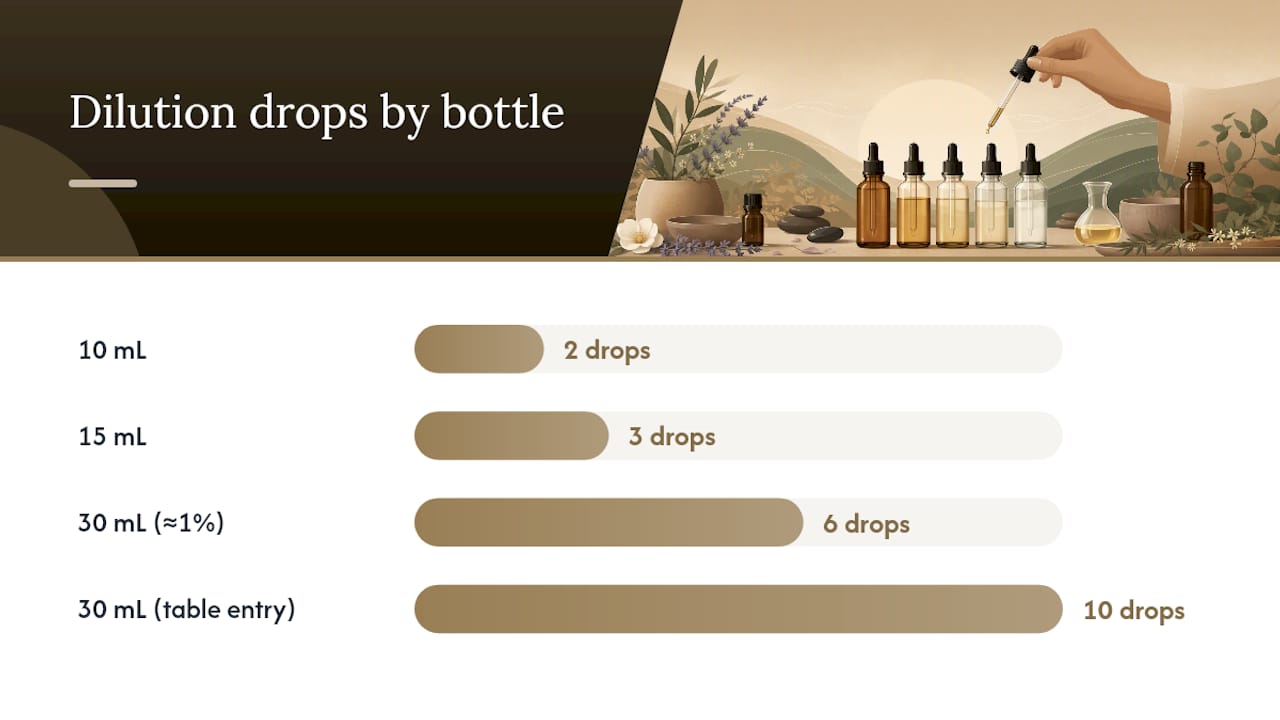
| Bottle Size | Approximate Drops for 1% Dilution |
|---|---|
| 10 mL | 2 drops |
| 15 mL | 3 drops |
| 30 mL | 6 drops |
| 30 mL | 10 drops |
Good carrier choices include jojoba oil, squalane, and sweet almond oil, though almond oil should be skipped by anyone with a nut allergy. Jojoba in particular mimics your skin’s natural sebum, which is part of why it shows up in formulated barrier-repair balms rather than raw DIY blends.
- Mix essential oils into a carrier oil, never apply them straight from the bottle.
- Read the INCI ingredient list on finished products. Essential oils listed near the end mean lower concentration.
- Skip any recipe that says “add a few drops” without specifying a total volume. That phrase is a guess, not a formula.
Finished cosmetic formulations exist for a reason: a chemist has already done this math and tested the result. A large gap exists between casual DIY practice and safe formulation, and that gap is where most facial reactions happen.
Where and How Should You Apply Diluted Oils?
Application technique matters almost as much as concentration.
- Apply diluted oil or an EO-containing product to clean, dry skin, avoiding the eyelids, nostrils, and lips entirely.
- Use a pea-sized amount for leave-on products; rinse-off cleansers can use slightly more since contact time is short.
- If you use retinoids or acids like glycolic or salicylic, apply your essential oil product on alternating nights, not layered on top.
- Wait at least 15 to 20 minutes after applying a scented nighttime product before adding sunscreen the next morning, especially if any citrus-derived oil was involved.
- Pat the product in gently rather than rubbing. Massage can drive more product into the skin than intended, raising the effective dose.
Consistency beats intensity here. A thin layer used correctly does more good than a thick one applied carelessly.
How Do You Patch-Test and Handle a Reaction?
Patch-test protocol is simple, and skipping it is the single most common mistake people make with essential oils.
- Apply a diluted drop to your inner forearm and cover it with a bandage.
- Leave it undisturbed and check at 24 hours, then again at 48 to 72 hours, since allergic reactions can be delayed rather than immediate.
- Immediate stinging usually means irritation. A rash that develops after a day or two suggests allergic contact dermatitis. Redness confined to sun-exposed areas points to phototoxicity.
- If a reaction occurs, wash the area with soap and water for at least 10 minutes, avoid sunlight, and apply a bland moisturizer.
Seek medical care for anything beyond mild, short-lived redness. The Tisserand Institute’s protocol remains the most cited practical reference for this exact scenario.
When Should You Stop and See a Dermatologist?
Stop immediately and get medical attention if you notice blistering, a rash that spreads beyond the application site, facial swelling, or any systemic symptom like difficulty breathing. Eye exposure also warrants an urgent care visit, not a home remedy.
A dermatologist can run formal patch testing using both standardized allergens and samples of your own products, which is often the only reliable way to identify the exact trigger. Pregnant people, infants, and anyone immune-suppressed should treat essential oils as a discuss-with-a-doctor category, not a self-directed experiment.
Why a Simple Balm Often Beats a DIY Essential Oil Blend
Finished formulations control concentration in a way a kitchen counter never can. When a company builds a face balm, the essential oil percentage, if it uses one at all, gets measured in batches, not guessed drop by drop.
That’s the philosophy behind Iron Bull Tallow: three ingredients, grass-fed Alberta tallow, hyaluronic acid, and jojoba oil, with no essential oil load to manage. Tallow supplies the same fatty acid profile as your skin’s own sebum, which supports barrier repair without the greasy film synthetic moisturizers often leave. Hyaluronic acid pulls water into the skin, addressing dryness and fine lines through hydration rather than fragrance.
- Short ingredient lists reduce the number of things that can go wrong on reactive skin.
- Barrier lipids like tallow support skin repair directly, instead of relying on a scent compound to feel like it’s “doing something.”
- Customers report visible improvements in texture and hydration within weeks, without patch-testing a spreadsheet of dilution ratios first.
Pro Tip: If your skin reacts easily, look for a product with three or four ingredients total and little to no added essential oil. Fewer variables mean fewer chances for a reaction.
How Long Do Essential Oils Last, and How Should You Store Them?
Essential oils degrade over time, and an oxidized oil is more likely to irritate your skin than a fresh one. Citrus oils are the most fragile, often losing potency and turning more irritating within 6 to 12 months of opening. Oils like lavender and frankincense hold up longer, sometimes two to three years, but only with proper storage.

Keep bottles in a cool, dark place, away from windows and direct sunlight. Heat and light both speed up oxidation, which changes the oil’s chemical makeup and can increase its potential to irritate skin that tolerated it fine when the bottle was new. A pantry shelf or a closed drawer works better than a bathroom cabinet, which tends to run warm and humid from showers.
Always keep the cap tightly sealed between uses, since oxygen exposure is one of the biggest drivers of degradation. Dark amber or cobalt glass bottles block more light than clear plastic, which is why most legitimate essential oil brands package this way.
Once an oil smells noticeably different from when you bought it, sharper, sourer, or just “off,” treat that as your cue to replace it rather than use it up. An oxidized oil applied to your face is more likely to cause the exact irritation this whole guide is trying to help you avoid. If you’re formulating your own diluted blends at home, make small batches rather than a year’s supply, since a diluted mixture in carrier oil has its own shorter shelf life, often just a few months, depending on the carrier you chose.
Ready for a Simpler, Safer Routine?
If dilution math and patch-test calendars sound like more hassle than your skin routine should require, you’re not wrong to want something simpler. Iron Bull Naturals’ skincare routine skips the guesswork by building hydration and repair into a formula that’s already measured and tested.
The flagship Iron Bull Tallow face moisturizer combines grass-fed tallow and hyaluronic acid in a formula with no complicated ingredient list to decode and no essential oil concentration to calculate yourself. For men who want fewer steps and fewer variables, that’s the entire point.
What the Research Actually Supports
The conventional advice on essential oils and skin splits into two unhelpful camps: breathless enthusiasm about “natural is Botox” claims, or blanket fear that treats every oil as equally dangerous. Neither holds up. The research supports something narrower and more useful: a small number of oils cause a disproportionate share of the reactions, concentration matters more than the oil itself, and most bad outcomes trace back to skipped patch tests or vague DIY measurements.
What’s overrated is the idea that essential oils are a shortcut to glowing skin. What’s underrated is how much a boring, well-formulated product with three or four ingredients can outperform a seven-oil blend mixed at midnight with no measuring involved. If you want hydration and barrier repair, prioritize the delivery system, tallow, hyaluronic acid, a stable carrier, before you prioritize the scent. Essential oils, when they help at all, help at the margins. Formulation discipline is what actually protects your skin.
This article is general information, not a substitute for advice from a qualified doctor. Consult a qualified healthcare professional about your own circumstances before acting on anything here.
Sources
- MDedge — Essential oils debunked: separating fact from myth
- PMC review on phototoxicity and essential oils
FAQ
Is It Good to Put Essential Oils on Your Face?
Only when properly diluted to around 1% or less and patch-tested first. Undiluted application raises the risk of irritation, allergic reactions, and, with certain oils, sun damage.
What Is the Best Essential Oil to Put on Your Face?
No single oil is universally “best,” but lavender, German chamomile, and frankincense tend to be better tolerated at low concentrations than oils like cinnamon or citrus. Patch testing still applies to all of them.
Which Essential Oil Is Like Botox for Wrinkles?
No essential oil replicates Botox’s effect on muscle activity. Claims comparing any oil to Botox aren’t backed by the dermatology literature and should be treated as marketing, not fact.
What Is the Best Oil for Aging Skin on the Face?
Rather than relying on an essential oil alone, barrier lipids like tallow paired with a humectant like hyaluronic acid address dryness and fine lines more directly by restoring moisture and supporting the skin barrier.
How Do I Know If an Essential Oil Is Causing My Skin to React?
Immediate stinging usually signals simple irritation, while a rash appearing a day or two later points to allergic contact dermatitis. If the reaction shows up only on sun-exposed skin, suspect phototoxicity, especially if a citrus oil was involved.


