


If your face is red, stinging when you apply anything, flaking, or reacting to products you’ve used for months without issue, you’ve over-exfoliated your skin. The fix starts now, not next week: stop every exfoliant and harsh cleanser in your routine immediately.
Two things to do in the next five minutes:
- Press a cool, damp washcloth to your face for relief from active burning or redness.
- Apply a fragrance-free, barrier-restoring moisturizer, something with ceramides or a simple occlusive balm, to the affected areas.
Everything else, including when you can start exfoliating again, comes after you’ve stopped the bleeding, so to speak.
Key Takeaways
Over-exfoliated skin heals fastest when you stop every active immediately, simplify to gentle cleansing and barrier-repair moisturizer, and reintroduce exfoliants slowly once symptoms fully resolve.
| Point | Details |
|---|---|
| Stop actives first | Halt all AHAs, BHAs, retinoids, and scrubs the moment redness or stinging appears. |
| Use the cool compress protocol | Apply a cool, damp cloth for 30 minutes several times daily during the first week. |
| Expect one week to a month | Mild cases improve within days; severe barrier damage can take up to a month to fully cycle. |
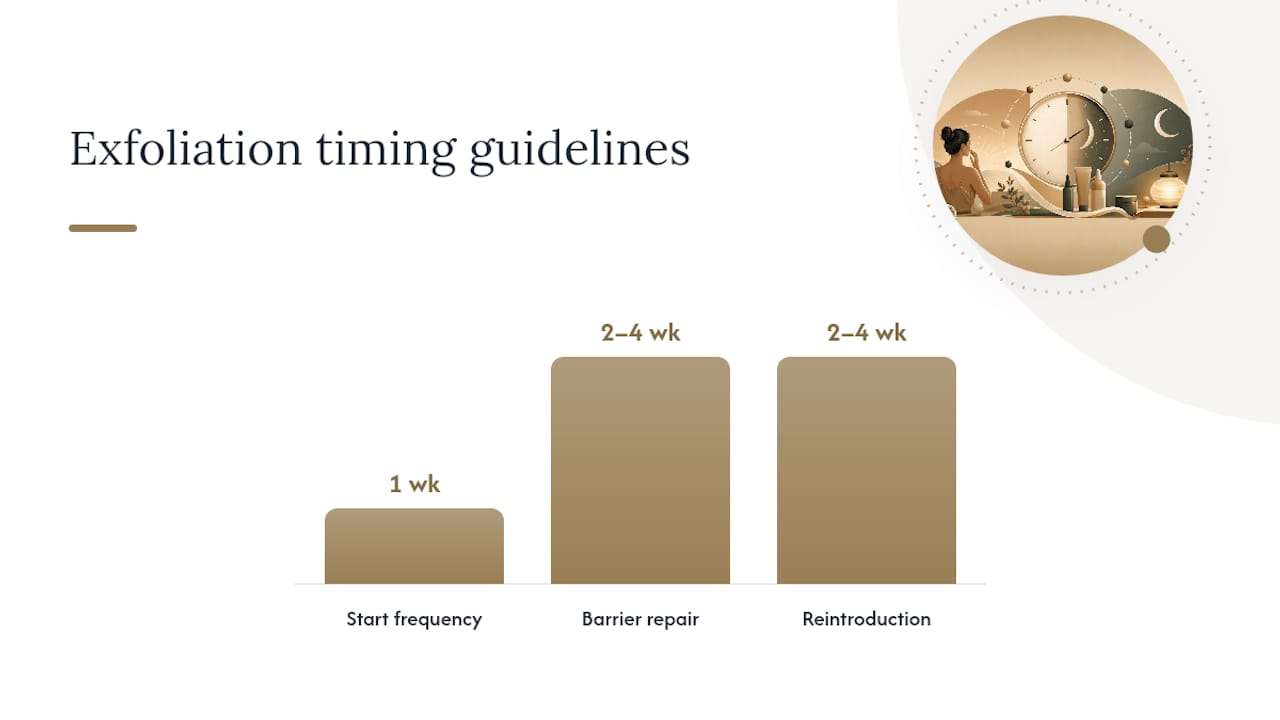
| Reintroduce one active at a time | Patch test a gentle exfoliant weekly, spacing new actives two to four weeks apart. |
| Choose minimal barrier support | Iron Bull Naturals’ tallow and hyaluronic acid balm fits a simplified, occlusive-first recovery routine. |
This article is general information, not a substitute for advice from a qualified doctor. Consult a qualified healthcare professional about your own circumstances before acting on anything here.
Table of Contents
- Signs of Over Exfoliated Skin You Shouldn’t Ignore
- What Causes Over-Exfoliation in the First Place
- Your 7 to 14 Day Recovery Plan for Over Exfoliated Skin
- How Long It Takes to Heal and When to Resume Exfoliating
- How to Prevent Over-Exfoliation Going Forward
- Why a Minimal Balm Approach Supports Barrier Recovery
- Sources
- FAQ
Signs of Over Exfoliated Skin You Shouldn’t Ignore
Over-exfoliation strips away too many layers of the stratum corneum, your skin’s outermost protective shell. Once that barrier thins out, it can’t hold water in or keep irritants out, which is exactly why symptoms escalate fast once they start, according to Westlake Dermatology.
Here’s what to look for, roughly in order of how commonly people notice them:
- Redness that doesn’t fade. Not the pink flush from a hot shower. Persistent, blotchy redness that lingers for hours.
- Burning or stinging when you apply anything. This is the big one. Moisturizer, sunscreen, even plain water can suddenly feel like it’s attacking your face.
- Flaking, peeling, or a tight, waxy texture. Skin that looks shiny or plastic-like isn’t glowing. It’s dehydrated and inflamed.
- New breakouts or sudden sensitivity. Products you’ve used for years start causing reactions because your barrier can no longer filter what touches it.
That waxy, almost sunburned sheen deserves particular attention. It signals dehydration and inflammation, not the “smooth, refined skin” many people mistake it for, per Westlake Dermatology’s analysis of over-exfoliation cases.
There’s a physiological reason products suddenly sting. When the barrier is compromised, nerve endings sit closer to the skin’s surface, so ingredients that never bothered you before now register as pain, according to dermatology commentary on moisturizer burn. If your moisturizer burns, that’s your skin telling you something is wrong, not that the product is “working.”
Seek medical care immediately if you notice open cracks, bleeding, severe pain, or a spreading rash. Those symptoms go beyond what a home routine can fix.

What Causes Over-Exfoliation in the First Place
Most over-exfoliation cases trace back to one habit: using exfoliants far more often than skin can tolerate. Daily acid toners or scrubs, when about once weekly or slightly more often is generally the safe ceiling for many people, wear down the barrier faster than it can rebuild.
A few other common culprits show up again and again:
- Layering actives without a plan. Combining retinoids, hydroxy acids, and vitamin C in the same routine multiplies irritation instead of multiplying results.
- Physical abrasion stacked on chemical exfoliation. Scrub beads or cleansing brushes used the same week as acids compound the damage.
- Professional treatments plus at-home actives. A chemical peel or microdermabrasion session followed by your usual retinol routine gives your skin no recovery window.
- Formulation red flags. Low-pH products, added alcohol, and fragrance all increase irritation risk, especially once the barrier is already compromised.
Tolerance varies person to person. Some people show damage after a single overly aggressive session; others push their skin further before symptoms appear, according to CVS Health’s guidance on exfoliation frequency. Either way, burning, persistent redness, or peeling is your skin’s stop signal, not a phase to push through.
Your 7 to 14 Day Recovery Plan for Over Exfoliated Skin
Recovery works best when you strip your routine down to almost nothing and let the skin rebuild without interference.
- Stop every exfoliating agent immediately. That means AHAs, BHAs, retinoids, physical scrubs, and any “resurfacing” product. Check ingredient lists on toners and serums, too. Exfoliants hide in products that don’t advertise themselves that way.
- Switch to gentle cleansing. A sulfate-free cleanser is usually fine, but if skin is raw or cracking, rinsing with cool water alone for a few days works better.
- Run the cool compress protocol. Apply a cool, damp cloth for 30 minutes, several times a day, during the first week. This is the same technique used in post-procedure clinical care to control acute irritation, and it translates directly to over-exfoliation recovery according to DermaQuest Clinical’s guidance.
- Moisturize with fragrance-free, ceramide-based products. For raw or cracked spots, a thick occlusive, petroleum jelly or a simple balm, seals in moisture and blocks further irritation. Dermatologists frequently recommend exactly this kind of thick emollient on damaged patches, per Real Simple’s roundup of dermatologist advice.
- Consider a short course of OTC hydrocortisone for inflammation, but only briefly and only if redness is significant. If your skin hasn’t improved within one to two weeks, or if symptoms worsen, see a dermatologist rather than waiting it out.
Pro Tip: Resist the urge to “test” whether your skin has healed by reapplying an active early. One premature reintroduction can reset the whole recovery clock.
Most people see meaningful improvement within days of stopping actives, but a full recovery phase often runs at least several days to a week for anything beyond mild irritation.
How Long It Takes to Heal and When to Resume Exfoliating
Healing timelines vary by severity, but there’s a pattern worth knowing. Many people notice real improvement within a few days of stopping actives. Mild cases often resolve within a week. More severe barrier damage, think visible peeling or persistent burning, can take up to a month for full skin-cycle turnover, according to Banner Health’s consumer guidance.
Don’t restart exfoliation on a calendar guess. Watch for these readiness signals instead:
- No stinging when you apply your regular moisturizer.
- No visible flaking, redness, or waxy texture.
- Skin feels hydrated and bounces back rather than feeling tight after washing.
Once you hit those markers, reintroduce slowly. Patch test a single gentle active, a PHA or lactic acid works well here, once weekly, and only increase frequency if your skin tolerates it without complaint.
How to Prevent Over-Exfoliation Going Forward
Preventing a repeat episode comes down to a handful of rules that are easy to state and genuinely easy to follow once you’ve felt the alternative.
- Start at once weekly with any new active, and learn your own skin’s tolerance before increasing frequency.
- Never mix chemical and physical exfoliants on the same day. Pick one method per session, not both.
- Match the active to your skin type. Salicylic acid tends to suit oily skin, lactic acid suits dry skin, and PHAs are the gentlest option for sensitive or reactive skin.
- Always follow exfoliation with moisturizer and SPF the next morning. Freshly exfoliated skin is more vulnerable to UV damage.
- Keep tools clean and skip exfoliation on broken or irritated skin entirely.
- Adjust for season. Cold, dry air often means your skin needs less frequent exfoliation, not the same schedule year round.
Clinical guidance backs a simple reintroduction rule for anyone rebuilding a routine after damage: introduce barrier-repair steps for two to four weeks first, then bring back only one new active every two to four weeks so you can actually tell what’s causing a reaction, per CVS Health’s practical framework.
Pro Tip: If a product contains added fragrance or alcohol high on the ingredient list, treat it as a “not during recovery” product, even if it’s not technically an exfoliant.
Why a Minimal Balm Approach Supports Barrier Recovery
Recovering skin doesn’t need a ten-step routine. It needs consistent hydration and a barrier sealed against water loss, which is exactly what occlusives and humectants are built to do. Petrolatum-based balms and similar occlusives reduce transepidermal water loss while ingredients like hyaluronic acid pull water into the stratum corneum, a combination reviewed in clinical barrier-repair literature as one of the more reliable strategies for restoring damaged skin.
Iron Bull Naturals built its face balm around that exact principle: grass-fed Alberta tallow paired with hyaluronic acid, and nothing else cluttering the formula. Men recovering from over-exfoliation don’t need to decode a twelve-ingredient label while their skin is already inflamed.
- Apply to slightly damp skin for better absorption.
- Spot-treat raw or flaking areas rather than layering over your entire face if only certain spots are affected.
- Use it at night, and skip any actives until your skin has fully calmed down.
The Author’s Perspective on Patience During Recovery
Overdoing exfoliation happens to almost everyone chasing smoother skin. The fix isn’t more product, it’s fewer ingredients and more patience. Iron Bull Naturals bets on simple, minimal routines because damaged skin doesn’t need complexity to heal. Give it time, and it usually does.
— Blaine
A Straightforward Way to Support Recovery
Everything in this recovery plan points to the same conclusion: strip down your routine and let barrier-repair ingredients do the work without interference. That’s harder than it sounds when most moisturizers on shelves list a dozen additives you can’t pronounce, any one of which could reignite irritation on compromised skin.

Iron Bull Naturals makes that part simple. The tallow face balm uses exactly three ingredients: grass-fed Alberta tallow, hyaluronic acid, and nothing else to second-guess while your skin is healing. During recovery, apply it to damp skin at night, spot-treating any raw or flaking areas until the burning and tightness fully resolve. Customers report visible improvements in texture and hydration within weeks of consistent use. Once your skin passes the readiness checks above, check out Iron Bull Naturals’ full lineup to build a simple routine that won’t put you back in this position.
Sources
- Over-Exfoliation: Warning Signs, Causes, and Prevention — Westlake Dermatology
- Signs of over-exfoliation — DermaQuest Clinical Blog
- Review of skin barrier and topical therapies — NCBI PMC
- How to heal over-exfoliated skin, according to MDs — Real Simple
FAQ
How Do You Heal Over-Exfoliated Skin?
Stop every exfoliant immediately, switch to a gentle cleanser, apply cool compresses for 30 minutes several times a day, and use a fragrance-free, ceramide or occlusive-based moisturizer like a simple tallow balm until symptoms resolve.
How Can You Tell If Your Skin Is Over-Exfoliated?
Look for persistent redness, burning or stinging when you apply products, flaking or a tight, waxy texture, and sudden sensitivity to products you previously tolerated fine.
How Long Does It Take for Over-Exfoliated Skin to Heal?
Mild cases often improve within days to a week, while more severe barrier damage can take up to a month for full recovery.
What Does Too Much Exfoliation Look Like?
Skin appears shiny or waxy rather than glowing, feels tight after washing, and may show visible peeling, redness, or breakouts that weren’t there before you increased your exfoliation routine.


