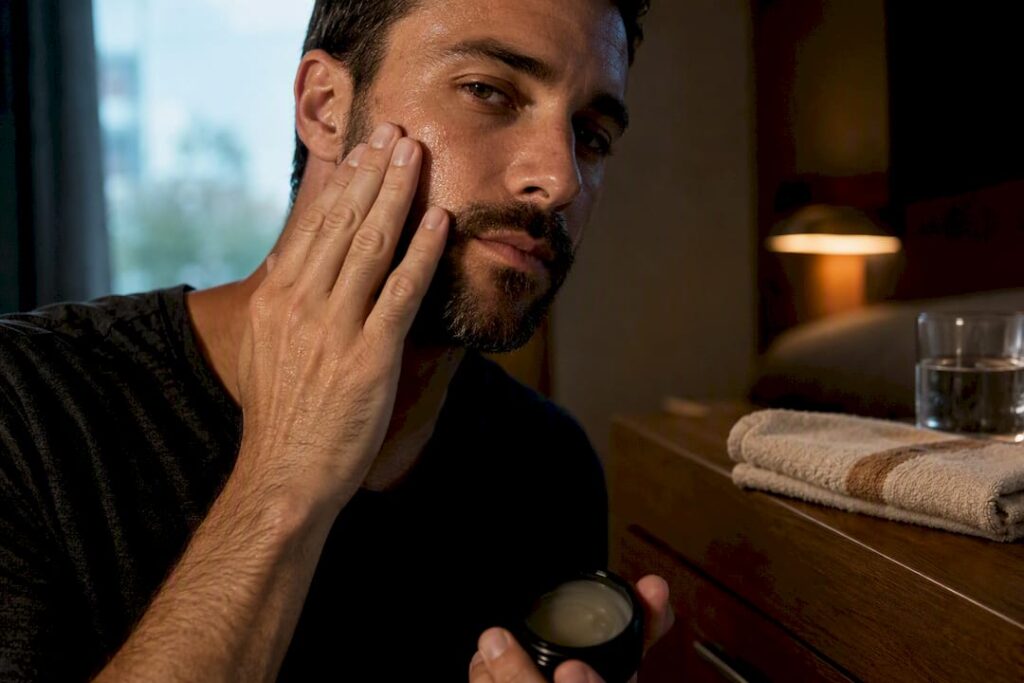
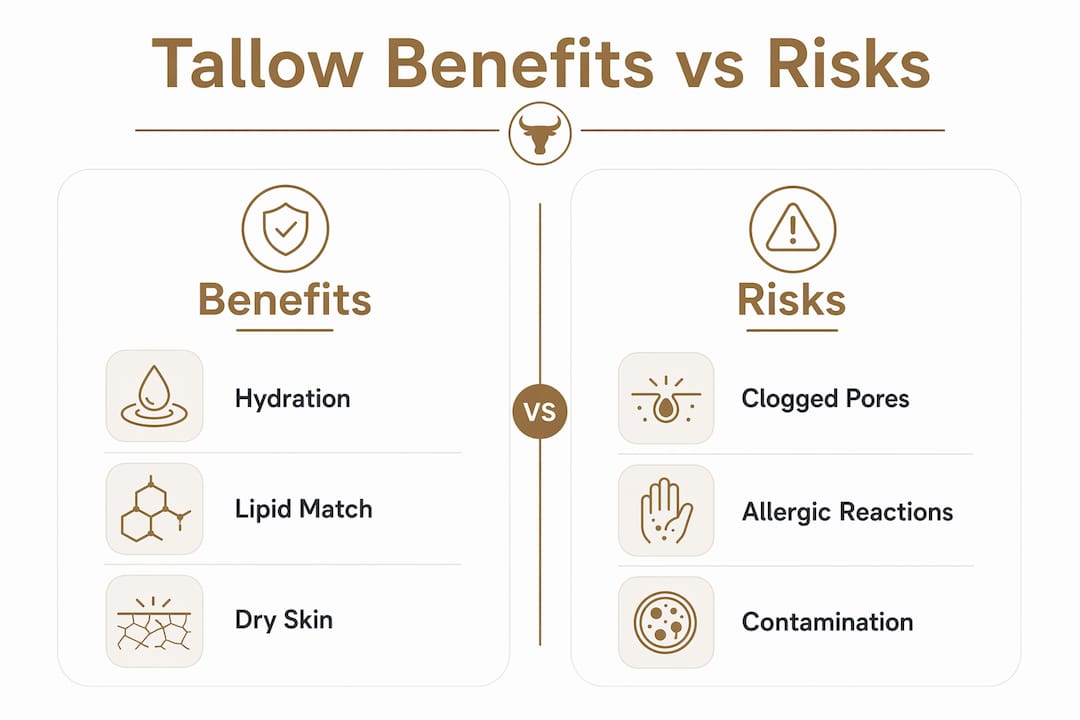
Tallow can genuinely help very dry or mature facial skin, but it carries real risks for acne-prone, oily, or sensitive skin types. The short answer is: it depends heavily on your skin type, the product quality, and how you use it.
Who is most likely to benefit:
- People with very dry, flaky, or barrier-compromised skin (think harsh winter dryness or post-procedure skin)
- Mature skin that has lost lipid density and needs occlusive support
- Men with dry, rough facial skin who want a simple, short-ingredient routine
Who should avoid it:
- Anyone with acne-prone, oily, or combination skin
- People with active breakouts, rosacea, or known sensitivity to animal fats
- Those with fragrance allergies (many tallow products add essential oils to mask the natural meaty scent)
Primary risks at a glance:
- Pore clogging and comedone formation, especially on the nose, chin, and forehead
- Allergic contact dermatitis from added fragrances or preservatives
- Contamination and rancidity in homemade or small-batch products without stability testing
- Zero UV protection, meaning daily use without sunscreen increases sun damage risk
The Cleveland Clinic flags limited research and warns specifically of clogged pores, irritation, and allergic reactions as the primary concerns for facial use.
Table of Contents
- What does the science say about tallow and facial skin?
- What are the potential benefits of tallow for your face?
- What are the risks and who should avoid tallow on the face?
- How do you use tallow safely on your face?
- How do you pick a quality tallow face product?
- How does tallow compare to common moisturizers and active ingredients?
- How should you store tallow products and avoid contamination?
- What does a trustworthy tallow face balm actually look like?
- Key Takeaways
- The case for tallow is narrower than the trend suggests
- Iron Bull Naturals makes a tallow balm worth trying
- Selected sources and further reading
What does the science say about tallow and facial skin?
The honest answer is: not much yet, and what exists is mostly promising but preliminary.
A peer-reviewed scoping review found that tallow may contribute to hydration and could mimic skin lipids, but the clinical evidence specific to facial application is limited. That is the key caveat. Most of the positive data comes from general emollient research, not controlled facial trials.
“Tallow’s popularity on social media has outpaced the available clinical data. It functions as a basic emollient, not a mechanism-targeted therapy for barrier repair.” — board-certified dermatologists, as reported by National Geographic
The biochemical rationale is real, though. Beef tallow contains fatty acids similar to skin lipids, including palmitic, stearic, and oleic acid. These are the same building blocks your skin barrier uses. The theory is that applying them topically could help reinforce a compromised barrier, much the way ceramide creams do. Trace amounts of fat-soluble vitamins A, D, E, and K may also be present, though whether they absorb meaningfully through intact skin is uncertain.
The limitations are significant. There are no large, controlled, randomized trials on tallow applied specifically to the face. Most studies that do exist use small sample sizes, inconsistent formulations, and short follow-up periods. Anecdotal reports of softer skin and improved texture are common, but anecdote is not clinical evidence. Anyone who tells you tallow is a proven skin-repair treatment is getting ahead of the data.

What are the potential benefits of tallow for your face?
The benefits that have some biochemical or anecdotal support are real, but they come with an asterisk.
Plausible benefits backed by biochemistry or user reports:
- Deep occlusive hydration: Tallow forms a physical barrier on the skin surface that slows transepidermal water loss, similar to petrolatum but with a lighter feel when warmed properly
- Fatty acid replenishment: Palmitic and oleic acid are native to human sebum, which means tallow may integrate more naturally into the skin barrier than purely synthetic emollients
- Fat-soluble vitamins: Small amounts of vitamins A, D, E, and K are present in grass-fed tallow; vitamin A in particular has a well-documented role in skin cell turnover, though the concentrations in topical tallow are far lower than in clinical retinoids
- Minimal ingredient exposure: A pure, unfragranced tallow balm has a very short ingredient list, which reduces the number of potential irritants compared to a 20-ingredient commercial moisturizer
- Short-term texture improvement: User reports frequently note softer skin and improved barrier feel after consistent use
Who sees the most improvement: People with very dry or mature skin, or those with barrier-compromised patches from eczema, cold weather, or post-shave irritation. Tallow’s occlusive weight is an asset there. For normal-to-oily skin, that same weight becomes a liability.
Where evidence is anecdotal versus supported: the hydration and occlusion effects are mechanistically plausible and supported by general emollient science. The vitamin absorption claims and the “biocompatibility” argument are more speculative. Treat them as interesting hypotheses, not proven outcomes.
What are the risks and who should avoid tallow on the face?
This is where the conversation gets more serious, and where most dermatologists pump the brakes.
Facial skin is structurally different from body skin. It has a thinner epidermis and significantly more active sebaceous glands. Heavy occlusives applied to the face can trap sebum beneath the surface, which is exactly the environment that leads to blackheads, whiteheads, and cystic acne. The Cleveland Clinic specifically notes that facial skin’s higher sebaceous activity makes occlusive animal fats more likely to cause breakouts than the same product applied to arms or legs.
“Tallow may help very dry skin but is not recommended for acne-prone, oily, or sensitive facial skin.” — dermatologists, as summarized by Scripps Health
Fragrance and allergen risk is the second major concern. Pure rendered tallow has a distinct meaty smell that most people find unpleasant on their face. To mask it, many brands add essential oils or synthetic fragrances. Those additives are among the most common triggers for allergic contact dermatitis, a reaction that shows up as redness, itching, and a rash that can persist for days. If you have sensitive skin, fragrance-free is non-negotiable.
Contamination risk is specific to homemade and small-batch products. Without proper rendering, filtering, and microbial stability testing, tallow can harbor bacteria or go rancid faster than expected. Applying a contaminated product to your face, especially over broken skin or active acne, can worsen infection.

Stop using and see a dermatologist if you notice: persistent new breakouts after starting tallow, signs of infection (warmth, swelling, pus), a spreading rash, or any reaction that does not resolve within a few days of stopping use.
How do you use tallow safely on your face?
If your skin profile fits the “likely to benefit” category, here is how to introduce tallow with the lowest possible risk.
Step-by-step safe introduction:
- Patch test first. Apply a small amount to the inside of your forearm or behind your ear. Wait 48 hours and check for redness, itching, or bumps before putting anything on your face.
- Start once a week. Apply only to a small area of your face, ideally a dry patch on the cheek or jaw, not the T-zone. One application per week for the first two weeks.
- Warm it before applying. Take a pea-sized amount and rub it between your palms until it softens to an oil. Then press it gently onto slightly damp skin. This reduces greasy residue and gives more even coverage.
- Increase frequency slowly. If no congestion or irritation appears after two weeks, move to twice weekly. Only go to daily use if your skin tolerates it well over a full month.
- Monitor for comedones. Check the areas you applied it for new blackheads or small bumps after each use. If you see either, scale back immediately.
Layering with actives and sunscreen:
Tallow is an occlusive, which means it should go on last in your routine, after any water-based serums or actives. Do not apply it directly over retinol or AHAs and BHAs on the same evening; those actives work by penetrating the skin, and a heavy occlusive layer on top can increase irritation. Space them on alternate nights until you know how your skin responds.
Tallow provides zero UV protection. Every morning routine that includes tallow must end with a separate broad-spectrum SPF 30 or higher sunscreen. The Iron Bull Tallow Sun Balm with zinc oxide is one option that pairs tallow-based hydration with mineral sun protection.
Pro Tip: Mix a small amount of tallow with a lighter, non-comedogenic moisturizer before applying. This cuts the occlusive load, reduces the risk of clogged pores, and makes the texture easier to manage, especially if you are new to using tallow for facial skin.
How do you pick a quality tallow face product?
Not all tallow products are equal, and the quality gap between a well-made commercial balm and a poorly rendered homemade batch is significant.
Sourcing matters. Grass-fed tallow generally contains a better fatty acid profile than conventional grain-fed tallow, with higher concentrations of oleic acid and fat-soluble vitamins. Look for products that state the sourcing region and feeding method explicitly. Vague claims like “natural tallow” with no origin information are a red flag.
Processing and rendering. Quality tallow should be rendered (slowly melted and filtered) to remove impurities, connective tissue, and water. Some products use “unrendered” or “raw” suet, which has a shorter shelf life and higher contamination risk. Ask the brand whether their tallow is wet-rendered or dry-rendered, and whether it goes through a filtration step.
Additives and labeling. A short ingredient list is a good sign. The fewer additives, the lower the irritation risk. Watch for:
- Essential oils (lavender, tea tree, eucalyptus) that smell pleasant but are common sensitizers
- Synthetic fragrances listed as “fragrance” or “parfum” with no further detail
- Preservatives that may not be appropriate for an oil-based product (some are water-phase preservatives that do nothing in an anhydrous formula)
Third-party testing. Ask whether the brand publishes microbial stability data or has third-party testing for heavy metals and contaminants. Many small-batch producers do not, which is a legitimate concern. A brand that can point to a Certificate of Analysis or a stability study is operating at a higher standard.
Questions worth asking any tallow brand:
- Where is your tallow sourced, and is it grass-fed?
- How is it rendered and filtered?
- Has it been tested for microbial contamination and stability?
- What is the shelf life, and does the packaging protect against oxidation?
How does tallow compare to common moisturizers and active ingredients?
| Ingredient | Comedogenicity | Evidence base | Best for | Facial use caution |
|---|---|---|---|---|
| Beef tallow | Moderate to high | Limited (emollient science; no controlled facial trials) | Very dry, mature, barrier-compromised skin | High: avoid acne-prone, oily skin |
| Petrolatum | Low | Strong (occlusive standard) | Dry, cracked skin; wound healing | Moderate: heavy feel, but non-comedogenic |
| Squalane | Very low | Moderate (lightweight emollient studies) | All skin types, including oily | Low: well-tolerated on most faces |
| Hyaluronic acid | None | Strong (humectant; multiple RCTs) | Dehydrated skin of all types | Very low: water-based, non-occlusive |
| Ceramides | None | Strong (barrier repair; multiple RCTs) | Eczema, dry, sensitive, barrier-damaged skin | Very low: targeted barrier repair |
| Retinol | None | Very strong (anti-aging; FDA-recognized) | Fine lines, texture, acne | Moderate: irritation risk, requires sunscreen |
When tallow makes sense:
Pick tallow when extreme occlusion and lipid replenishment are the goal and comedogenic risk is low for your skin type. Severely dry winter skin on the cheeks and jaw, post-shave barrier repair, or mature skin that has lost lipid density are the scenarios where tallow’s fatty acid profile and occlusive weight work in its favor. Pairing it with a barrier-repair formula that includes ceramides and hyaluronic acid can address both the occlusive and humectant sides of hydration.
When to pick something else:
Oily, acne-prone, or combination skin does better with squalane or a ceramide-based moisturizer. Hyaluronic acid serums handle dehydration without any occlusion risk. For anti-aging goals, retinol has decades of clinical evidence behind it that tallow simply cannot match. Dermatologists at Scripps Health recommend reserving tallow for body skin and using dermatologist-recommended moisturizers for the face in most cases.
For a deeper look at how targeted serums compare to occlusive balms, this guide to facial serums and evidence-based actives covers the ingredient science in detail.
How should you store tallow products and avoid contamination?
Tallow is an animal fat, which means it behaves like any other fat: it can go rancid, and it can grow bacteria if handled carelessly.
Storage best practices:
- Keep commercial tallow balms in a cool, dark place away from direct sunlight and heat sources
- Homemade or small-batch tallow without preservatives should be refrigerated and used within 3–4 months
- Products with added antioxidants (vitamin E, rosemary extract) have a longer stable shelf life at room temperature, typically 6–12 months, but check the brand’s stated shelf life
- Avoid storing tallow in the bathroom, where heat and humidity accelerate oxidation
Signs of spoilage to watch for:
- A sour, rancid, or “off” smell that differs from the product’s original scent
- Texture changes: graininess, separation, or an unusually soft or liquid consistency
- Discoloration, particularly yellowing or darkening beyond the original color
- Any visible mold or unusual film on the surface
If you notice any of these, discard the product. Applying rancid fat to your face can cause irritation and may worsen existing skin conditions.
Hygiene checklist:
- Always use a clean spatula or scoop rather than fingers to remove product from a jar
- Never double-dip a used applicator back into the container
- Keep the lid tightly closed between uses
- If the product has been open for longer than the stated shelf life, replace it even if it looks fine
What does a trustworthy tallow face balm actually look like?
The quality checklist from the previous sections maps directly onto what separates a consumer-ready tallow balm from a risky DIY batch. Here is what that looks like in practice.
A well-built tallow balm starts with a clear sourcing statement: grass-fed, region-identified tallow with a documented rendering and filtration process. The ingredient list should be short, typically three to five ingredients, with no synthetic fragrances and no water-phase preservatives that do not belong in an anhydrous formula.
The Iron Bull Naturals anti-wrinkle formulation illustrates this approach. The product pairs grass-fed Alberta tallow with hyaluronic acid and jojoba oil, keeping the formula to a minimal set of ingredients that each serve a specific function: the tallow provides occlusive lipid replenishment, the hyaluronic acid adds humectant hydration, and the jojoba oil lightens the texture to reduce the heavy, greasy feel that pure tallow can leave. That combination addresses the main practical complaint about tallow balms while preserving the fatty acid benefits.
From a consumer-trust standpoint, the features that matter most are: a named sourcing origin, a published ingredient list with no hidden “fragrance” entries, packaging that limits air and light exposure (opaque or amber glass jars with tight seals), and realistic performance claims that do not overstate the clinical evidence. A brand that says “deeply hydrates and supports barrier repair” is making a defensible claim. A brand that says “reverses aging” or “replaces retinol” is not.
Controlled long-term facial studies on tallow are still absent, so any honest product in this category should set expectations accordingly: meaningful hydration and barrier support for the right skin type, not a clinical treatment.
Key Takeaways
Tallow benefits for the face are real but narrow: the ingredient works best as an occlusive emollient for very dry or mature skin, and the risks outweigh the rewards for anyone prone to breakouts.
| Point | Details |
|---|---|
| Best skin type for tallow | Very dry, mature, or barrier-compromised skin benefits most; oily and acne-prone skin should avoid it. |
| Patch test before full use | Apply to forearm or behind ear for 48 hours before putting any tallow product on your face. |
| Apply correctly | Warm a pea-sized amount between palms, then press onto slightly damp skin to reduce greasiness. |
| Always add sunscreen | Tallow provides no UV protection; pair it with a broad-spectrum SPF 30 or higher every morning. |
| Iron Bull Naturals option | Iron Bull Naturals combines grass-fed tallow with hyaluronic acid and jojoba oil for a short-ingredient, non-greasy face balm built for men. |
The case for tallow is narrower than the trend suggests
The tallow skincare trend has a real biochemical foundation, and I do not think it deserves the dismissal it sometimes gets from mainstream dermatology. Fatty acids that mirror your skin’s own lipids, a short ingredient list, no synthetic emulsifiers — these are genuinely appealing qualities, especially for men who want a simple routine without a shelf full of products.
But the trend has also been oversold in ways that set people up for frustration. The “ancestral skincare” framing implies that tallow is what skin was always meant to have, which is a romanticized reading of limited evidence. Your skin does not recognize tallow as a native substance just because it shares some fatty acids with sebum. It responds to what you put on it based on concentration, formulation, and your individual skin chemistry.
Where I would personally consider tallow: very dry skin in winter, post-shave irritation on the jaw and neck, or mature skin that has lost lipid density and needs something heavier than a standard moisturizer. Those are the use cases where the occlusive weight is an asset rather than a liability.
Where I would not go near it: active acne, facial rosacea, or any skin that already runs oily through the T-zone. The risk of trapping sebum and triggering a breakout cycle is too high, and there are better-evidenced options for those concerns.
The other thing worth saying plainly: the quality of the product matters as much as the ingredient itself. A poorly rendered, heavily fragranced tallow balm from an unverified small-batch producer is a different product than a clean, grass-fed, minimal-ingredient formula. If you are going to try tallow on your face, the sourcing and formulation decisions are not secondary details.
Iron Bull Naturals makes a tallow balm worth trying
If the quality checklist in this article describes what you are looking for, Iron Bull Naturals built their tallow face moisturizer for men around exactly those standards: 100% grass-fed Alberta tallow, hyaluronic acid for humectant hydration, and jojoba oil to keep the texture manageable without a greasy finish. Three ingredients. No synthetic fragrances. No hidden additives.

That short formula is the point. It reduces the number of potential irritants, makes the product easier to patch test, and gives you a clear picture of what you are actually putting on your skin. For men dealing with dryness, post-shave irritation, or early signs of aging who want something straightforward and natural, it is a well-matched option. Browse the full men’s face moisturizer range to find the right fit, and if you have specific skin concerns, a quick consultation with a dermatologist before starting any new topical routine is always worth it.
This article is general information, not medical or dermatological advice. Confirm any skincare changes with a qualified dermatologist for your specific situation.
Selected sources and further reading
- Is Beef Tallow Good for Your Skin? — Cleveland Clinic: Clinician-reviewed overview of tallow’s risks for facial use, including clogged pores, irritation, and lack of sun protection.
- Beef Tallow in Skin Care: Safety, Benefits and Risks — Scripps Health: Dermatologist guidance on reserving tallow for body skin and choosing proven moisturizers for the face.
- Beef Tallow as Skin Care? Experts Explain What’s Truth and Myth — National Geographic: Expert analysis of the fatty acid science, vitamin content, and the gap between social media popularity and clinical evidence.
- Beef Tallow for Skin: Risk and Usage Guidance — NBC News: Practical guidance on application technique, patch testing, slow introduction, and contamination concerns from clinicians and journalists.
- PMC Scoping Review on Tallow and Skin — PubMed Central: Peer-reviewed scoping review covering tallow’s hydration potential, biocompatibility with skin lipids, and significant research gaps on facial application.
- USDA FoodData Central — Beef Tallow Nutrient Profile: Primary source for tallow’s fatty acid and fat-soluble vitamin composition.