

A moisturizer works in layers of time. You feel it in minutes, dry skin usually looks better within about two weeks, and anything aimed at fine lines needs six weeks to three months. If you are judging a new balm after three days, you are judging it too early, or too late, depending on what you expect it to do.
Below is a practical timeline built on dermatology guidance and clinical data, plus the habits that speed it up and the signs that your product is the problem.
TL;DR
- Right after you apply it, a moisturizer can hydrate the surface and temporarily plump skin. That is real, but it fades if you stop.
- Dry, flaky skin often improves within about 2 weeks of consistent self-care.
- Fine lines: a quick plumping effect in days, but most products need at least 6 weeks, sometimes 3 months, and creams cannot erase every sign of aging.
- Stinging, burning or tingling means irritation, not ‘working’. Stop and reassess.
- Apply twice a day, on damp skin after washing, and change one thing at a time.
Table of Contents
- The short answer: three clocks running at once
- What happens in the first hour
- Weeks 1 to 2: dry, flaky skin starts to turn
- Weeks 2 to 8: texture, tone and breakouts
- Weeks 6 to 12: fine lines and the honest ceiling
- Timeline at a glance
- What speeds results up, and what slows them down
- When it is not working: irritation versus patience
- How to track your own results
- Our perspective: simple formulas, honest expectations
- Try a simple routine for 60 days
- FAQ
- Sources
The short answer: three clocks running at once
People ask ‘how long does moisturizer take to work’ as if there were one answer. There are three separate clocks.
- Minutes to hours: surface hydration and softness.
- One to four weeks: less flaking, less tightness, calmer texture, a healthier-feeling barrier.
- Six weeks to three months: visible changes in fine lines and overall skin quality, where a moisturizer is helping alongside sun protection and other habits.
Most disappointment comes from expecting the third clock’s results on the first clock’s schedule. The rest comes from skipping days, so the second clock never gets to finish.
What happens in the first hour
Moisturizers do two jobs. Humectants pull water in, and occlusive or emollient ingredients slow the water that escapes from your skin. Both start working on contact.
A study of 60 healthy adults found that a tested moisturizer raised hydration in the outer skin layer and cut water loss immediately after use, compared with skin left bare. Applying right away or after a 30-minute delay performed similarly, so there is no need to stress over the exact minute.
The American Academy of Dermatology (AAD) also notes that a good moisturizer can temporarily plump skin, making fine lines and wrinkles less noticeable. You have to apply it every day to keep seeing that effect. This is why a balm can look great at 8 a.m. and say nothing about what it is doing to your skin over months.
What you should notice: skin feels less tight after washing, a smoother surface, less visible dryness around the nose and cheeks.
What you should not conclude yet: that it has ‘repaired’ anything or reduced wrinkles.
Weeks 1 to 2: dry, flaky skin starts to turn
This is the window where most men with dry skin get their first honest answer. The AAD says that with effective self-care, many people see improvement in dry skin within 2 weeks. It is a general timeline, not a promise for every product or every condition.
A randomized trial gives that number some teeth. In 52 people with moderate-to-severe dry skin, using a cleanser plus moisturizer twice daily produced significantly more improvement after 2 weeks than cleanser alone. The gains showed up in dryness scores, scaling, itch-related symptoms, and how smooth, soft and textured the skin felt.
Not everything moved, though. In the same trial, redness and fissures (cracks) did not improve significantly in that time. If you have deep cracks on your knuckles or heels, or persistent redness, two weeks may not be enough and a dermatologist can tell you why.
A realistic week-2 checklist:
- Flaking along the jaw, brow or around the nose is reduced.
- Itching and tightness are less noticeable.
- Your face no longer looks chalky by mid-afternoon.
- Shaving stings less.
If none of that has changed after two weeks of twice-daily use, the product, the amount, or something else in your routine deserves a look.
Weeks 2 to 8: texture, tone and breakouts
After the first couple of weeks, improvements get subtler. Skin renews its outer layer on a slow cycle, so changes in how it looks and feels build gradually.
For acne-prone skin, the AAD says most people following a treatment plan that includes an appropriate moisturizer see improvement in 4 to 8 weeks. The moisturizer is a supporting player there: it keeps acne medicines from drying you out, but it is not the treatment.
For rough, bumpy skin such as keratosis pilaris, the AAD notes that clearing takes time and recommends seeing a dermatologist if there is no improvement after 4 to 6 weeks.
What you might notice in this window:
- A more even, less rough feel across cheeks and forehead.
- Fewer episodes of irritation after shaving or windy weather.
- Makeup-free skin that looks less dull.
Weeks 6 to 12: fine lines and the honest ceiling
This is where marketing and reality part ways. According to the AAD, a moisturizer can plump fine lines within days, but most products take at least six weeks to work and sometimes up to three months. The same page is blunt that creams, gels and lotions cannot reduce all signs of aging skin.
So what should a moisturizer realistically do for lines by week 12?
- Keep skin hydrated enough that fine, dehydration-type lines look softer.
- Reduce the irritation and dryness that make lines look deeper.
- Support the skin while daily sunscreen does the long-term protective work.
What it will not do is erase deep folds or reverse years of sun damage. If a product promises that, be skeptical. If lines are your main concern, a dermatologist can discuss prescription options that moisturizers cannot match.
Timeline at a glance
| Time | What a consistent moisturizer can do | What to expect from it alone |
|---|---|---|
| Minutes to hours | Raises surface hydration, slows water loss, temporarily plumps skin | Softer, smoother feel; fades if you stop |
| 1 to 2 weeks | Improves dryness, scaling, itch, smoothness | Less flaking and tightness; redness and cracks may linger |
| 4 to 8 weeks | Supports acne plans and rough-texture care | More even texture; see a dermatologist if stubborn conditions have not budged by 4 to 6 weeks |
| 6 to 12 weeks | Helps fine lines look softer when used daily | Modest changes; cannot reduce all signs of aging |
What speeds results up, and what slows them down
How fast a moisturizer works depends on your skin type, how dry you are, and the product you choose, according to the AAD’s guidance on picking a moisturizer. Some habits change the timeline more than others.
Apply it while skin is still damp
The AAD recommends moisturizing right after bathing, while skin is damp, because that helps trap water and limit evaporation. For most men, that means a minute after you wash your face or shave, before you reach for your phone.
Match the texture to your dryness
Creams and ointments are generally more hydrating than lotions, the AAD says. A thin lotion on very dry, cold-weather skin can feel pleasant and still not keep up. A richer balm does more for stubborn dryness, as long as it absorbs without leaving a slick film you will want to avoid.
Use it twice a day
The trial that showed results at two weeks used moisturizer twice daily. Once a day, or ‘when I remember’, is a different experiment.
Change one thing at a time
The AAD cautions against stacking too many anti-aging products at once, because layering multiple actives often causes irritation that can make aging skin look worse. If you start a new moisturizer the same week as a retinoid, an exfoliating acid and a new cleanser, you will never know which one helped or hurt. Add one product, give it two to four weeks, then add the next.
Watch the ingredient list
The more fragrance, dyes and petroleum-derived fillers in a formula, the more variables for sensitive skin. If you want to cut those out, our guide to petroleum-free skincare explains what to skip and what to use instead.
When it is not working: irritation versus patience
Not every bad first week is ‘purging’ or an adjustment period. Common moisturizer side effects include sensory irritation such as smarting, tingling or stinging, and allergic contact dermatitis. The AAD adds that products that sting, burn or tingle are likely irritating your skin, which can make signs of aging more noticeable.
A simple way to sort it out:
- Mild tightness that eases as skin adapts: reasonable to continue for a couple of weeks.
- Stinging or burning on contact, new redness, hives or a spreading rash: stop the product. If it does not settle within a few days, or you suspect an allergic reaction, see a dermatologist or your primary care doctor.
- Dry, flaky or itchy skin that continues or worsens after about two weeks of good self-care: book a dermatologist. Persistent dryness can be eczema, a fungal issue or something else a moisturizer will not fix.
- Stubborn rough bumps after 4 to 6 weeks: same advice, per the AAD guidance above.
Beard-area skin has its own wrinkles here: shaving, ingrown hairs and dandruff-like flaking all muddy the timeline. Our beard skincare routine walks through a dermatologist-based daily plan if that is your situation.
How to track your own results
Memory is a poor judge of slow change. A simple log beats guessing.
- Day 0: take a photo in the same bathroom light, no filter. Note your biggest complaint: flaking, tightness, shine, lines.
- Daily: moisturize morning and night. Skipping days resets your expectations, not your skin.
- Day 14: repeat the photo. Rate tightness and flaking out of 10.
- Day 28: repeat. Decide: keep, adjust, or stop.
- Day 60 to 90: judge fine lines and overall texture, not before.
If your plan includes sun exposure, factor that in. A man who works outdoors will see dryness return faster than a desk worker, and sun damage undoes slow gains. Our guide to skincare for outdoor workers covers sun protection that holds up on a job site.
Our perspective: simple formulas, honest expectations
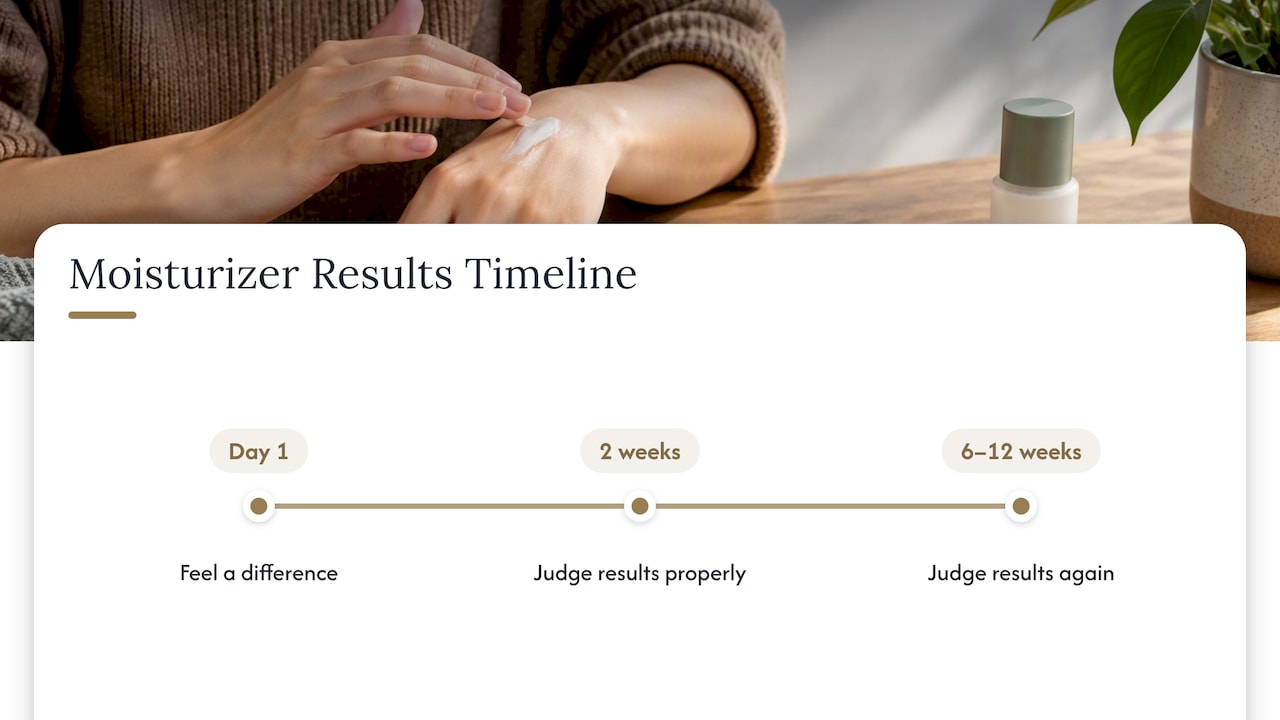
We make skincare for men who do not want a twelve-step routine, so the question we hear most is how soon they will see something. Our honest answer follows the dermatology timeline above: you will feel a difference on day one, and judge it properly at two weeks and again at six to twelve.
We built Iron Bull Tallow around three key ingredients: grass-fed Alberta tallow, hyaluronic acid and jojoba oil. The reasoning is simple. Fewer ingredients means fewer things that can sting, and a formula you can actually keep using is the one that produces results. Consistency is the variable that matters most, and men quit routines that are fussy, greasy or slow to absorb. That is why we focus on a balm that absorbs without a heavy residue and is suitable for sensitive skin.
Customers tell us they notice better hydration and smoother texture within weeks, which fits the timeline. We do not tell anyone a balm will erase deep wrinkles. If a product claims to do that in a week, walk away. And if your skin is stinging or a rash is spreading, no moisturizer of ours, or anyone’s, is the answer: see a dermatologist.
If you want the reasoning behind tallow itself, we explain why beef tallow works on skin and what jojoba adds in our jojoba oil balm guide.
— Blaine
Try a simple routine for 60 days
If you want to test the timeline above with a minimal routine, our Iron Bull face balm and sun balm are made for exactly that: one balm for daily hydration, one for sun exposure. Orders come with a 60-day money-back guarantee, which covers the full window in which fine-line and texture changes are usually judged. Not sure which tallow balm suits you? Our guide to choosing a tallow balm lays out the criteria.
FAQ
How many days does it take for moisturizer to work?
You can feel surface hydration the first time you apply it. For dry skin, the American Academy of Dermatology says many people see improvement within about two weeks, so roughly 14 days of consistent use is a fair first checkpoint. Changes in fine lines take far longer.
Why does my skin look worse after starting a new moisturizer?
Most often it is irritation or an allergy to an ingredient, not a harmless adjustment period. Stinging, burning, tingling, new redness or a rash are signs to stop the product. If the reaction does not calm down within a few days, see a dermatologist.
Can a moisturizer get rid of wrinkles?
No. It can plump skin so fine lines look less noticeable, and that effect disappears if you stop using it. The AAD says most products need at least six weeks, sometimes three months, and that creams cannot reduce all signs of aging.
Should I moisturize in the morning, at night, or both?
Both is the best test of whether a product works. The two-week trial results came from twice-daily use. Apply it after washing while your skin is still damp to help lock in water, and add sunscreen in the morning.
When should I see a dermatologist instead of waiting longer?
See one if dryness or itching continues or worsens after about two weeks of good self-care, if you have cracks, a spreading rash or intense redness, or if rough bumps have not improved after 4 to 6 weeks. These can have causes a moisturizer will not fix.
Sources
- AAD: Dry skin overview
- AAD: Many ways to firm sagging skin
- AAD: How to maximize results from anti-aging skin care products
- AAD: How to pick the right moisturizer for your skin
- AAD: Moisturizer and acne
- AAD: Keratosis pilaris diagnosis and treatment
- Randomized trial of a consistent skin care regimen in dry skin
- Study of immediate versus delayed moisturizer application
- Moisturizers: The Slippery Road