Sodium hyaluronate is the sodium salt of hyaluronic acid. Chemically they are close relatives, and in a moisturizer they do the same job: pull water into the outer layers of skin and hold it there. The practical differences are stability, molecular size and how a formula uses each one. They are not a rivalry where one wins.
That is the short version. Below is the longer one: what each name means on a label, whether “smaller” really means “deeper,” how low and high molecular weight hyaluronic acid behave, and how to get the most hydration out of whichever you use.
TL;DR
- Sodium hyaluronate is the salt form of hyaluronic acid. Both bind water, and both are considered safe for skin.
- Sodium hyaluronate is the form most often used in cosmetics, largely because it is more stable in a formula.
- Molecular weight matters more than the name. Larger molecules hydrate the surface, smaller ones can reach slightly deeper, and the best products mix sizes.
- Apply either one to damp skin and seal it with a moisturizer, or it has little to hold on to.
- Ignore claims that one name is automatically better. Check the full formula and how your skin responds.
Table of Contents
- What each name means on the label
- Is sodium hyaluronate smaller, and does it go deeper?
- Low vs. high molecular weight hyaluronic acid
- What these ingredients actually do for your skin
- Which should you choose?
- How to apply it so it actually works
- Is it safe? What to check first
- Our perspective
- Hydrolyzed hyaluronic acid vs. sodium hyaluronate
- Where a balm fits in your routine
- FAQ
- Sources
What each name means on the label
Hyaluronic acid (HA) is a molecule your body already makes. It sits in skin, joints and eyes, and it is known for holding a lot of water. Harvard Health describes it as a naturally occurring compound that attracts and binds water, and notes that sodium hyaluronate works the same way.
Sodium hyaluronate is what you get when hyaluronic acid is converted to its sodium salt. In a bottle, pure hyaluronic acid is a bit fussy. The salt version is easier to work with, and as one dermatologist quoted by The Zoe Report puts it, it is less prone to oxidation and so more stable. That stability explains the label pattern you see. A 2025 review in PMC, citing 2023 U.S. Food and Drug Administration data, reports sodium hyaluronate as the most frequently used form of HA in cosmetic formulations.
So when you flip over a jar and see “sodium hyaluronate” in the ingredients, you are very likely looking at hyaluronic acid in its most common cosmetic dress.
A third name: hydrolyzed hyaluronic acid
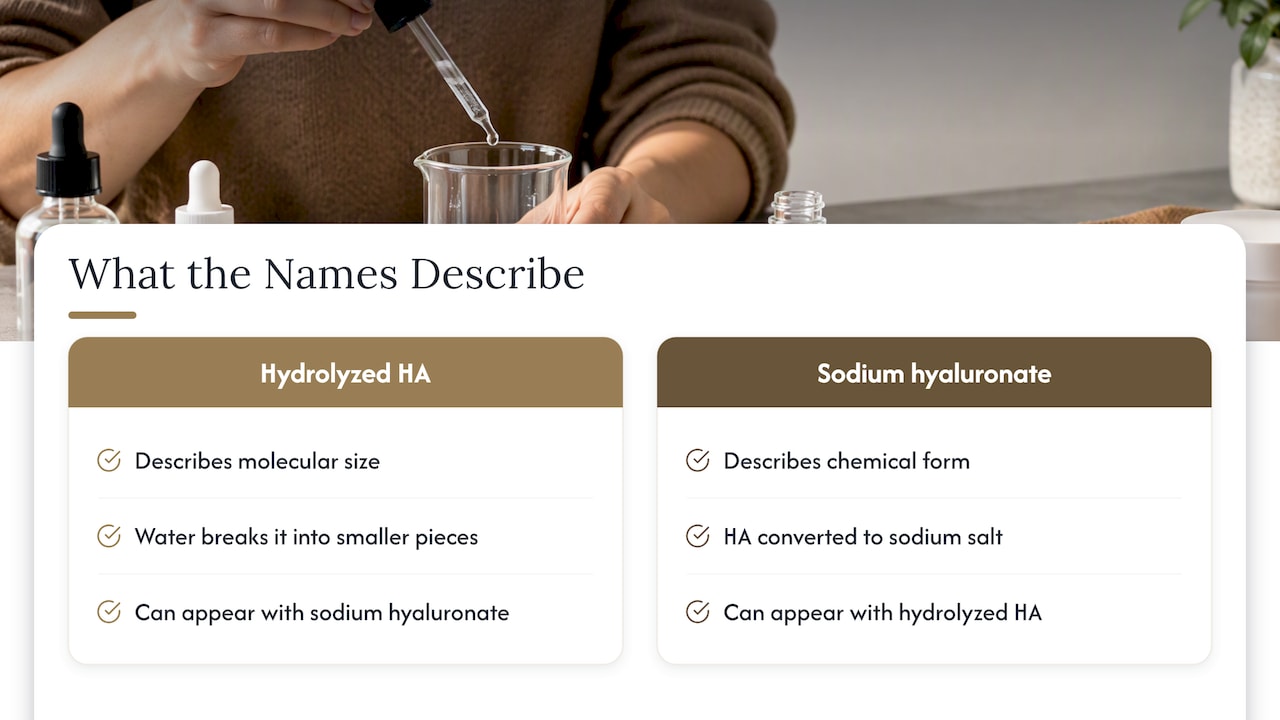
You will also see “hydrolyzed hyaluronic acid.” Hydrolyzing means breaking the molecule into smaller pieces with water. According to The Zoe Report, this is one way to shrink HA so it can work in a topical product. Sodium hyaluronate is the other common route, by making the salt.
The two terms describe different things. One is about size (hydrolyzed, meaning cut down), the other about chemical form (a salt). A product can use either, and some use both so that the formula contains more than one molecular size.
Is sodium hyaluronate smaller, and does it go deeper?
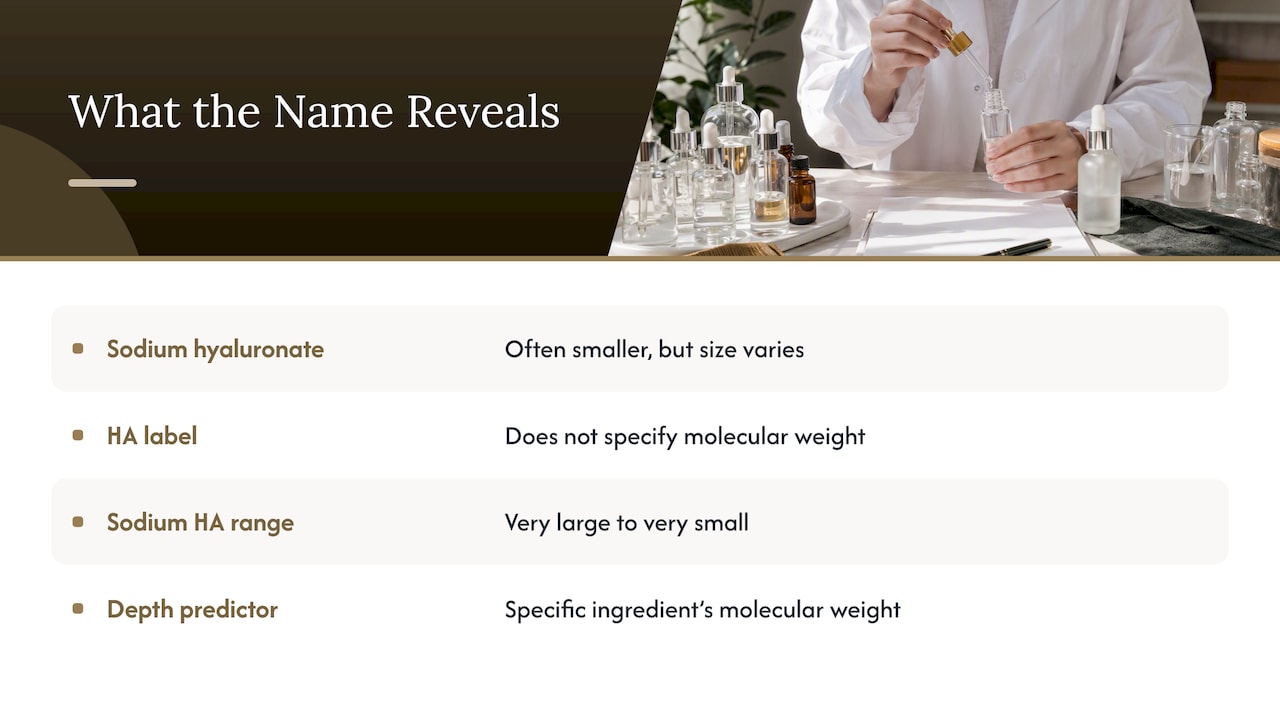
This is the claim behind most of the top-ranking articles on this topic. You will read that hyaluronic acid hydrates the surface while sodium hyaluronate goes deeper. There is some truth in it, but it is oversimplified.
Sources such as Healthline say sodium hyaluronate has a lower molecular weight than high-molecular-weight hyaluronic acid, which lets it get into the epidermis more easily. Byrdie adds the caveat: a smaller molecular size may mean it penetrates more readily, but that does not necessarily make it better.
Here is the catch. “Sodium hyaluronate” is not one fixed size. Manufacturers sell it in a range of molecular weights, from very large to very small. Likewise, “hyaluronic acid” on a label does not tell you the size. The name alone cannot tell you how deep anything goes. What matters is the molecular weight of the specific ingredient, which brands rarely print.
So the honest rule is this: a sodium hyaluronate product is often made with a smaller molecule, but you cannot assume it.
Low vs. high molecular weight hyaluronic acid
Size is the variable that actually changes how the ingredient behaves. It is measured in kilodaltons (kDa).
| High molecular weight | Low molecular weight | |
|---|---|---|
| What it does | Holds more water, stays on the topmost layer | Binds less water, can penetrate a bit deeper |
| Best for | Immediate surface hydration, a smooth feel | Reaching deeper layers, supporting plumpness over time |
| Typical concern | Can feel slightly tacky in some formulas | May provoke irritation in compromised skin |
The first row comes from Harvard Health: higher-molecular-weight HA retains water better but stays on the skin’s topmost layer, while lower-molecular-weight HA binds less water and can penetrate somewhat deeper. The PMC review notes that HA below roughly 50 kDa can get through the epidermis to reach deeper layers, where it is linked to plumping, firmness and a reduced look of wrinkles.
The third row deserves attention. The same PMC review points out that low-molecular-weight HA can trigger an inflammatory response in the context of wound healing. For healthy skin in a normal moisturizer that is rarely a problem, but it is a reason to go easy if your skin is raw, broken or reactive.
The practical answer to “which size is better” is both. Harvard Health’s own suggestion is a product that combines high and low molecular weight forms. The big molecules give you surface moisture right away, and the small ones add what the big ones cannot.
What these ingredients actually do for your skin
Strip away the marketing and the benefits are modest but real. Harvard Health says hyaluronic acid helps hydrate dehydrated skin, softens the look of wrinkles, and may help prevent acne by curbing dryness.
Note the wording: it hydrates, and it softens the look of wrinkles. Water-plumped skin looks smoother. That is a surface effect, not a permanent change in the skin’s structure. If you stop applying it, the effect fades.
For men, three situations come up most:
- Dry, tight skin after shaving. Hydration helps skin feel more comfortable, particularly in cold or dry air.
- Fine lines around the eyes and forehead. Hydrated skin shows lines less. It will not erase them.
- Irritation from razor use or harsh cleansers. HA supports hydration, but it is not a treatment for a damaged barrier. A rich moisturizer does more of that work.
Which should you choose?
For most people, the name on the front matters far less than three practical questions.
- Is it in a product you will actually use every day? A well-made moisturizer you apply twice daily beats a fancy serum that sits in a drawer.
- Does the formula include something to seal the water in? HA attracts water, but it needs an occlusive or emollient layer to keep it from evaporating.
- Does your skin tolerate it? If it stings or turns red, size and form do not matter. Stop and reassess.
If you want a rule of thumb: oily or combination skin tends to like lightweight gels with sodium hyaluronate. Dry, mature or weather-beaten skin usually does better with HA inside a richer balm or cream, where the fats do the sealing.
How to apply it so it actually works
The biggest mistake is putting HA on bone-dry skin in a dry room. Humectants pull water from wherever they can, and if the environment is dry, they can draw it from deeper in the skin instead of from the air.
Harvard Health, drawing on American Academy of Dermatology guidance, recommends this approach:
- Cleanse your face and leave it slightly damp.
- Apply your HA or sodium hyaluronate product to the damp skin.
- Follow right away with a moisturizer that seals it in.
- In the morning, finish with sunscreen. Hydrated skin is not protected skin.
That third step is where most routines fall short. A watery serum alone leaves the water free to evaporate. Pair it with a moisturizer that has real emollients and occlusives.
Is it safe? What to check first
Harvard Health considers hyaluronic acid safe and unlikely to cause side effects on skin. That is a good track record, but “unlikely” is not “never.” Reactions usually come from other ingredients in the formula, such as fragrance, alcohol or preservatives, rather than from the HA.
Before you commit to a new product:
- Test a small patch on your jawline or inner forearm for a day or two.
- Read the whole ingredient list, not only the hero ingredient.
- Be cautious with very low molecular weight formulas if your skin is inflamed or freshly irritated.
If you have persistent redness, rashes or a condition like eczema or rosacea, see a board-certified dermatologist before adding new actives. If you would rather get hands-on advice about your skin type, in-home skincare appointments with a licensed esthetician can help you sort out what your skin tolerates and which routine suits it.
Our perspective
We get asked about this a lot, usually by guys who have stared at a label and gotten nowhere. Here is how we see it.
The sodium hyaluronate versus hyaluronic acid debate is mostly a naming problem. Brands love to turn a salt form into a “deeper-penetrating breakthrough,” and the claim is bigger than the evidence. What counts is whether the product hydrates your skin without making it greasy, and whether it is simple enough that you will use it every morning.
That is why we built Iron Bull Tallow the way we did. It is a face balm made from 100% natural, grass-fed Alberta tallow and infused with hyaluronic acid. We pair the humectant with a rich, skin-compatible fat on purpose, because HA on its own can only attract water. It needs something to hold the water in. Tallow does that job, and the result absorbs without the greasy feel that puts so many men off moisturizers.
We also keep formulas short. Fewer ingredients mean fewer things that can irritate, which matters for men whose skin is already dealing with shaving, wind and sun. Customers tell us they notice better hydration and texture within a few weeks, and we back the product with a 60-day money-back guarantee, so you can see for yourself with little risk.
Our advice is plain: do not choose a moisturizer on the strength of one ingredient name. Look at the whole formula, the texture, and how your skin feels after two weeks.
— Blaine
Hydrolyzed hyaluronic acid vs. sodium hyaluronate
Because readers often ask, here is how these two compare side by side.
| Sodium hyaluronate | Hydrolyzed hyaluronic acid | |
|---|---|---|
| What it is | The sodium salt of hyaluronic acid | Hyaluronic acid broken into smaller pieces with water |
| Why it is used | Stable in formulas, widely available | Smaller size for easier absorption |
| How common | The most frequent HA form in cosmetics | Common in serums and moisturizers |
You can see how they overlap: a salt form can also be a small one, and a hydrolyzed form can be sold as a salt. Treat both as signals that the brand has thought about molecular size, then look at the rest of the formula.
Where a balm fits in your routine
If you want one step that handles hydration and sealing, a balm with HA built in is a simple way to do it. Our Iron Bull Beef Tallow Face Moisturizer for Men and Sun Balm are made for men who want hydration and daily protection without a ten-step routine. Apply the face balm to slightly damp skin after washing, and use the sun balm as the last step in the morning.
FAQ
Is sodium hyaluronate better than hyaluronic acid?
Not by default. Sodium hyaluronate is the salt form and is more stable in products, which is why it is so common. Whether either one works better for you depends on the molecular weight used, the rest of the formula and how your skin responds.
Can I use hyaluronic acid and sodium hyaluronate together?
Yes. They are closely related and work the same way, so layering them is not harmful. Many products already list both. Apply them to damp skin and finish with a moisturizer to seal in the water.
Does low molecular weight hyaluronic acid work better?
It reaches slightly deeper, but it binds less water than larger molecules. Low molecular weight HA can also provoke inflammation in wounded skin, per a PMC review. A mix of sizes is usually the sensible choice.
Can hyaluronic acid irritate my skin?
It is considered safe and rarely causes side effects. Irritation usually comes from fragrance or other ingredients in the formula. Patch test new products, and see a dermatologist if redness or rashes persist.
Sources
- Hyaluronic acid for skin: Benefits, how to use it, and side effects, Harvard Health
- Hyaluronic Acid in Topical Applications: The Various Forms, PMC
- Sodium Hyaluronate in Skin Care: Benefits, Side Effects, Healthline
- Everything You’ve Ever Wanted to Know About Sodium Hyaluronate, Byrdie
- Sodium Hyaluronate vs. Hyaluronic Acid: What To Know, The Zoe Report