
Petroleum-free skincare means products made without petrolatum (petroleum jelly), mineral oil, paraffin and similar crude-oil derivatives. Instead they rely on plant oils, butters, animal-derived fats like tallow, or humectants like glycerin and hyaluronic acid. Going petroleum-free is mostly a choice about texture, ingredient philosophy and daily habit. It is not a safety emergency. This guide covers what the label actually tells you, where petrolatum still wins, and how to pick a replacement that you will use every morning.
TL;DR
- Petrolatum is not toxic and, in its refined form, is non-comedogenic. Skipping it is a preference, not a rescue.
- Check labels for more than “petrolatum”: mineral oil, paraffin and some synthetic waxes are also petroleum-derived.
- Petrolatum is still the stronger seal for cracked, severely damaged skin. For everyday face care, a petroleum-free balm that doesn’t feel greasy is often the one men actually keep using.
- “Natural” does not mean “hypoallergenic.” Essential oils and other plant ingredients can irritate, so patch test anything new.
- Look for short ingredient lists, a clear guarantee and a formula built for your skin concern.
Table of Contents
- What petroleum-free skincare actually means
- How to read a label for hidden petroleum derivatives
- Is petrolatum safe for your face?
- When petrolatum is still the better choice
- Why men switch: texture, consistency and a shorter routine
- Natural, clean, non-toxic: what the words do and don’t mean
- Petroleum-free options by type
- Our perspective: simple, men-specific, and honest about trade-offs
- How to choose a petroleum-free moisturizer
- Try a petroleum-free face balm built for men
- FAQ
- Sources
What petroleum-free skincare actually means
Petrolatum is a semi-solid mixture of hydrocarbons refined from petroleum. Poison Control describes it as a common household product used in many medicated ointments, and petroleum jelly is generally considered nontoxic in the amounts people use on skin. The FDA lists petrolatum as an active ingredient in its skin protectant monograph, which is the regulatory category for products that protect chapped or irritated skin.
So why do people avoid it? Usually for one of four reasons:
- They don’t like how it feels. It is heavy, shiny and tends to transfer onto collars, pillowcases and steering wheels.
- They prefer ingredients that don’t come from fossil fuels. That is a values call, and a legitimate one.
- They want a shorter, more recognizable ingredient list.
- They believe it causes breakouts. This one is mostly a myth, covered below.
The phrase “petroleum-free” is not a regulated claim on a face moisturizer. It is a marketing description, so the ingredient list is your only reliable evidence.
How to read a label for hidden petroleum derivatives
A product can skip petrolatum and still contain other petroleum-derived ingredients. Based on the dermatology review we worked from, watch for paraffin, mineral oil and certain synthetic waxes in addition to petrolatum itself.
Here is a quick checklist for the back of the jar:
| Look for on the label | What it is | Petroleum-derived? |
|---|---|---|
| Petrolatum, petroleum jelly | Occlusive semi-solid | Yes |
| Mineral oil, paraffinum liquidum | Light occlusive oil | Yes |
| Paraffin, microcrystalline wax | Wax used to thicken | Yes |
| Tallow, shea butter, beeswax | Animal or plant fats and waxes | No |
| Jojoba oil, other plant oils | Emollients | No |
| Glycerin, hyaluronic acid | Humectants that draw in water | No |
Two cautions. First, ingredient names can vary, and some synthetic waxes are harder to trace by name alone. If a label is unclear, ask the brand directly. Second, a marketing line such as “clean” tells you nothing about what is inside. Read the list.
Is petrolatum safe for your face?
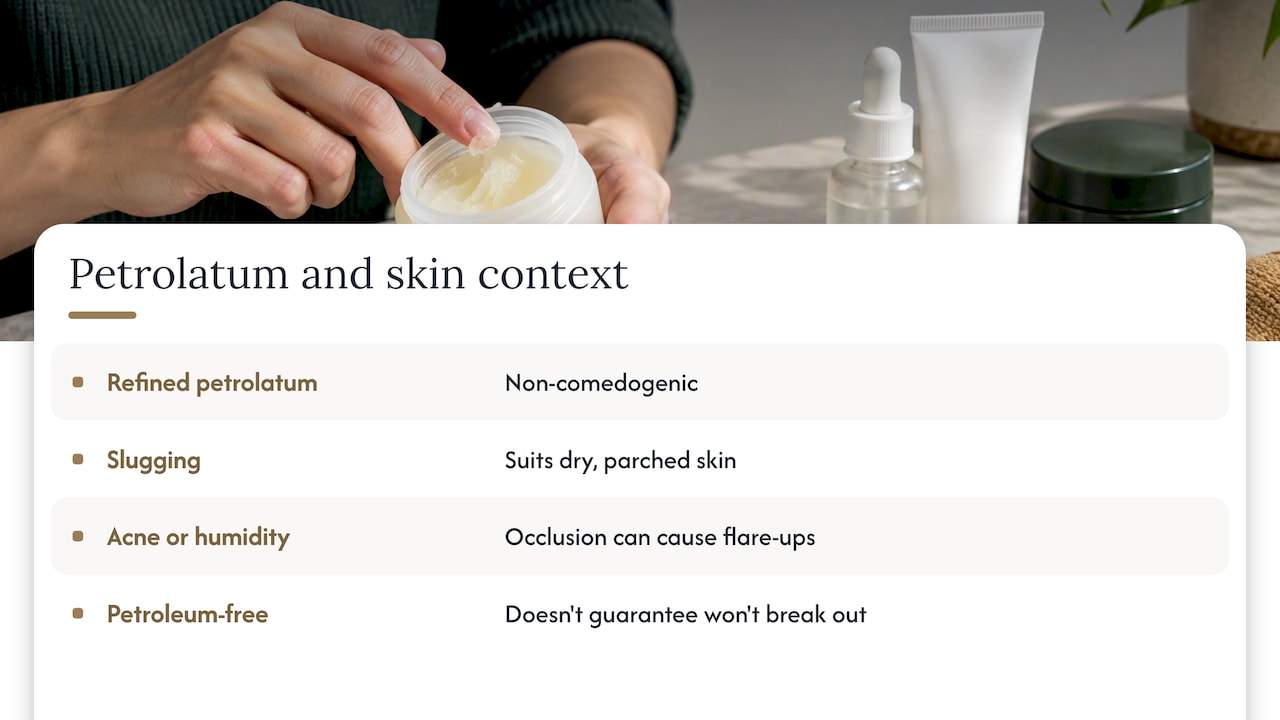
For most men, yes. The long-running worry that petroleum jelly clogs pores traces back largely to older, less pure versions of the ingredient and to its greasy feel. The International Academy of Cosmetic Dermatology notes that pure, refined petrolatum is non-comedogenic, and a 2023 review in the Journal of the American Academy of Dermatology set out to address the many myths around it.
There is a real caveat, though. An occlusive layer can hold sweat and bacteria against the skin. The Cleveland Clinic explains in its guide to slugging, the practice of sealing skin with a heavy layer, that the technique suits dry, parched skin but can cause flare-ups on acne-prone skin or in humid conditions. The problem is the occlusion in the wrong setting, not a toxic ingredient.
If you are acne-prone, the American Academy of Dermatology suggests looking for oil-free or non-comedogenic labels rather than focusing only on whether a product is petroleum-free. Many petroleum-free products can still clog pores, so the label “petroleum-free” is not the same as “won’t break you out.”
When petrolatum is still the better choice
We sell petroleum-free products, and we would still tell you this: for severely cracked hands, split heels, or a barrier that is badly damaged, petrolatum is hard to beat. Dermatologists note that the trade-off with going petroleum-free is often less of the sealed-in, “impenetrable” moisture barrier. High-glycerin and plant-butter formulas rehydrate very well, but they may not match petrolatum on the most damaged skin.
We go deeper on this in our piece on when dermatologists prefer petrolatum over a natural alternative, and on the everyday decision in when men should use petroleum jelly versus a moisturizer.
A simple rule of thumb:
- Cracked, bleeding or very rough patches on hands, feet or elbows: a petrolatum ointment can make sense. See a doctor if skin is infected, won’t heal, or looks like eczema.
- Daily face care, post-shave comfort, windburn, mild dryness: a petroleum-free balm that absorbs without a slick film is a strong fit.
Why men switch: texture, consistency and a shorter routine
The main advantage of going petroleum-free is often textural and sensory rather than clinical. Traditional petrolatum ointments are excellent occluders, but their greasy feel is why many men give up on them. A moisturizer you skip does nothing. One you apply every morning in thirty seconds does a lot.
That is the logic behind most of what we do. If you want the short version of building a routine around it, see our simple skincare routine for men, or our three-step, five-minute routine.
Natural, clean, non-toxic: what the words do and don’t mean
These terms get blurred, so here is how we use them.
- Natural generally means ingredients come from plants, animals or minerals rather than being synthesized. There is no single legal definition for skincare.
- Clean is a retailer or brand standard. It differs from one company to the next.
- Non-toxic is the loosest of the three. In practice brands use it to mean they leave out certain ingredients they consider questionable. Check which ones.
None of these equals “safe for sensitive skin.” Dermatologist Rebecca Kazin, MD, quoted by the American Academy of Dermatology, makes the point that there is no one-size-fits-all moisturizer. In the same vein, the dermatology review we cited above notes that essential oils can be potent allergens even in natural formulas, sometimes causing more irritation than synthetic alternatives.
Practical step: before putting any new product on your whole face, apply a small amount to your inner forearm or behind the ear for a few days. If you get redness, itching or burning, stop. If you have eczema, rosacea or a history of contact allergies, ask a dermatologist before switching.
Petroleum-free options by type
Without naming brands, here are the main families of petroleum-free moisturizers and what each is good at.
| Type | Strength | Watch out for |
|---|---|---|
| Plant-butter balms (shea, cocoa) | Rich, softening, good seal | Can feel heavy; shea is a nut-derived ingredient |
| Animal-fat balms (tallow, lanolin) | Closely resembles skin’s own lipids; strong comfort | Lanolin allergies exist; tallow suits those who are comfortable with animal-derived products |
| Glycerin-rich creams | Light, non-greasy, hydrating | Less seal on very damaged skin |
| Plant-oil blends | Simple, flexible | Some oils are comedogenic; fragrance and essential oils may irritate |
| Humectant gels (hyaluronic acid) | Water-light feel | Need an oil or balm on top in dry climates |
For a longer side-by-side, we put together a guide to petroleum-free alternatives to heavy ointments, and a balm versus cream decision rule if you can’t decide on format.
Our perspective: simple, men-specific, and honest about trade-offs
We started Iron Bull Naturals because most men’s skincare is either a ten-step routine or a drugstore tub that feels like grease. Our view is that a man’s face needs three things: hydration, protection and as few steps as possible.
That is why our face balm is built on three key ingredients. It uses grass-fed Alberta beef tallow, hyaluronic acid and jojoba oil. Tallow is rich in the kind of fats skin already makes. Hyaluronic acid pulls in water. Jojoba oil helps the balm spread and absorb. The result is meant to hydrate and repair without that greasy film, and to be gentle on sensitive and all skin types.
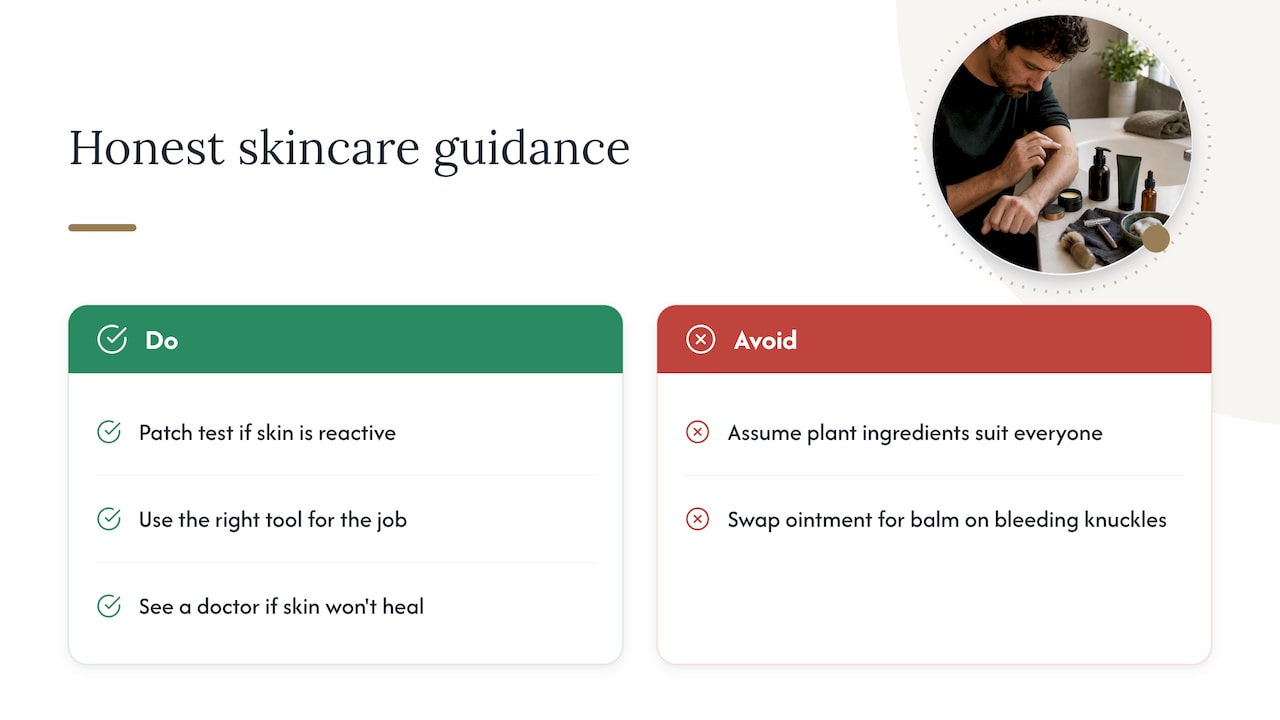
We also want to be straight about two things. First, our formulas include essential oils, and as the dermatologists above say, plant ingredients are not automatically gentle for everyone. If your skin is reactive, patch test first. Second, we would not tell a man with split, bleeding knuckles to swap his ointment for a face balm. Use the right tool for the job, and see a doctor when skin isn’t healing.
What we do stand behind: simplicity, a short ingredient list, and a 60-day money-back guarantee, so you can test the balm over several weeks, which is how long skin changes usually take to show.
— Blaine
How to choose a petroleum-free moisturizer
Use these criteria in order.
- Define the problem. Everyday tightness and flaking, irritation after shaving, fine lines, or severe cracking? The last one may call for petrolatum or a doctor.
- Read the full ingredient list. Look for the petroleum derivatives in the table above, not only the word “petrolatum.”
- Consider your skin type. If you break out easily, look for non-comedogenic labeling. Our guide to balm vs. cream can help with the format.
- Check for irritants. Fragrance and essential oils are common triggers. If you know you react to them, choose accordingly.
- Pick a texture you will use. The best product is the one in your morning routine. Absorbs quickly, no film, no shine.
- Look for a return policy. Skin takes weeks to respond, so a guarantee that covers that window matters.
- Don’t forget sun protection. A moisturizer does not replace sunscreen. We cover the options in sun balm versus sunscreen.
For dry or irritated skin in particular, our pages on dehydrated skin in men and irritation relief with a three-ingredient tallow balm go through the steps in detail.
Try a petroleum-free face balm built for men
If you want a daily moisturizer without petrolatum, mineral oil or paraffin, our Iron Bull Beef Tallow Face Moisturizer for Men is made with grass-fed Alberta tallow, hyaluronic acid and jojoba oil. For daytime protection there is also our Iron Bull Sun Balm. You can see everything in the shop, and the 60-day money-back guarantee lets you judge the results on your own skin.
FAQ
Is Vaseline petroleum-based?
Yes. Petroleum jelly is petrolatum, a refined petroleum product, and Vaseline-type products are essentially pure petrolatum, as Poison Control explains. It is classed by the FDA as a skin protectant. If you want to avoid petroleum, you need a different base such as plant butters, tallow or lanolin.
Is petrolatum safe for the face?
For most people, yes. Refined petrolatum is considered non-comedogenic, though it can trap sweat and bacteria on acne-prone skin or in humid weather. If you break out easily, use a lighter non-comedogenic moisturizer and talk to a dermatologist about persistent acne.
What is a good natural moisturizer for the face?
Look for a short ingredient list, a texture you will use daily, and as few known irritants as possible. Tallow balms, plant-oil blends and glycerin-based creams are common petroleum-free choices. Natural does not guarantee gentleness, so dermatologists recommend picking by skin type and testing a small area first.
Does moisturizer help acne?
It can. The American Academy of Dermatology says dryness can prompt skin to produce more oil, and a moisturizer helps people using acne treatments tolerate them. Choose one labeled oil-free or non-comedogenic rather than choosing only on the petroleum-free claim.
What does non-toxic skincare mean?
There is no legal definition. Brands use it to say they leave out certain ingredients they consider concerning, and the list differs from brand to brand. Read the ingredient list, and don’t assume “non-toxic” also means “won’t irritate you.”
Sources
- What is petroleum jelly? Poison Control
- OTC Monographs, FDA
- Petrolatum, Grease, and Acne, International Academy of Cosmetic Dermatology
- Petroleum jelly: A comprehensive review, Journal of the American Academy of Dermatology
- Slugging: Does This Skin Care Trend Work? Cleveland Clinic
- Moisturizer: Why you may need it if you have acne, American Academy of Dermatology
- How to pick the right moisturizer for your skin, American Academy of Dermatology
- Aveeno Skin Relief Healing Ointment Review, DermApproved