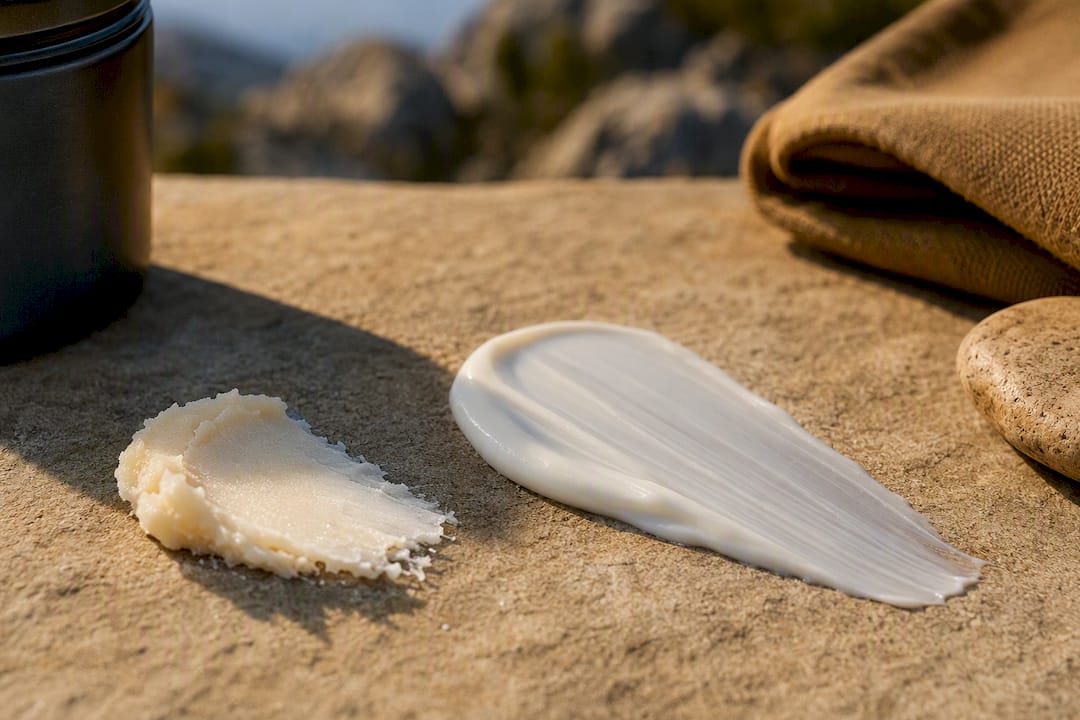
Both sun balms and conventional sunscreens block UV rays, but they’re built for different jobs. A balm is a wax-based, targeted formula best suited for daily face use, while a tested lotion or spray sunscreen covers larger areas and holds up in water. Pick based on where you’re applying it and how long you’ll be outside, and reapply every two hours no matter which one you choose.
TL;DR:
- A sun balm is best for targeted, daily face application due to its wax-based, long-lasting, non-slipping formula, while sunscreens suit large areas and water resistance.
- SPF 30 filters about 97% of UVB rays, and changing from lotion to balm does not affect the tested SPF value, which depends on the formulation, not packaging.
- Mineral filters like zinc oxide cause fewer allergic reactions and are safer for sensitive or reactive skin, especially when free from fragrances and preservatives.
- Reapplication every two hours is essential, regardless of product type, and layering protection with clothing or shade still offers the best coverage.
- Concentrate on consistent use of the preferred product, applying the right amount and correctly targeting high-risk areas, rather than debating which product is better.
Table of Contents
- Sun Balm vs Sunscreen: A Side-by-Side Look
- How SPF and Filters Actually Work
- What the Label Actually Has to Tell You
- Applying Sun Balm and Sunscreen the Right Way
- Who Should Worry About Irritation
- Quick Scenarios: Balm or Bottle?
- Why a Tallow-Based Balm Fits a No-Fuss Routine
- Try Iron Bull Naturals for Your Daily Face Protection
- The Real Lesson in the Balm vs Sunscreen Debate
- Sources
- FAQ
Sun Balm vs Sunscreen: A Side-by-Side Look
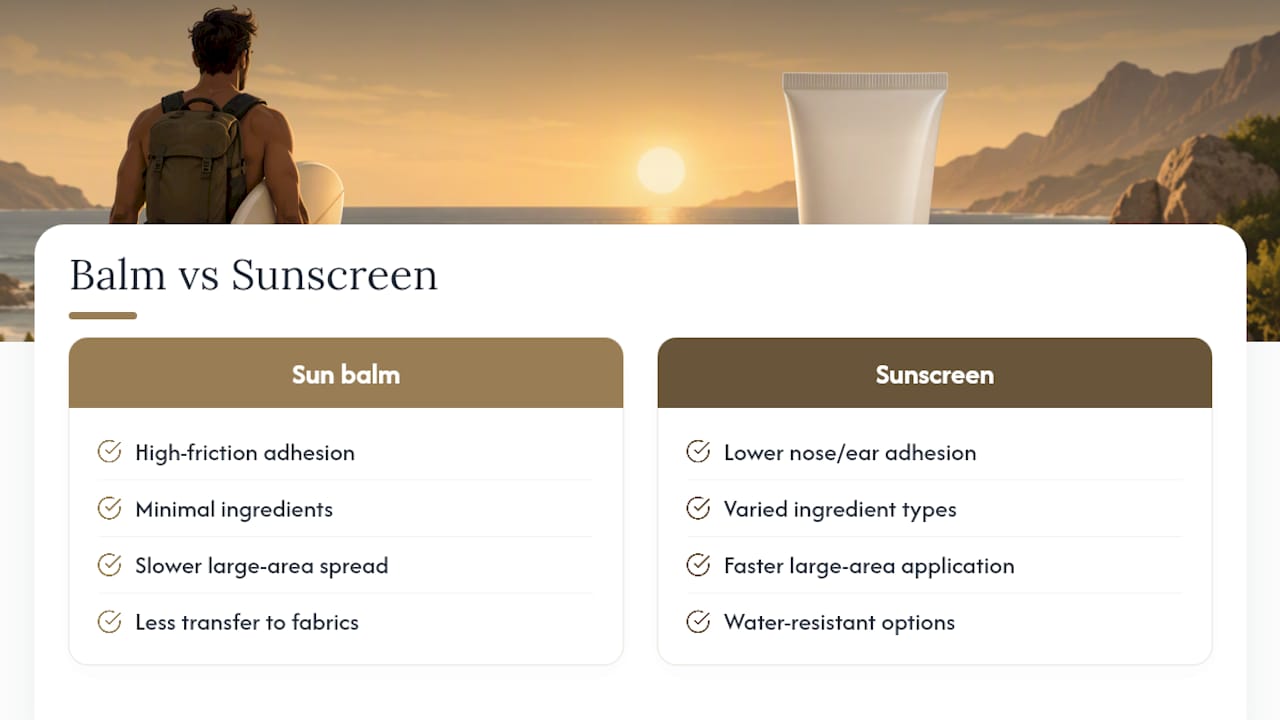
A sun balm is an anhydrous formula, meaning it is built from waxes, butters, and oils with no water content. That structure lets it grip skin on the nose, ears, and lips without sliding off, which is exactly where thin lotions tend to wear thin fastest. Conventional sunscreen is usually an emulsion, blending water and oil so it spreads easily across the arms, legs, and torso.
Balms typically lean on mineral actives like zinc oxide, while bottled sunscreens split between mineral, chemical, and hybrid formulas depending on the brand. Physical blockers reflect and scatter UV light at the skin’s surface, and chemical filters absorb it and convert it to heat, and both approaches work when applied correctly.
Sun balm strengths: long adhesion on high-friction spots, minimal ingredient lists, less transfer onto masks or collars.
Sun balm tradeoffs: slower to spread over large areas, not ideal for full-body coverage.
Conventional sunscreen strengths: faster application over big surfaces, widely available in water-resistant formulas.
Conventional sunscreen tradeoffs: can rub off faster on the nose and ears during activity.
How SPF and Filters Actually Work
SPF measures how much longer your skin takes to burn with protection versus without it, and the number matters more than most people realize. SPF 30 filters about 97% of UVB rays, while SPF 15 stops roughly 93%. That six-point gap sounds small, but it’s the difference dermatologists point to when they recommend SPF 30 as the practical floor, not SPF 15.
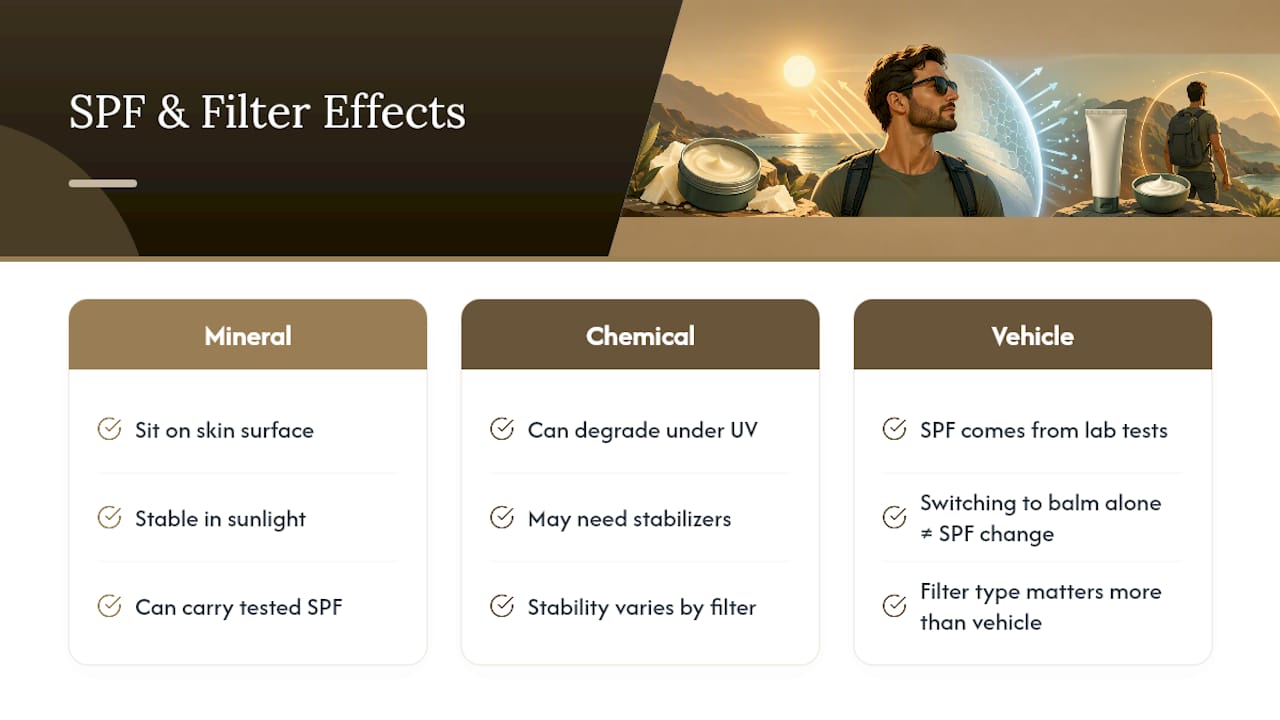
Mineral filters like zinc oxide and titanium dioxide sit on the skin’s surface and stay stable in sunlight. Some chemical filters degrade faster under UV exposure, which is why formulators often pair them with stabilizers.
Here’s the part people miss: switching a sunscreen from a lotion to a balm doesn’t automatically change its SPF. The number on the label comes from lab testing, not from the vehicle. A balm can carry the same tested SPF as a lotion, but only if the finished product actually went through that testing. If you’re comparing mineral versus chemical actives to decide what fits your skin, the filter type matters more than whether it’s packaged as a stick, balm, or cream.
What the Label Actually Has to Tell You
Every legally sold sunscreen in the U.S. follows FDA OTC Monograph M020, which lists which active ingredients are allowed, what the “Uses” and “Warnings” sections must say, and how SPF and broad-spectrum claims get tested. That’s also why you’ll never see “waterproof” on a real sunscreen label anymore. The monograph doesn’t allow it, because no product resists water indefinitely.
Water resistance gets labeled in one of two windows: 40 minutes or 80 minutes, based on testing while swimming or sweating. Once that window closes, the FDA requires reapplication, and even outside water, everyone should reapply at least every two hours.
“Broad-spectrum” means the product protects against both UVA and UVB rays, not just one. No sunscreen, balm or lotion, blocks 100% of UV radiation. Layering sunscreen with a hat, shade, or long sleeves closes the gap that any single product leaves open.
Applying Sun Balm and Sunscreen the Right Way
Dermatologists recommend about 1 ounce, roughly a shot glass, for full-body coverage, and around a full teaspoon for the face and neck alone. Chemical filters need about 15 minutes to bind before they start working, while mineral formulas protect on contact.
- Warm the balm between your fingers before applying so it glides instead of dragging.
- Press it into the nose, ears, and lips, the spots that burn first and rub off fastest.
- Spread lotion evenly in one direction across larger areas like the chest and shoulders.
- Reapply every two hours, or right after swimming, sweating, or toweling off.
- Layer over facial hair by pressing balm into the skin beneath a beard rather than just skimming the surface.
Apply sun protection after moisturizer, not before, so it sits on top as the final barrier. If you’re unsure on the order, this simple AM routine breakdown walks through it step by step.
Pro Tip: Keep a balm in your bag or car for touch-ups. A lotion reapplication midday feels messy at a desk, but pressing balm onto your nose and ears takes ten seconds and nobody notices.
Who Should Worry About Irritation
Mineral filters like zinc oxide and titanium dioxide cause fewer allergic reactions than some chemical filters, according to a peer-reviewed review of sunscreen ingredients. Oxybenzone, in particular, shows up repeatedly in contact-allergy reports. If your skin reacts to fragranced lotions or breaks out after sun exposure, a mineral-based balm with a short ingredient list is usually the safer starting point.
Fragrance and preservatives, not the UV filter itself, cause a lot of the irritation people blame on sunscreen. Patch-test anything new on your inner forearm for two days before putting it on your face. Eyelids and lips need extra care. Use a dedicated SPF lip balm, and ask a dermatologist before applying anything new near recently treated or broken skin.
Quick Scenarios: Balm or Bottle?
- Commuting or working near windows: a face balm handles daily, low-intensity exposure without feeling heavy.
- Beach day, swimming, or a long hike: a tested, water-resistant sunscreen covers more skin and survives sweat.
- Bearded guys who hate reapplying lotion: balm presses into skin under facial hair better than a runny formula.
- Sensitive or reactive skin: mineral balms with short ingredient lists lower the odds of a reaction.
For the face-focused half of that list, Iron Bull Naturals Sun Balm is built exactly for that use case: daily wear, targeted areas, minimal ingredients.
Why a Tallow-Based Balm Fits a No-Fuss Routine
Iron Bull Naturals built its lineup around keeping formulas short. The Iron Bull Beef Tallow Face Moisturizer for Men uses grass-fed Alberta tallow and hyaluronic acid, and the Iron Bull Naturals Sun Balm follows the same philosophy for daytime protection.
Tallow is naturally occlusive, meaning it forms a barrier that locks moisture in. That same barrier quality helps a mineral filter adhere to skin instead of sliding off by midday, which matters most on the nose, ears, and other spots that take the brunt of sun exposure.
[Author professional credentials related to skincare formulation would appear here.] [Customer testimonials or detailed case studies would appear here.] [Scientific studies or clinical trials supporting product efficacy would appear here.]
Try Iron Bull Naturals for Your Daily Face Protection
If you’re commuting, walking the dog, or spending most of your day near windows rather than at the beach, a targeted balm solves a problem lotions weren’t built for: staying put on your nose and ears without feeling greasy by lunch.

Iron Bull Naturals Sun Balm uses the same short-ingredient philosophy as the brand’s tallow moisturizer, built for men who want one simple product instead of a five-step routine. It’s designed to layer into the three-step routine Iron Bull Naturals recommends for men without adding extra steps or guesswork. Check current pricing and grab a tube from the Iron Bull Naturals shop and see how it fits into your morning before your next long day outside.
The Real Lesson in the Balm vs Sunscreen Debate
People spend more time debating which product is “better” than actually reapplying either one. That’s the gap that matters. A dermatology-backed guide from Tufts Medicine makes the same point: the best sunscreen is the one you’ll actually use consistently, not the one with the most impressive ingredient list.
For most men, that means keeping it stupid simple. A balm on your face every morning, tucked into a routine that already includes a moisturizer, beats an elaborate five-product regimen you abandon by March. Save the tested, water-resistant lotion for the beach or the long hike, and let the balm handle the daily grind.
— Blaine
Sources
- Sunscreen: How to help protect your skin from the sun — U.S. FDA
- OTC Monograph M020 — Sunscreen Drug Products for Over-the-Counter Human Use — FDA
- Sunscreens: a review of types, allergens, and recommendations — PMC
FAQ
What Is a Sun Balm?
A sun balm is a wax-based sunscreen formula, usually built from ingredients like tallow, shea butter, or jojoba oil combined with a mineral UV filter such as zinc oxide. It’s designed for targeted, daily application on the face rather than full-body coverage.
Which Sunscreen Ingredients Should You Avoid?
Chemical filters like oxybenzone show up frequently in contact-allergy reports, so people with sensitive or reactive skin often do better with mineral filters like zinc oxide or titanium dioxide. Fragrance and certain preservatives added to sunscreen formulas cause irritation more often than the UV filters themselves.
Is It Okay to Apply Sunscreen on Eyelids?
Eyelid skin is thin and sits close to the eyes, so use a formula specifically labeled safe for that area rather than a standard body sunscreen. Mineral-based options tend to cause less stinging, and a dedicated SPF lip balm should cover the lips separately.
Is Sunblock or Sunscreen Healthier?
Neither term is inherently healthier. “Sunblock” typically refers to mineral filters that reflect UV light, while “sunscreen” often refers to chemical filters that absorb it, and both are effective when they’re broad-spectrum, SPF 30 or higher, and applied correctly. People with sensitive skin generally tolerate mineral formulas better, based on the lower rate of contact allergy reported for zinc oxide and titanium dioxide.