
A non-toxic face balm is one with a short, transparent ingredient list, no unnecessary fragrance, and nothing that regularly triggers skin reactions. The most reliable options tend to be minimalist formulas built on tallow, jojoba, or beeswax rather than long ingredient decks. A simple tallow-based balm fits that description for a lot of men who just want hydration without the guesswork.
TL;DR:
- A minimalist balm with only tallow, hyaluronic acid, and jojoba oil reduces the risk of skin reactions and is suitable for most men seeking hydration.
- Labels claiming “non-toxic,” “clean,” or “natural” are unregulated and not reliable indicators of safety; ingredient panels provide the true safety information.
- Water-containing balms require preservatives and have a longer shelf life, while anhydrous balms avoid preservatives but are more prone to contamination.
- Fragrance and essential oils are common irritants, so choosing unscented formulas with short ingredient lists minimizes contact reactions, especially for sensitive skin.
- Patch-testing any new balm on your inner forearm for several days helps identify sensitivities before facial application.
Table of Contents
- What “non-toxic” means for cosmetics and why labels can mislead
- Ingredient guide: what actually goes into a non-toxic face balm
- How to choose a non-toxic face balm for your skin type and concerns
- How to use a face balm safely and effectively
- Why a minimalist tallow-based balm can be a non-toxic choice
- The real problem with most “non-toxic” skincare marketing
- Try a simple, three-ingredient balm built for men’s skin
- Sources
- FAQ
What “non-toxic” means for cosmetics and why labels can mislead
“Non-toxic,” “clean,” and “natural” sound like regulated terms. They are not. The FDA does not define or regulate “natural” or “clean” claims for cosmetics, so any brand can print those words on a label. Safety instead comes down to the toxicological profile of each ingredient and how the finished product was tested, which is left largely to the manufacturer.
There’s a second wrinkle. A balm that claims to “treat,” “heal,” or “cure” a skin condition can cross into drug territory. The FDA’s guidance on cosmetics versus drugs explains that a product’s intended use, not just its ingredients, determines how it gets classified and regulated. A brand promising to “reverse aging” or “cure eczema” is making a drug claim it likely can’t back up, which is a red flag more useful than any “non-toxic” badge on the front of the jar.
Since the label itself won’t tell you much through marketing language, check the actual ingredient panel instead:
- The ingredients must be listed in descending order by quantity, so the first few names are what you’re really applying.
- Look for warning statements. Their absence on a product that should carry one is a labeling problem, not a safety win.
- Check whether the product contains water. Water-containing creams need a preservative system to prevent microbial growth, while anhydrous (water-free) balms often skip preservatives entirely but carry their own shelf-life and contamination tradeoffs.
None of this means every long ingredient list is dangerous or every three-ingredient balm is safe. It means the ingredient panel, not the front-label buzzword, is where the real information lives.
Ingredient guide: what actually goes into a non-toxic face balm
Every face balm ingredient falls into one of three functional roles: occlusive (seals in moisture), emollient (softens and smooths), or humectant (draws water into the skin). Knowing which role an ingredient plays tells you more than any marketing copy.
- Tallow supplies fatty acids and cholesterol similar to what’s already in human skin, which makes it an effective barrier-supporting occlusive.
- Jojoba oil is a lighter emollient that absorbs quickly, good for layering under other products or for combination skin.
- Beeswax adds structure and occlusion, helping a balm hold its shape and slow water loss.
- Shea butter is a heavier emollient often used for very dry or rough patches.
- Squalane and olive-derived oils sit between jojoba and tallow in weight, offering emollience without heavy occlusion.
Formulation type changes how these ingredients behave on skin. Petrolatum-based ointments are the most studied occlusives: petrolatum at 5% or higher can cut transepidermal water loss by more than 98%, while lanolin, mineral oil, and silicones reduce water loss by smaller amounts. Tallow and beeswax work on a similar occlusive principle, just with a different fatty acid profile than petroleum-derived options. Ointments, creams, and lotions also differ in greasiness and how long they stay active on skin, which is why the same ingredient can feel completely different depending on the base it’s mixed into.
Hyaluronic acid shows up in some minimalist balms as the humectant piece, pulling moisture into the skin rather than sealing it in. It pairs well with an occlusive because the humectant draws water and the occlusive keeps it from evaporating back out.
Not every “natural” ingredient is harmless. Added fragrance, citrus oils, and potent essential oils are among the most common causes of contact reactions in otherwise gentle formulas. Preservatives in water-containing creams can also carry allergen risk, and lanolin, despite being a natural sheep-derived emollient, is a well-documented sensitizer for a subset of users. A genuinely minimalist balm avoids most of these by simply leaving them out rather than relying on a “hypoallergenic” claim to do the work.
Anhydrous balms and water-based creams aren’t interchangeable. Anhydrous balms skip the preservative requirement that water-containing formulas need, but that same lack of preservative means they’re more vulnerable to contamination once you start dipping fingers into the jar. Water-based creams last longer on the shelf and spread more easily, but only when properly preserved.
How to choose a non-toxic face balm for your skin type and concerns
Choosing well starts with a short checklist you can run through in under a minute at the store shelf or on a product page.
- Read the ingredient list first, not the front label, and count how many ingredients are actually in the formula.
- Skip added fragrance unless you know your skin tolerates it, since fragrance remains one of the most common irritant categories in skincare.
- Watch for long botanical blends. A dozen plant extracts stacked together raises the odds that one of them doesn’t agree with your skin.
- Check for sourcing transparency, meaning the brand tells you where key ingredients like tallow or oils come from, not just that they’re “natural.”
- Note the preservative situation. A water-containing product with no listed preservative is a bigger concern than an anhydrous balm with none.
Skin type changes what “right” looks like. Very dry skin generally benefits from a heavier, occlusive-forward balm such as one built on tallow or shea. Combination or oily skin usually does better with a lighter emollient like jojoba or squalane that won’t sit heavy under makeup or sunscreen. Reactive, eczema-prone, or generally sensitive skin should prioritize fragrance-free above almost everything else, since dermatology guidance consistently points to minimizing ingredient lists and avoiding fragrances and multiple botanical extracts as a practical strategy for managing reactive skin.
Treat a few phrases as red flags rather than selling points: vague “clean” claims with no ingredient detail, botanical lists that run past ten or fifteen items, and any therapeutic language implying the balm treats a medical skin condition. None of those claims are backed by the kind of evidence a real drug approval would require.
Pro Tip: Introduce a new balm on its own for two weeks before adding anything else new to your routine, so if a reaction shows up, you know exactly what caused it.
How to use a face balm safely and effectively
Application technique matters almost as much as the formula itself. Apply balm to slightly damp skin right after washing or showering, since damp skin holds the moisture the balm then locks in. Start with a small amount, roughly a pea-sized dab for the whole face, and build up only if your skin still feels tight or dry.
Layering order matters when you’re combining products:
- Humectants (like a hyaluronic acid serum) go on first, onto damp skin.
- Lightweight serums come next.
- Balm goes on as the outer, sealing layer.
- Sunscreen always goes last, and a heavy balm underneath can sometimes affect how evenly some sunscreen textures spread.
A balm also works well after shaving, when skin is freshly irritated and needs both moisture and barrier support, or as an overnight layer for repair while you sleep. Watch for warning signs: new breakouts concentrated where you apply the balm, persistent redness, or itching that develops after a week or two of use. Those point to either a comedogenic reaction or a sensitivity to a specific ingredient, and a dermatologist can help pinpoint which one before you keep guessing through more products.
Why a minimalist tallow-based balm can be a non-toxic choice
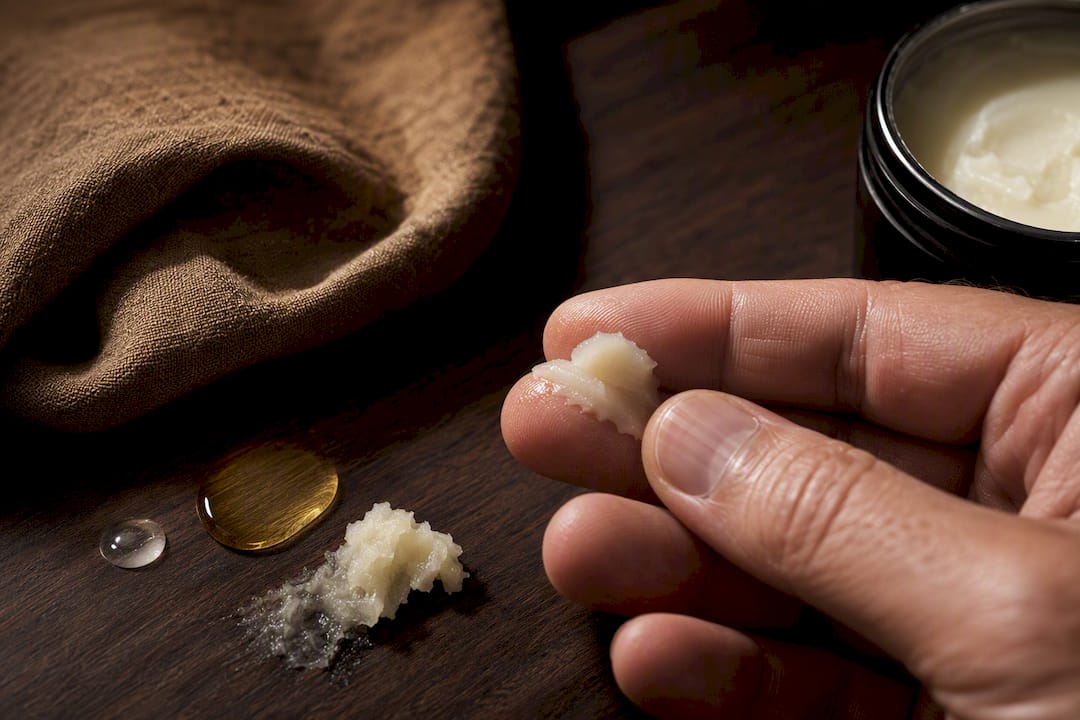
One face balm is built around three main ingredients: tallow, hyaluronic acid, and jojoba oil. That short list is the point. Fewer ingredients means fewer chances for an unexpected reaction, and it makes the label easy to actually read and understand before you buy.

The tallow supplies the occlusive, barrier-supporting fat structure described earlier, while the hyaluronic acid adds the humectant piece that pulls moisture into the skin rather than just sitting on top of it. Jojoba rounds out the formula as a lighter emollient, which helps the balm absorb without leaving the heavy, greasy film that turns a lot of men off moisturizer in general. This combination targets men dealing with dryness, fine lines, and general irritation, and is backed with a money-back guarantee.
None of this replaces a dermatologist’s advice for a diagnosed skin condition, and no balm, minimalist or not, works identically for everyone. Grass-fed tallow, while generally well tolerated, is still an animal-derived fat, and anyone with a known sensitivity to lanolin or other animal lipids should patch-test before applying it to the full face. That’s true of any new balm regardless of brand: a pea-size dab on the inner forearm, worn for a day or two, tells you more than any ingredient list can on its own.
The real problem with most “non-toxic” skincare marketing
Most of the non-toxic skincare conversation focuses on the wrong fight. Shoppers get trained to scan for scary-sounding chemical names, when the more useful habit is counting total ingredients and asking whether each one is doing something for your skin. A synthetic-sounding preservative at 0.5% in a well-tested formula is often a smaller risk than a “natural” blend of six different essential oils.
The conventional advice, “avoid parabens, avoid sulfates, buy natural,” treats every synthetic ingredient as suspect and every plant-derived one as safe. That’s backward often enough to matter: fragrance, whether synthetic or a “natural” essential oil blend, remains one of the most common causes of contact reactions, while some well-tested preservatives have decades of safety data behind them.
If you take one thing from this, prioritize ingredient count and fragrance-free formulation over chasing a “natural” or “clean” label. A balm with three or four ingredients and no added scent will serve most men better than a twelve-ingredient formula stacked with botanical extracts you can’t pronounce and haven’t tested.
— Blaine
Try a simple, three-ingredient balm built for men’s skin
If the ingredient-transparency approach above makes sense to you, One face balm is built around exactly that idea. It contains tallow, hyaluronic acid, and jojoba oil, nothing else, aimed at hydrating and repairing skin without the greasy film that makes a lot of men skip moisturizer entirely.

You can pick it up as a single purchase or set up recurring shipments so you’re not reordering every few weeks. Both options are available through the Iron Bull Naturals shop, alongside the brand’s Sun Balm for daytime protection with a similarly short ingredient list.
A few practical notes before you order:
- Patch-test on your inner forearm for a day or two before applying to your full face, especially if you have a known sensitivity to lanolin or other animal-derived fats.
- Apply to slightly damp skin after washing, using a small amount first.
- The product comes with a money-back guarantee, so trying it comes with a built-in exit if it doesn’t work for your skin.
- Pair it with a short routine rather than a long one. The simple skincare routine for men covers how to build a full morning and night routine around a single balm like this one.
If you’re tired of ingredient lists you need a chemistry degree to parse, start with the shop page and see whether a three-ingredient balm gets you the results a twelve-ingredient one hasn’t.
Sources
For anyone who wants to check the regulatory details directly, the FDA’s homemade cosmetics fact sheet and cosmetics labeling regulations cover ingredient listing and preservative rules in full. Dermatology guidance on minimalist routines for reactive skin is summarized in Harvard Health’s eczema skin-care strategies article, and moisturizer mechanics are explained in the AAD’s occlusive research summary linked above.
- Small businesses / homemade cosmetics: Fact sheet | FDA
- Take control of eczema with simple skin-care strategies | Harvard Health
FAQ
What is the least toxic facial moisturizer?
There’s no official “least toxic” ranking, since the FDA doesn’t certify cosmetics by toxicity level. The most practical approach is a fragrance-free balm with a short, transparent ingredient list, such as a simple tallow, jojoba, or beeswax formula, checked against the label-reading steps covered earlier in this article.
What is the best face cream without chemicals?
Every cosmetic ingredient, including water, tallow, and shea butter, is technically a chemical, so “without chemicals” isn’t a meaningful filter. A better standard is a minimal ingredient list with no added fragrance and nothing on it you can’t identify, which points toward simple tallow-based or single-oil balms rather than long botanical blends.
What is the best non-toxic skincare brand?
No single brand holds an official “non-toxic” certification, since that term isn’t regulated for cosmetics. Look instead at how few ingredients a brand uses and how clearly it discloses sourcing; Iron Bull Naturals, for example, builds its balm around three named ingredients rather than a long, unlabeled blend.
What is the best balm for face?
The right balm depends on your skin type: heavier, occlusive-forward balms like tallow or shea suit very dry skin, while lighter emollients like jojoba fit combination or oily skin better. Fragrance-free, short-ingredient formulas tend to work best across skin types, especially for anyone prone to irritation or eczema.
How do I know if a face balm is actually non-toxic?
Check the full ingredient panel rather than the front-label claims, since terms like “non-toxic” and “clean” aren’t defined by the FDA for cosmetics. Favor short lists, no added fragrance, and clear sourcing information, and patch-test any new product on your forearm before applying it to your face.