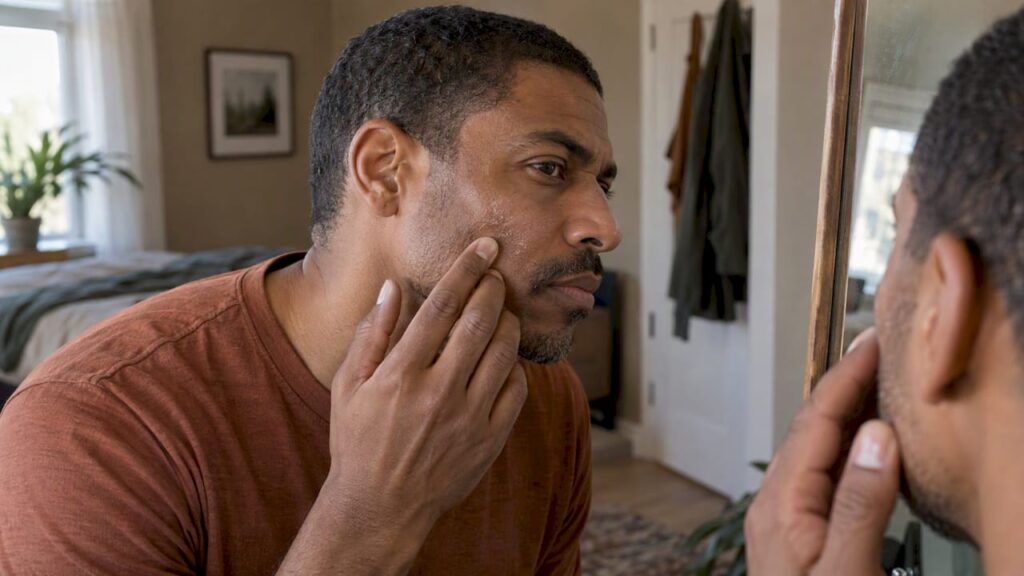


True allergic contact dermatitis from jojoba oil is uncommon, though it does happen. If you notice redness, itching, or swelling after using a jojoba product, stop using it, rinse the area with lukewarm water and a gentle cleanser, and apply a cool compress. For anything unclear or recurring, a dermatologist can confirm what’s actually going on with a patch test.
TL;DR:
- Most reactions to jojoba oil are irritant rather than allergic and typically appear within minutes to hours, remaining confined to the application area.
- True allergic contact dermatitis from jojoba is rare, usually delayed by 24 to 72 hours, and can spread beyond the initial contact site.
- Fragrance additives, preservatives, and contaminants in blended products are the most common triggers for reactions attributed to jojoba, not the jojoba itself.
- Patch testing the actual product and patch testing again after several days help identify true jojoba allergy, especially if reactions keep recurring or worsen.
- Using simplified, fragrance-free formulations with fewer ingredients can significantly reduce the risk of irritating or allergic reactions, especially for sensitive skin.
Table of Contents
- How Common Is a Jojoba Oil Reaction, and Who’s at Risk?
- Recognizing an Allergic Reaction vs. Simple Irritation
- What Actually Causes Reactions Blamed on Jojoba Oil
- How a Dermatologist Diagnoses a Jojoba-Related Reaction
- First Aid and Medical Treatment for a Reaction
- How to Patch-Test Jojoba Products at Home
- Safer Alternatives if You React or Have Sensitive Skin
- When to See a Dermatologist vs. Head to the ER
- Cross-Reactivity: Does a Jojoba Reaction Mean Other Oils Are Off-Limits?
- Living With a Jojoba Sensitivity Long Term
- Pure Jojoba Oil vs. Blended Products: Does the Formulation Matter?
- Why the “Natural Means Hypoallergenic” Myth Needs to Die
- A Simple, Three-Ingredient Option Worth Trying After You’ve Patch Tested
- Sources
- FAQ
How Common Is a Jojoba Oil Reaction, and Who’s at Risk?
Genuine allergic reactions to jojoba oil are rare. A 2021 literature review covering jojoba’s chemistry and safety found that patch tests on human subjects rarely turned up allergic reactions, with animal studies showing only mild, reversible irritation. That’s a reassuring baseline, but “rare” is not “never.” Isolated case reports of jojoba-related contact dermatitis, confirmed through patch testing, show that a small subset of people do react.
Some people are simply more prone to skin reactions in general, and jojoba oil is not an exception to that pattern. A few factors raise your odds:
- A history of multiple contact allergies (dermatologists sometimes call this being “hyperallergic”)
- A compromised skin barrier from eczema, psoriasis, recent sunburn, or over-exfoliation
- Repeated occupational exposure, such as working daily with jojoba-based massage oils or cosmetic formulations
- Sensitivity to fragrances or preservatives blended into the jojoba product, rather than the oil itself
One detail catches a lot of people off guard: tolerance isn’t permanent. The American Academy of Dermatology notes that skin can become sensitized to an ingredient after months or years of trouble-free use. If a product you’ve used for a year suddenly starts causing irritation, that’s not necessarily a coincidence tied to a “bad batch.” Your immune system may have simply changed its mind about an ingredient it once tolerated.
This is part of why dermatologists are cautious about blanket claims that any natural oil is universally safe for everyone, indefinitely. Jojoba’s safety profile is strong on the population level. On the individual level, your skin gets the final vote.
Recognizing an Allergic Reaction vs. Simple Irritation
Not every red, itchy patch after applying jojoba oil is an allergy. Most reactions people blame on an allergy are actually irritant contact dermatitis, a nonimmune response that happens when a substance simply irritates the skin’s surface. Distinguishing the two matters because they call for different responses.
Irritant contact dermatitis shows up fast, often within minutes to a few hours of application, and stays confined to exactly where the product touched. Allergic contact dermatitis takes longer to appear, typically 24 to 72 hours after exposure, and can spread beyond the application site as your immune system mounts a broader response. This delayed, spreading pattern is one of the clearest clinical clues that distinguish true allergy from irritation.
Watch for these local symptoms, which can appear with either type of reaction:
- Redness or a rash that looks like sunburn or hives
- Itching that ranges from mild to intense
- Swelling, especially around the eyes if the product migrated there
- Small blisters or oozing skin
- Scaling or dry patches that persist for days after you stop the product
Most reactions stay mild and local. But a small minority escalate into something that needs emergency treatment. Roughly speaking, the line between “call your dermatologist this week” and “go to the ER now” comes down to whether the reaction stays on your skin or starts affecting your airway and whole body.
Signs that mean you should head to an emergency room immediately: swelling of the tongue, lips, or throat; difficulty breathing or swallowing; hives that spread rapidly across large areas of your body; dizziness or a feeling of your throat closing. These symptoms suggest a systemic allergic response, not just localized dermatitis, and they can progress quickly.
What Actually Causes Reactions Blamed on Jojoba Oil
Jojoba is a seed, not a tree nut. Botanically, jojoba comes from the seeds of Simmondsia chinensis, a desert shrub, and what’s extracted from it isn’t technically an oil at all. It’s a liquid wax ester, chemically distinct from the triglyceride oils in almonds, cashews, or walnuts. There’s no established medical evidence of cross-reactivity between jojoba and tree-nut allergies, because the proteins responsible for nut allergies aren’t present in refined jojoba wax in the same way.
That distinction matters for anyone who assumes a nut allergy automatically rules out jojoba oil. It doesn’t work that way, though anyone with a serious nut allergy history should still patch test rather than assume.
So if intrinsic sensitization to refined jojoba is genuinely uncommon, what’s causing the reactions people do experience? A few likely culprits show up again and again in clinical guidance:
- Fragrance additives. The AAD identifies fragrances as one of the most frequent triggers in cosmetic contact dermatitis, and jojoba products are routinely scented.
- Preservatives. Parabens, formaldehyde releasers, and other stabilizers added to extend shelf life are common allergens in their own right.
- Oxidation byproducts. Jojoba oil is unusually stable and resistant to rancidity compared with many plant oils, but any oil that has degraded or been stored improperly can develop irritating byproducts.
- Contaminants from processing. Unrefined or poorly processed batches may carry residual plant material that refined jojoba wax does not.
- Other blended botanicals. Multi-ingredient serums and lotions often combine jojoba with several other active ingredients, any of which could be the actual trigger.
This is the single most useful mental model if you’re trying to figure out what happened to your skin: the jojoba itself is probably innocent. The fragrance, preservative, or “and 14 other ingredients” sitting next to it on the label is the more likely suspect. If you want a deeper look at how jojoba behaves in different formulations, Iron Bull Naturals’s guide to jojoba oil for men breaks down where it typically shows up in grooming products.
How a Dermatologist Diagnoses a Jojoba-Related Reaction
If your reaction doesn’t resolve quickly, or if it keeps coming back with different products, a professional evaluation gives you a real answer instead of a guess.
1. History first. Your dermatologist or allergist will ask what products you used, when the reaction started relative to application, whether you’d used the product before without issue, and whether the rash stayed localized or spread. Bring the actual product, not just its name. The AAD’s testing guidance specifically recommends brining the full item, packaging included, because many contact allergens are proprietary fragrance blends or preservatives that don’t appear on standard test panels.
2. Patch testing. This is the diagnostic standard for allergic contact dermatitis. Small amounts of suspected allergens, applied in adhesive patches, are placed on your back and left undisturbed for 48 hours, then read again at 72 to 96 hours, since allergic responses are often delayed. A positive reaction shows up as localized redness, swelling, or small blisters exactly where that specific allergen touched your skin.
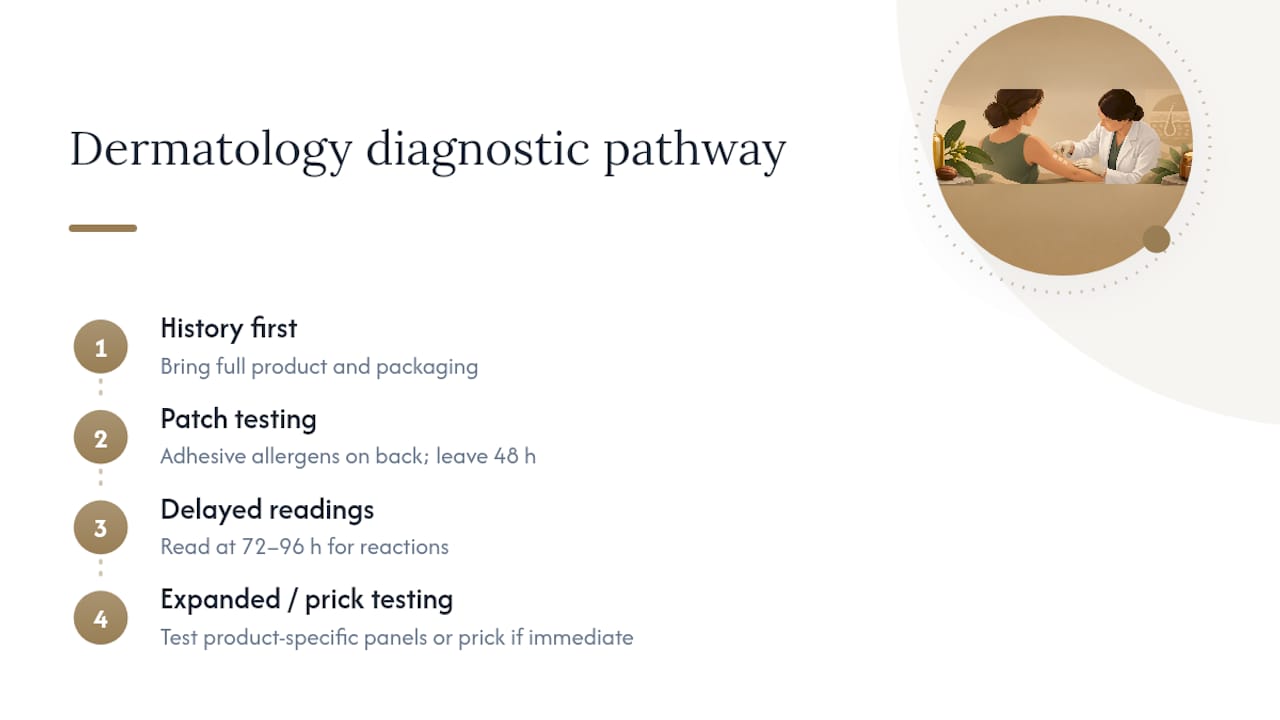
3. Expanded or product-specific panels. Standard patch test panels cover common allergens but frequently miss ingredients unique to a specific cosmetic formula. When jojoba oil is a suspect, your dermatologist may test the product itself alongside standard trays, which is part of why bringing the physical bottle matters.
4. Prick testing, in specific cases. If your reaction pattern suggests an immediate, IgE-mediated response (hives within minutes, for example) rather than delayed contact dermatitis, a prick test may be used instead. This is far less common for jojoba-related reactions, which typically follow the delayed contact-dermatitis pattern.
A positive patch test result to jojoba or to a specific additive gives you something concrete to work with: an ingredient to avoid and a defensible reason to skip similar products going forward. A negative result doesn’t always mean you’re in the clear, since standard panels can miss proprietary mixtures, but it does help rule out the most likely allergens.
Pro Tip: Take a photo of any reaction as it develops, with a timestamp, before you treat it. Dermatologists rely heavily on how a rash looked and how quickly it changed, and a photo timeline is often more useful to them than your memory of “it looked kind of red.”
First Aid and Medical Treatment for a Reaction
The moment you notice a reaction, stop using the suspected product entirely. Continuing to apply it “to see if it gets better” is the most common mistake people make, and it usually makes things worse.
Here’s the practical sequence to follow:
- Wash the area gently with a mild, fragrance-free cleanser and lukewarm water. Avoid hot water, which can worsen irritation.
- Apply a cool, damp compress for 15 to 20 minutes to calm redness and itching.
- For mild dermatitis, over-the-counter 1% hydrocortisone cream applied thinly to the affected area can reduce inflammation.
- An oral antihistamine, such as diphenhydramine or a non-drowsy option like cetirizine, can control itching and any accompanying hives.
- Keep the area moisturized with a plain, fragrance-free product once the acute reaction calms, since a damaged skin barrier heals more slowly if left dry.
Most localized reactions improve within a few days using this approach, as outlined in general consumer safety guidance on jojoba oil. If the rash is widespread, doesn’t improve after several days of home care, or keeps recurring, it’s time to see a dermatologist rather than keep cycling through hydrocortisone. Persistent or severe cases sometimes need a prescription-strength topical steroid or, in more serious instances, a short course of oral steroids.
Pro Tip: Skip the temptation to “tough it out” with a slightly milder version of the same product. If your skin reacted to a jojoba blend, switching to a different jojoba product from a different brand doesn’t reset anything. The allergen, whether it’s jojoba or something blended with it, is still the same category of ingredient.
Emergency thresholds are non-negotiable. Call 911 or go to the nearest ER if you experience swelling of the lips, tongue, or throat, any difficulty breathing or swallowing, rapidly spreading hives, or dizziness and lightheadedness. These are signs of a systemic reaction, and they require immediate medical attention rather than home treatment.
How to Patch-Test Jojoba Products at Home
A simple home patch test before committing to a new jojoba-based product catches most problems before they become a face-wide rash. Here’s a straightforward method:
- Pick a discreet test site. The inner forearm or behind the ear works well, since both are easy to monitor and rarely visible if something goes wrong.
- Apply a small amount. Use about the size of a dime, undiluted, directly to clean, intact skin. Don’t test on broken, sunburned, or freshly exfoliated skin, since compromised skin barriers react more easily and can give a false positive.
- Leave it uncovered. You don’t need to occlude the area with a bandage for a basic home test; visibility helps you monitor it easily.
- Wait and observe. Check the site at 24 hours and again at 72 hours, since allergic reactions are often delayed rather than immediate.
- Record what you see. Note redness, swelling, itching, or blistering, and take a photo with the date. This record becomes useful if you need to describe the reaction to a dermatologist later.
- Escalate if needed. If the area shows real redness, swelling, or blistering, don’t apply the product elsewhere. If the reaction is significant or doesn’t resolve within a few days, seek professional patch testing instead of repeating home trials with similar products.
Professional testing is the better route if you’ve already had a widespread or severe reaction, if you’re testing because of repeated occupational exposure, or if a home test result is genuinely ambiguous. When shopping for jojoba products in general, favor fragrance-free formulations with a short, recognizable ingredient list. The more additives in a bottle, the harder it is to know which one your skin actually objects to.
Safer Alternatives if You React or Have Sensitive Skin
If jojoba oil consistently causes irritation, or if you’d rather avoid the guesswork altogether, look for products built around fewer, simpler ingredients. Basic emollients and occlusives like petrolatum, glycerin, and straightforward ceramide-based formulas have long track records of low sensitization risk, largely because there’s less in the formula to react to.
A few practical rules for choosing a replacement:
- Favor single-ingredient or near-single-ingredient products over long ingredient lists.
- Skip anything with added fragrance, even “natural” fragrance, since botanical fragrance compounds are still common allergens.
- Look for formulas positioned as dermatologist-tested or hypoallergenic, and still patch test them anyway.
- Compare oils directly when you’re unsure. Jojoba oil and squalane have different molecular structures and different irritation profiles, which is worth understanding if jojoba specifically gave you trouble.
Fewer ingredients means fewer variables. That’s the entire logic behind minimal-formula skincare, and it’s worth applying to whatever replaces your jojoba product.
When to See a Dermatologist vs. Head to the ER
Emergency signs deserve repeating on their own, because they’re the ones that matter most: facial or throat swelling, breathing difficulty, rapidly spreading hives, or dizziness after using a jojoba product. Any of these means calling 911 or getting to an emergency room without delay. Don’t wait to see if it passes.
Outpatient dermatology care is the right call for anything short of that. Reasons to book an appointment include a rash that hasn’t improved after several days of home care, a reaction that keeps recurring with different products, or uncertainty about whether you’re dealing with irritation or true allergy. Expect the visit to include a history review, possibly a patch test scheduled over several days (given the 48 to 96 hour reading window), and a treatment plan tailored to what’s found.
If your exposure is occupational, ask your dermatologist for documentation. A confirmed diagnosis and written recommendation can support a request for workplace accommodations, such as switching products or wearing protective gloves during tasks that involve repeated jojoba contact.
Cross-Reactivity: Does a Jojoba Reaction Mean Other Oils Are Off-Limits?
Cross-reactivity concerns come up often, especially from people wondering whether a jojoba reaction means they need to avoid an entire category of plant-derived oils. The honest answer is that jojoba’s cross-reactivity profile isn’t well established in the medical literature, largely because true jojoba allergy itself is uncommon enough that large-scale cross-reactivity studies don’t really exist.
What is clear is the botanical distinction. Because jojoba is a seed-derived wax ester rather than a triglyceride oil, it doesn’t share the same protein structures as tree nuts, so a tree-nut allergy doesn’t automatically predict a jojoba reaction, and vice versa. That said, if you react to jojoba and also use other botanical oils in your routine, most of the time the shared culprit is a fragrance compound or preservative common to both products, not a structural similarity between the oils themselves.
If you’ve had a confirmed jojoba reaction, the more useful next step isn’t avoiding all plant oils on principle. It’s asking your dermatologist to test the other products in your routine that share ingredients, particularly fragrance and preservative systems, since that’s where the real overlap tends to live.
Living With a Jojoba Sensitivity Long Term
A confirmed jojoba allergy doesn’t mean giving up on skincare, but it does mean reading labels more carefully than most people ever have to. Once you know jojoba (or, more likely, a specific additive in jojoba products) is a trigger, the management strategy is mostly about avoidance and having a plan ready for accidental exposure.
Keep a written or phone-stored list of confirmed allergens from your patch test results, since ingredient names vary across brands and it’s easy to miss “Simmondsia chinensis seed oil” buried in a long list if you’re not looking for it specifically. Some people find it useful to photograph the ingredient panel of any new product before buying, then check it against their allergen list at home.
For ongoing flare-ups, dermatologists sometimes recommend keeping a low-dose topical steroid on hand for occasional accidental exposure, along with an antihistamine for itching. If your reactions have ever been severe or systemic, ask your doctor whether carrying an epinephrine auto-injector is appropriate, particularly if you have a broader history of significant allergic reactions.
The good news is that once the actual trigger is identified through testing, most people manage a jojoba sensitivity easily by simply choosing different products. It’s a much narrower problem than it feels like in the moment.
Pure Jojoba Oil vs. Blended Products: Does the Formulation Matter?
Reaction risk isn’t uniform across every jojoba product on the market, and the formulation matters more than people usually assume. Pure, cold-pressed or refined jojoba oil, used on its own, carries the low sensitization risk described in the research: rare in human patch testing, mild and reversible in animal studies. That’s the cleanest version of the risk profile.
Blended products change the picture. A face cream, serum, or multi-oil blend that includes jojoba alongside a dozen other active ingredients, preservatives, and fragrance compounds introduces far more variables. If you react to a blended product, there’s no way to know from that experience alone whether jojoba was actually responsible, since it’s just as likely to be the preservative system or the fragrance.
This is part of why patch testing the actual product matters more than testing “jojoba” as a generic category. It’s also why, if you’ve reacted to a jojoba-containing cosmetic, it’s worth trying a pure, single-ingredient jojoba oil under professional guidance before writing off jojoba entirely. Some people who react to a heavily fragranced jojoba lotion tolerate plain jojoba oil without issue, because the oil was never the actual trigger.
Why the “Natural Means Hypoallergenic” Myth Needs to Die
The most persistent misconception in this whole conversation is the idea that “natural” and “hypoallergenic” are the same thing. They aren’t, and treating them as interchangeable is how a lot of people end up blaming an innocent oil for a reaction actually caused by fragrance or a preservative three ingredients down the label.
Jojoba oil earns its reputation as one of the gentler options in skincare honestly. The research backs that up. But gentle on average isn’t the same as safe for everyone, and the responsible way to use any new skincare ingredient, natural or otherwise, is to test it on a small patch of skin before trusting it on your face. That’s not caution for caution’s sake. It’s the same logic dermatologists apply professionally, just scaled down to something you can do at your kitchen sink.
What frustrates me most about how this topic usually gets covered online is the false binary: either jojoba oil is universally safe, or it’s a hidden allergen everyone should fear. Neither framing is honest. The real answer is boring and specific: it’s low risk, well-documented, and worth testing anyway, because “low risk” isn’t “no risk,” and your skin doesn’t care about population statistics when it’s the one having the reaction.
If you’re drawn to simpler formulas partly because fewer ingredients means fewer unknowns, that instinct is sound. It’s the same reasoning behind minimal-ingredient moisturizers gaining ground with men who got tired of ingredient lists they can’t pronounce and don’t trust.
— Blaine
A Simple, Three-Ingredient Option Worth Trying After You’ve Patch Tested
If jojoba oil (or, more likely, something blended with it) has caused you trouble, the fix isn’t necessarily giving up on moisturizing your face. It’s finding a formula with fewer places for a hidden allergen to hide. Iron Bull Naturals built its tallow face moisturizer around exactly that idea: grass-fed Alberta tallow, hyaluronic acid, and jojoba oil, three ingredients total, with no added fragrance and no long list of stabilizers to sort through.

That three-ingredient approach doesn’t eliminate the need for caution. Jojoba oil is one of the components, so if you’ve had a confirmed jojoba reaction specifically, patch test this product the same way you’d patch test anything else, and check with your dermatologist first if you’ve ever had a severe reaction to jojoba or its close relatives. But for the much larger group of men whose skin simply reacts to overloaded ingredient lists, fragrance blends, and preservative systems, a formula this stripped down removes most of the usual suspects before they ever touch your face.
The product is backed with a money-back guarantee, so testing it on your own skin doesn’t carry the usual risk of a wasted purchase if it’s not the right fit. Visit the Iron Bull Naturals shop to see the full lineup, including the tallow moisturizer and the mineral sun balm, and start with a small patch on your forearm before committing to daily use on your face.
Sources
- Jojoba Oil: An Updated Comprehensive Review on Chemistry, Pharmaceutical Uses, and Toxicity (PMC)
- Contact Dermatitis: A Practice Parameter‑Update (AAAAI)
- Patch testing can find what’s causing your rash (AAD)
- Drugs
This article is general information, not a substitute for advice from a qualified doctor. Consult a qualified healthcare professional about your own circumstances before acting on anything here.
FAQ
Is jojoba a nut or a seed?
Jojoba is a seed, not a nut. It comes from the seeds of the Simmondsia chinensis shrub, and what’s extracted is a liquid wax ester rather than a true oil, which is structurally different from tree-nut oils.
Why does jojoba oil make me itchy?
Itching after using a jojoba product is usually irritant contact dermatitis, not a true allergy, and often traces back to a fragrance or preservative blended into the product rather than the jojoba itself. True allergic reactions are documented but uncommon, so persistent itching is worth investigating with a patch test rather than assuming it’s the jojoba.
How many people are allergic to jojoba oil?
There’s no widely cited population-level allergy rate for jojoba oil, and the available research points to it being uncommon rather than measured at a specific percentage. A 2021 literature review found patch tests rarely turned up allergic reactions in human subjects, with occasional case reports on record.
Can you use jojoba oil if you’re allergic to nuts?
Likely yes, since jojoba is a seed-derived wax ester and not a tree nut, and there’s no established medical evidence of cross-reactivity between the two. If you have a severe nut allergy, patch testing jojoba oil first is still the safer approach before applying it broadly.
Is jojoba oil hypoallergenic?
Jojoba oil is often described as low in allergenic potential, but “hypoallergenic” doesn’t mean zero risk for every person. It’s one of the gentler options in skincare, backed by low sensitization rates in patch testing, though a small number of people still react, usually to a fragrance or preservative rather than the jojoba itself.
What’s the difference between contact dermatitis from jojoba oil and a true allergy?
Irritant contact dermatitis shows up quickly and stays where the product touched, while true allergic contact dermatitis is delayed, usually appearing 24 to 72 hours later, and can spread beyond the application site. A dermatologist can tell the difference with a patch test.