


Yes, sun-damaged skin in men can often be improved, but not completely undone. Visible damage like rough texture, fine lines, and dark spots responds to treatment, while the deeper DNA changes that caused it are permanent. The single most important first step is starting daily broad-spectrum SPF 30+ and getting any scaly, sandpaper-like patch checked for actinic keratosis before it progresses. From there, most men build a plan around tretinoin or another retinoid, sometimes paired with an in-office procedure for deeper spots or wrinkles.
Your next move depends on how much damage you’re dealing with:
- See a dermatologist if you notice a spot that’s changed color, bled, or hasn’t healed in a few weeks.
- Start a slow topical program (retinoid first, then vitamin C and exfoliating acids) if you’re dealing with texture and early pigmentation.
- Ask about in-office procedures like chemical peels or laser resurfacing if you have deep wrinkles, thickened skin, or spots that topicals haven’t touched after a few months.
Key Takeaways
Sun damage in men can be meaningfully improved with consistent SPF, the right topicals, and professional treatment for deeper changes, but the underlying DNA damage never fully disappears.
| Point | Details |
|---|---|
| Start with SPF and a checkup | Daily broad-spectrum SPF 30+ plus a dermatologist evaluation of any scaly or non-healing patch comes first. |
| Match treatment to damage depth | Topicals fix texture and mild pigmentation; procedures handle deep wrinkles and thickened skin. |
| Watch actinic keratoses closely | Untreated AKs have a risk of progression to squamous cell carcinoma that requires medical assessment. |
| Introduce actives slowly | Start with a retinoid two to three nights weekly before adding vitamin C or AHAs to avoid irritation. |
| Simplify to stay consistent | Iron Bull Naturals’ tallow moisturizer and sun balm cover hydration and protection in two easy steps. |
Table of Contents
- Signs of Sun-Damaged Skin in Men and Where They Show Up
- Can Topical Treatments Reverse Sun Damage, or Do You Need a Procedure?
- A Simple AM/PM Skincare Routine for Men With Sun Damage
- In-Office Treatments for Moderate to Severe Sun Damage
- When Sun Spots and Rough Patches Need a Doctor, Not a Moisturizer
- How Long It Takes to See Results
- How to Introduce Retinoids, Vitamin C, and AHAs Without Wrecking Your Skin
- Why Men’s Skin Ages Differently From Sun Exposure
- The Psychological Weight of Sun Damage and How Men Actually Cope
- Where Iron Bull Naturals Fits Into a Men’s Sun-Damage Routine
- Sources
- FAQ
Signs of Sun-Damaged Skin in Men and Where They Show Up
Sun damage on men’s skin doesn’t show up as one thing. It’s a collection of changes that build over decades of unprotected exposure, and most men have several of them at once without realizing it’s all one problem.
The common signs include fine lines and wrinkles (especially around the eyes and forehead), leathery or rough texture, brown patches known as solar lentigines or age spots, and small red spider veins called telangiectasia. Some men also develop white spots called idiopathic guttate hypomelanosis, usually on the shins or forearms. The one that matters most medically is the actinic keratosis: a dry, rough, sandpapery patch that feels different than it looks, often on the scalp, ears, or backs of the hands.
Men tend to carry damage in a specific pattern: forehead, nose bridge, tips of the ears, back of the neck, and a bald or thinning scalp. These are the spots that get the most direct sun and the least product attention. Forearms and the backs of hands take a beating too, especially for men who drive, golf, or work outdoors.
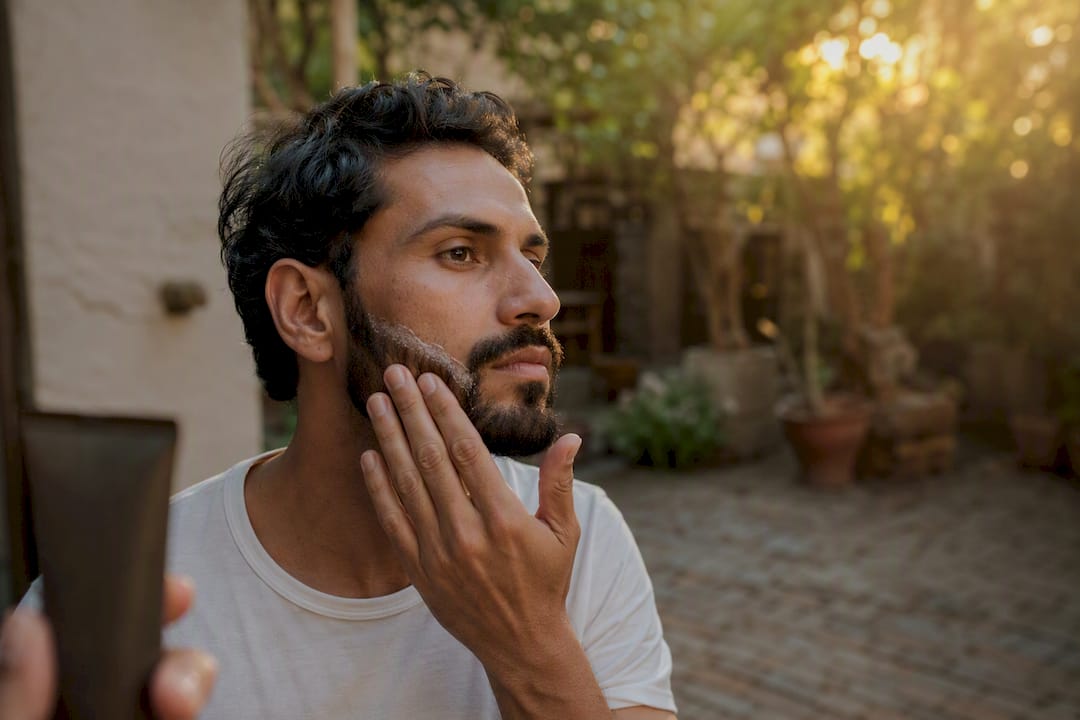
Pro Tip: If you have a beard or mustache, sunscreen tends to pool at the edges instead of absorbing into the hair-covered skin underneath. Use a lightweight, non-greasy formula and rub it in against the grain, then use a spray or stick for the scalp and part line where a beard doesn’t offer any coverage.
Any spot that bleeds, changes shape or color quickly, or won’t heal after several weeks needs a professional look, not a wait-and-see approach.
Can Topical Treatments Reverse Sun Damage, or Do You Need a Procedure?
The honest answer splits into two categories. Topicals do real work on surface-level changes: rough texture, fine lines, and some pigmentation respond well to consistent use of the right ingredients over weeks to months. Deep wrinkles, significant skin laxity, and thickened leathery patches usually need something stronger than a cream.
Prescription tretinoin is the best-studied topical for reversing photoaging. It’s often the starting point dermatologists recommend before layering in vitamin C or exfoliating acids. For deeper correction, procedures like laser resurfacing or chemical peels stimulate collagen production in ways a topical alone can’t match.
What responds to what:
- Topicals: fine lines, rough texture, mild to moderate pigmentation, dullness
- Procedures: deep wrinkles, significant skin laxity, thickened or leathery patches, stubborn dark spots
- Both together: most real-world cases, since topicals maintain what procedures achieve
A notable share of untreated actinic keratoses can progress to squamous cell carcinoma, which is why a scaly patch that doesn’t respond to moisturizer needs a dermatologist’s eyes, not a skincare aisle guess.
That risk figure comes from research on UV damage and skin cancer progression, and it’s the reason self-diagnosis has limits here. Board-certified dermatologists combine topical and procedural treatments specifically because certain lesions need medical evaluation before anyone reaches for a retinoid.
A Simple AM/PM Skincare Routine for Men With Sun Damage
You don’t need twelve steps. You need the right four or five, done consistently, in the right order.
- AM: Cleanse. A basic gel or foam cleanser removes overnight oil buildup without stripping skin.
- AM: Apply a vitamin C serum. Vitamin C is an antioxidant that helps defend against daytime UV exposure and gradually brightens existing dark spots.
- AM: Moisturize if needed. A lightweight, hyaluronic-acid-based moisturizer helps hold water in skin that sun exposure has already dried out.
- AM: Apply broad-spectrum SPF 30+ and reapply. Cover ears, neck, and any bald scalp area, and reapply every two hours if you’re outside for extended periods.
- PM: Cleanse, then apply a retinoid. Tretinoin (prescription) or retinol (over-the-counter) goes on clean, dry skin at night, since both increase sun sensitivity.
- PM: Moisturize. Retinoids can be drying at first, so a rich but non-greasy tallow-based moisturizer helps offset flaking while you build tolerance.
Add an alpha-hydroxy acid like glycolic acid one to two times a week once your skin tolerates the retinoid, never stacked on the same night.
Pro Tip: If you hate multi-step routines, the minimum that actually moves the needle is cleanse, treat (retinoid at night or vitamin C in the morning), and protect. Everything else is optional polish.
In-Office Treatments for Moderate to Severe Sun Damage
When home care stalls, procedures pick up the slack. Each one targets a different layer or type of damage, and matching the right tool to the right problem matters more than picking the most aggressive option available.
Cryotherapy freezes individual actinic keratoses off, usually in a five-minute office visit with minimal downtime, and it’s often the first response to a suspicious rough patch. Chemical peels use acids at varying strengths to remove damaged surface layers, improving tone and mild texture issues over a series of sessions. Microdermabrasion physically exfoliates the outer skin layer for a quick texture refresh with essentially no recovery time.

For more stubborn discoloration, IPL (intense pulsed light) targets pigmented spots and broken capillaries without ablating the skin surface. Fractional lasers go deeper, creating controlled micro-injuries that trigger collagen remodeling over several weeks. CO2 ablative laser resurfacing is the most intensive option, removing entire layers of damaged skin for significant improvement in deep wrinkles and severe sun damage, at the cost of a week or more of visible recovery.
Microneedling and injectables like fillers or Botox aren’t direct sun-damage treatments, but dermatologists often use them alongside resurfacing to address volume loss and dynamic wrinkles that photoaging accelerates.
| Procedure | Downtime | Typical sessions | Best for |
|---|---|---|---|
| Cryotherapy | Minimal | 1 per lesion | Individual actinic keratoses |
| Chemical peel | 3–5 days | 3–6 | Texture, mild pigmentation |
| Microdermabrasion | None | Multiple | Surface refresh, dullness |
| IPL | 1–2 days | 3–5 | Spots, redness, capillaries |
| Fractional laser | 3–5 days | 2–4 | Fine lines, moderate texture |
| CO2 ablative laser | 1–2 weeks | 1–2 | Deep wrinkles, severe damage |
Choose a board-certified dermatologist for any of these, and ask for a full skin check before scheduling. Dermatologists routinely combine resurfacing with a topical maintenance plan because procedures reset the skin but don’t prevent new damage from accumulating.
When Sun Spots and Rough Patches Need a Doctor, Not a Moisturizer
Most sun damage is cosmetic. Some of it isn’t, and knowing the difference protects more than your appearance.
Get evaluated promptly for any patch that’s scaly and won’t clear up, bleeds without an obvious cause, or has a mole or spot that’s changed size, shape, or color over a few weeks or months. New nodules or sores that don’t heal within a month deserve the same urgency.
For screening cadence, check your entire skin surface every one to two months at home. See a dermatologist at least once a year, or twice a year if you already have multiple actinic keratoses or a history of significant sun exposure (think decades of outdoor work, farming, construction, or competitive sports).
A rough patch that feels like sandpaper but looks unremarkable is exactly the kind of thing men dismiss for months. That delay is the actual risk, not the spot itself.
If you take medication for blood pressure, acne, or several other common conditions, mention it during your visit. Some prescriptions increase photosensitivity, which changes both your sunburn risk and how your skin responds to certain in-office treatments.
How Long It Takes to See Results
Patience matters here more than most men expect walking in.
- Topical retinoids: initial texture changes in 4 to 6 weeks, meaningful improvement in pigmentation and fine lines over 3 to 6 months
- Vitamin C: brightening effects typically appear in 4 to 12 weeks of consistent morning use
- AHAs: visible texture improvement within several weeks of regular, low-frequency use
- Chemical peels and lasers: changes become visible after the healing period, often requiring multiple sessions spaced weeks apart for full results
Home care is a slower, steadier climb. Procedures deliver faster, more dramatic single-session change but come with recovery time and cost. Track progress with monthly photos taken in the same lighting, and give any new product or protocol at least eight weeks before deciding it isn’t working.
How to Introduce Retinoids, Vitamin C, and AHAs Without Wrecking Your Skin
Most men who quit on active ingredients didn’t fail because the product doesn’t work. They started too many, too fast, and their skin revolted before results had a chance to show.
- Start with a retinoid two to three nights a week. Whether it’s prescription tretinoin or over-the-counter retinol depends on what your dermatologist recommends or what you can access.
- Build to nightly use over 4 to 6 weeks once your skin tolerates the initial frequency without excessive flaking.
- Add vitamin C in the morning only after your nighttime routine is stable, layering it under moisturizer and SPF.
- Introduce an AHA like glycolic acid once or twice a week, never on the same night as your retinoid.
Watch for redness that doesn’t fade by morning, persistent flaking, or stinging that lasts more than a few minutes after application. Those are signs to back off to every other night, not push through.
Concurrent, aggressive introduction of multiple actives is the single most common reason men give up on a routine that would have worked fine if it had been paced correctly.
Men with darker skin tones should move especially slowly with exfoliating acids and lightening agents, since irritation can trigger post-inflammatory pigmentation that’s harder to treat than the original sun damage. A dermatologist’s input matters more here, not less.
Why Men’s Skin Ages Differently From Sun Exposure
Men’s skin is roughly 25 percent thicker than women’s skin on average, with a denser collagen structure and more oil-producing glands. That extra thickness delays the appearance of fine lines, which is part of why men often notice sun damage later than women do, even with equivalent lifetime exposure.
The delay isn’t a shield. Men’s skin also loses collagen more suddenly rather than gradually, so damage that stayed hidden for years can appear to arrive all at once in the late 30s and 40s. The daily habit of shaving adds mechanical exfoliation that changes how topicals absorb and how quickly the skin barrier recovers from irritation.
Men also produce more sebum, which affects product texture preferences and explains why heavy, occlusive creams often feel intolerable while lighter, fast-absorbing formulas get used consistently. That’s a real factor in treatment outcomes: a product that sits in a bathroom cabinet unused doesn’t help anyone, regardless of its ingredient list.
Testosterone-driven skin thickness also changes how deep resurfacing procedures need to go to achieve the same result a thinner-skinned patient would see from a lighter treatment. Dermatologists sometimes adjust laser settings or peel strength specifically for that reason, which is one more argument for working with someone experienced in treating men rather than assuming identical protocols apply across the board.
The Psychological Weight of Sun Damage and How Men Actually Cope
Sun damage carries an emotional cost that gets less attention than the physical one, partly because men are less likely to talk about it.
Visible aging, especially when it arrives faster than expected, connects to real feelings about masculinity, vitality, and how a man is perceived at work or in relationships. Men who spent years outdoors for work or hobbies sometimes feel a strange mix of pride and regret: the tan and the texture came from a life they don’t regret living, but the mirror tells a harder story than they expected.
The coping pattern that works best isn’t denial or overcorrection. It’s a realistic middle ground: understanding that some damage is permanent, some is treatable, and taking action on the treatable part restores a sense of control that waiting around never provides. Men who start even a basic routine, whether that’s daily SPF or a first dermatologist visit, tend to report less anxiety about their skin within a few months, not because the skin transforms overnight but because they’ve stopped feeling passive about it.
Talking to a dermatologist also reframes the problem. A professional assessment usually separates the alarming from the cosmetic, and that clarity alone reduces the low-grade worry that comes with not knowing whether a spot is dangerous or just cosmetic.
Why a simple, consistent approach beats a complicated one
Men respond better to skincare when it’s framed as maintenance, not vanity. A three-step routine done every day beats a ten-step routine done twice a month, and starting with a dermatologist check removes the guesswork before you spend money on the wrong products.
Where Iron Bull Naturals Fits Into a Men’s Sun-Damage Routine
You don’t need a bathroom shelf full of products to protect and repair sun-damaged skin. You need a handful of things that actually work, applied consistently, and Iron Bull Naturals built its lineup around exactly that principle.

The routine outlined above depends on two things doing their job well: hydration that doesn’t feel greasy, and protection that doesn’t get skipped because it’s a hassle to apply. Iron Bull Tallow, made from grass-fed Alberta tallow and hyaluronic acid, was formulated specifically to restore the moisture sun-damaged skin loses without leaving residue on your hands, collar, or pillowcase. For daytime protection, the tallow-based sun balm covers the mineral SPF layer with the same non-greasy approach, which matters most for the guys who currently skip sunscreen because every option they’ve tried feels heavy or leaves a white cast.
Three ingredients, no filler, hypoallergenic enough for sensitive and post-procedure skin. If you’re ready to simplify your routine to the essentials that back the plan above, start with the three-step daily routine and build from there.
Sources
- Beyond the burn: What UV radiation does to your skin — UAB Medicine
- How dermatologists treat sun-damaged skin — American Academy of Dermatology (AAD)
- Sun-damaged skin — Harvard Health
- Five ways to reverse signs of sun damage — Ohio State Wexner Medical Center
- Age spots — Mayo Clinic
This article is general information, not a substitute for advice from a qualified doctor. Consult a qualified healthcare professional about your own circumstances before acting on anything here.
FAQ
Can sun-damaged skin be fixed?
Visible signs like texture, fine lines, and pigmentation can be significantly improved with retinoids, vitamin C, and procedures like laser resurfacing, though the DNA-level damage that caused them is permanent.
Is it too late to fix sun-damaged skin?
It’s rarely too late to see meaningful improvement, since even long-standing texture and pigmentation issues respond to consistent treatment, though results take months rather than weeks for established damage.
How long does it take for skin to heal from sun damage?
Topical treatments typically show initial results in 4 to 12 weeks, while procedures like chemical peels or laser resurfacing show visible improvement after the healing period, often over multiple sessions spaced weeks apart.
How can I tell if my skin is sun-damaged?
Look for rough, sandpaper-like patches, brown spots, fine lines concentrated on the forehead and around the eyes, and visible broken capillaries, especially on the nose, ears, and neck.
What’s the simplest way to start treating sun damage?
Begin with daily broad-spectrum SPF 30+, a consistent hydrating moisturizer like Iron Bull Naturals’ tallow balm, and a low-frequency retinoid at night before adding other actives.


