

Face chafing on a run is friction plus sweat: a hat band, sunglasses, a buff or your own stubble rubs the same patch of skin for miles until it turns red and stings. Prevention is simple. Cut the rubbing, keep the skin from staying wet and salty, and put a thin barrier on the contact points before you head out. If it has already happened, wash gently, protect the skin and give it a few days off from whatever caused it.
TL;DR
- Chafing is irritation from repeated rubbing, and sweat, heat and humidity make it worse.
- On the face, the usual culprits are hat bands, sunglasses pads, masks, neck gaiters, chin straps and stubble.
- Prevent it with smooth, moisture-wicking gear that fits, plus a thin barrier on contact points, tested before race day.
- Treat it by washing gently, patting dry and protecting the skin. Minor cases usually clear up within a few days.
- See a healthcare provider if it worsens, doesn’t improve in a few days, or looks infected.
Table of Contents
- What face chafing actually is
- Why sweat makes it worse
- Where runners get chafed on the face
- How far until it starts?
- How to prevent face chafing on runs
- How to treat chafed facial skin after a run
- When to stop running and see a doctor
- Aftercare that keeps skin ready for the next run
- Our balm for the run-to-recovery routine
- Our perspective on runner’s skin
- FAQ
- Sources
What face chafing actually is
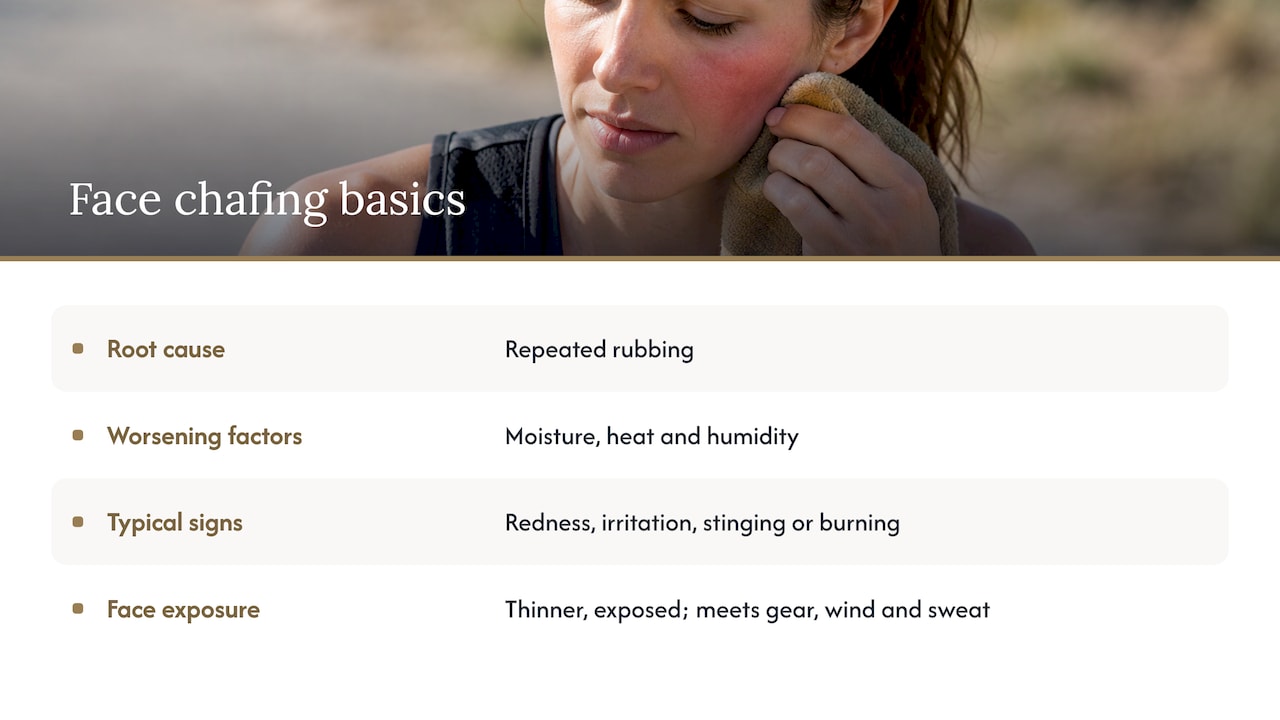
Chafing is skin irritation caused by repeated rubbing, whether skin on skin or skin against clothing or other materials. According to the Cleveland Clinic, friction is the root cause, and moisture, heat and humidity make it worse. Typical signs are redness, irritation, and stinging or burning.
The face is a less obvious place to get it than the inner thighs or underarms, but it is skin like any other. It is also thinner and more exposed than most, and it meets gear, wind and sweat on every run.
Why sweat makes it worse
Sweat does more than make you damp. According to U.S. Dermatology Partners, sweat increases friction, softens skin and breaks down its barrier, and its acidity and saltiness add to the irritation. That is why a headband that felt fine for the first two miles can feel like sandpaper at mile six.
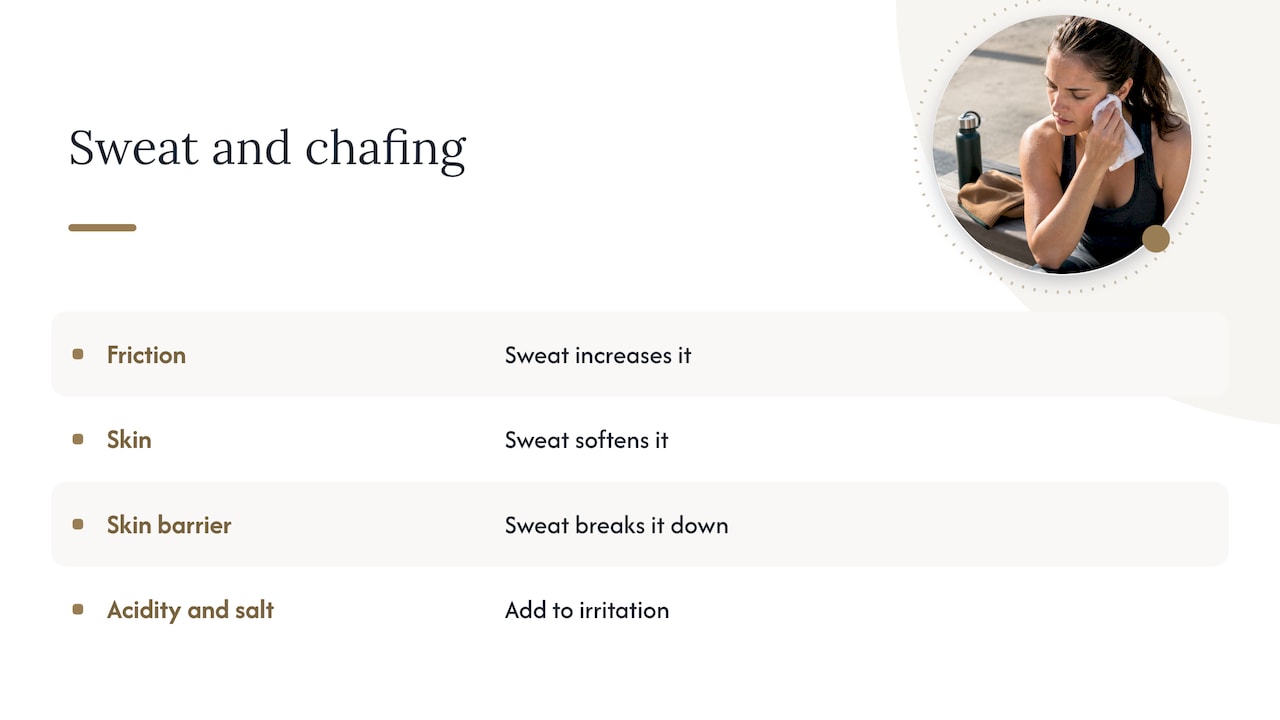
It also explains why the same gear can be fine on a cool morning and a problem on a humid afternoon. Heat means more sweat, more salt left behind as it dries, and softer skin that gives up more easily.
Where runners get chafed on the face
You know your own hot spots better than anyone, but these are the common contact points:
- Forehead and temples: hat brims, visors and headband seams, especially when soaked.
- Bridge of the nose and cheekbones: sunglasses pads and frames that bounce with every stride.
- Ears and behind the ears: glasses arms, mask loops and hat edges.
- Chin and jawline: chin straps, balaclavas, neck gaiters and, for many men, stubble rubbing against fabric.
- Upper lip and cheeks: a mask or buff that slides with each breath, trapping moisture.
- Neck and collar line: a gaiter edge or a stiff collar, which is close enough to the face to count.
Men deal with one extra factor. Stubble gives fabric a rough surface to catch on, and a freshly shaved face is already a little irritated before you add sweat and friction. If shaving on race morning is part of your routine, give the skin some time before the run, not minutes.
How far until it starts?
There is no single mileage where face chafing begins. The San Francisco Marathon describes how a small hot spot at mile 2 can turn into a swollen welt by mile 8, and notes that sensitive skin, body hair, saltier sweat, stride, weather and gear all play a part.
For your face, think in terms of conditions rather than distance:
| Condition | Why it raises the risk |
|---|---|
| Hot, humid run | More sweat, softer skin, more salt on the surface |
| Cold, windy run | Dry, windburned skin plus a gaiter or balaclava rubbing on it |
| New gear | Unbroken-in seams and straps that you haven’t tested on long runs |
| Long effort | The same patch of skin takes thousands of repetitions of rubbing |
| Fresh shave | Skin that is already sensitive meets sweat and fabric |
The practical rule: if you feel a hot spot, a sting or a warm patch, deal with it then. The same marathon guide points out that chafing almost never fixes itself mid-run.
How to prevent face chafing on runs
Start with the gear
The Cleveland Clinic advises avoiding cotton, choosing moisture-wicking fabrics and properly fitting clothes. Apply that to your head and face gear:
- Choose hats, headbands and gaiters in smooth, wicking synthetic fabric rather than cotton, which holds sweat against your skin.
- Check the seams. Flat seams sitting on your forehead or jaw are the ones that cause trouble.
- Fit matters in both directions: too loose and it slides and rubs, too tight and it presses and rubs in one place.
- Adjust sunglasses so they sit still. Pads that bounce on the nose bridge are a common source of soreness.
- Swap soaked gear for a dry spare on long runs if you can.
Add a barrier where the contact is
Anti-chafing products work as a protective barrier on the surface of the skin. U.S. Dermatology Partners notes that dermatologists advise avoiding alcohol-based products, which can make irritation worse, and being cautious with talc-containing ones. Pick something non-drying, apply a thin layer and keep it off your eyes.
A few points specific to the face:
- Thin beats thick. A heavy layer slides, stings in the eyes when sweat runs, and can make gear slip.
- Target contact points, not the whole face: hat line, nose bridge, jaw and chin strap line.
- Watch acne-prone skin. The American Academy of Dermatology says petroleum jelly can help prevent chafing when applied to problem areas, but advises against putting it on the face if you are acne-prone, as it may cause breakouts. If that is you, choose a barrier you know your skin tolerates.
- Test it first. Try any new product on an easy run, never for the first time on race day, and give your skin time to react before you rely on it.
If you want to understand how a balm differs from petroleum jelly, our guide on petroleum jelly versus moisturizer for men walks through when each makes sense.
A 5-minute pre-run routine
- Wash your face with a mild cleanser and pat it fully dry. Don’t apply a barrier over sweat or grit.
- If you shave, do it well before the run, not right before.
- Apply a thin layer of your barrier to contact points: forehead line, nose bridge, jaw, chin strap line.
- Let it settle for a minute or two so it isn’t sliding when you put your gear on.
- Put on dry, clean gear, and check that nothing twists or bunches.
Our short guide to a 30 second barrier balm step for the face covers the same idea for everyday routines.
How to treat chafed facial skin after a run
The Cleveland Clinic and U.S. Dermatology Partners agree on the basics: gently wash the area with mild soap and water, pat it dry, and apply a thin, protective layer of petroleum jelly. U.S. Dermatology Partners also mentions zinc oxide ointment as an option. Here is what that looks like in practice:
- Rinse early. Get the sweat and salt off as soon as you can after the run. Use lukewarm water and a mild, unscented soap.
- Pat, don’t rub. A clean towel, pressed gently. No scrubbing.
- Protect the skin. Apply a thin layer of a protective ointment, as the sources above describe. For badly chafed areas, REI’s advice is to clean with lukewarm water and soap, pat dry and loosely cover with nonstick gauze so nothing keeps rubbing.
- Skip the irritants. No alcohol-based toners, aftershaves or harsh exfoliants while the skin is raw.
- Rest the spot. The Cleveland Clinic says to stop or avoid the activity causing the chafing while the skin heals. In practice, that means changing the gear that caused it, or taking a day or two off before you put it back on.
For severe chafing or inflammation, U.S. Dermatology Partners notes that dermatologists may recommend 1% hydrocortisone cream applied twice daily for a few days to calm irritation. Ask a pharmacist or your healthcare provider before using it on your face, since facial skin is thin and you should confirm that it is appropriate for you.
How long does healing take?
| Stage | What you see | What to do |
|---|---|---|
| Mild | Pink or red, slight sting | Wash, dry, protect, change the gear |
| Moderate | Red, tender, a rough or raw feel | Protect with a thin barrier or cover loosely, skip the run if gear will rub it |
| Severe | Broken skin, swelling, oozing or heat | Contact a healthcare provider |
Minor chafing usually clears up within a few days, according to the Cleveland Clinic. If it takes longer or gets worse, talk to a healthcare provider.
When to stop running and see a doctor
Pay attention to the signals:
- Mid-run: a hot spot, stinging or a warm patch is your cue to stop and fix the problem. Adjust the gear, wipe the area dry, or take the hat or buff off.
- After the run: contact a healthcare provider if symptoms get worse or don’t improve within a few days.
- Broken skin: chafing can break the skin and let bacteria in, possibly causing infection. U.S. Dermatology Partners notes that doctors may prescribe antibiotic or antifungal treatment when infection is suspected.
See a doctor or dermatologist if you notice pus, spreading redness, increasing pain, heat, swelling or a fever. Also see one if the same patch keeps coming back despite changes to your gear. Persistent facial redness or irritation can have causes other than running, and our guide to face irritation in men explains when it is time to get it looked at.
Aftercare that keeps skin ready for the next run
Chafed skin needs the same basics as any irritated skin: gentle cleansing, hydration and protection. Between runs:
- Keep your cleanser mild and your showers lukewarm. Hot water strips skin that is already stressed.
- Moisturize after washing so the skin barrier isn’t left dry and tight.
- Protect against the sun. Runners who train outdoors are exposed for long periods, and a sunburnt, chafed forehead is a miserable combination.
- Wash your hats, headbands and gaiters regularly. Dried salt and residue make fabric rougher.
If your skin is on the sensitive side, our guide on choosing and using a sensitive skin balm can help you build a simple routine.
Our balm for the run-to-recovery routine
Iron Bull Naturals makes skin care for men, built around simple formulas. Our face balm combines grass-fed Alberta beef tallow, hyaluronic acid and jojoba oil with essential oils. It is designed to hydrate and soothe irritated skin without a greasy residue, and it is suitable for sensitive and all skin types.
Many runners use a balm like ours at the end of the day, after washing, to keep the skin hydrated and comfortable between runs. You can see how the formula is built on our tallow face balm page, or read about our balm for irritated skin.

If your face is dry or irritated from wind, sweat and gear, you can shop the Iron Bull face balm and sun balm. Your order is backed by our 60-day money-back guarantee.
Our perspective on runner’s skin
Most runners think about chafing below the neck and forget the face. The skin up there takes the wind, the sun, the salt and the straps, and it gets almost no attention until it stings.
We built Iron Bull around a simple idea: fewer ingredients, chosen well. Our balm uses grass-fed Alberta tallow, which is designed to deliver rich moisture, with hyaluronic acid and jojoba oil, so it absorbs without the greasy feel that puts so many guys off a face product. Men tell us they like that it is quick to apply and they can get on with their day.
For a runner, the habit matters more than the product: gentle washing, a calm routine after the run, and a protective layer once you have rinsed off the sweat. Treat your face the way you treat your legs, with a plan, not a reaction.
Blaine
FAQ
What does chafing mean when running?
Chafing is skin irritation from repeated rubbing against skin, clothing or other materials. It shows up as redness, irritation and stinging or burning. Sweat, heat and humidity make it worse.
What is the fastest way to heal chafed skin on the face?
Wash gently with mild soap and water, pat the skin dry and protect it with a thin layer of ointment. Stop whatever gear is rubbing it. Minor chafing usually clears up within a few days, per the Cleveland Clinic.
Is petroleum jelly OK on a runner’s face?
The American Academy of Dermatology says petroleum jelly can help with chafing on problem areas. It advises against using it on the face if you are acne-prone, because it may cause breakouts. If you are unsure, ask a dermatologist what suits your skin.
What causes chafing on a runner’s face?
Friction is the cause: hats, sunglasses, masks, gaiters, straps or stubble rubbing on the skin. Sweat softens the skin and adds salt, which makes the friction more damaging. Gear that is loose, wet, seamed or cotton makes it more likely.
When should I see a doctor about face chafing?
Contact a healthcare provider if the skin gets worse or isn’t improving after a few days. Do the same if you see broken skin, pus, swelling, spreading redness or heat, which can point to infection.
Sources
- Chafing Causes, Treatment & Prevention, Cleveland Clinic
- The Best Science-Backed Way to Stop Chafing, U.S. Dermatology Partners
- 5 ways to use petroleum jelly for skin care, American Academy of Dermatology
- Avoid Chafing, Save Your Run!, The San Francisco Marathon
- Managing Chafing: Prevention & Treatment, REI Expert Advice