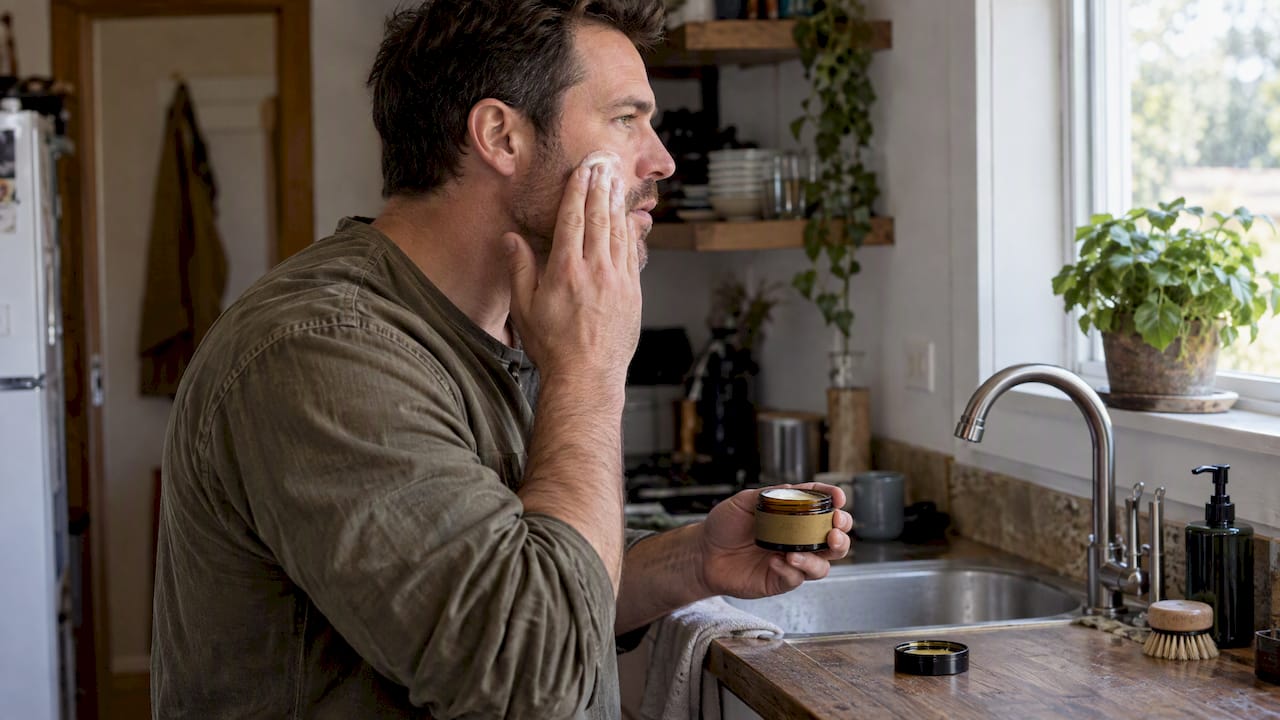
A fragrance-free balm that combines barrier lipids with a humectant like hyaluronic acid is the fastest over-the-counter way to calm irritated facial skin. Iron Bull Naturals makes a simple, three-ingredient tallow balm that fits this profile for men looking for a straightforward option. Patch test any new product for 7 to 10 days on your inner arm before applying it to your face, and most people notice less dryness and redness within a couple of weeks of consistent use.
TL;DR:
- Choose products labeled free of fragrance, not merely unscented, and avoid menthol, alcohol, exfoliating acids, and essential oils that can aggravate reactive skin.
- If breakouts accompany irritation, look for a noncomedogenic label; tubes suit daytime layering, while thicker jar ointments are better reserved for overnight dryness.
- Patch test on your inner forearm for 7 to 10 days, checking daily for redness, itching, or bumps before applying the product to your face.
- After gentle cleansing, press a thin layer onto slightly damp skin; wait a minute or two before applying sunscreen or prescribed treatments.
- Seek care if a rash worsens despite a week or two of gentle care, or if pus, crusting, fever, swelling, or disproportionate pain develops.
Table of Contents
- What a soothing face balm does and when to use one
- Key calming ingredients to look for (and common irritants to avoid)
- How to choose a balm for irritated facial skin: a practical checklist
- How to use a soothing face balm safely and effectively
- When irritation needs medical attention and treatment options overview
- Why Iron Bull Naturals’ tallow balm fits the irritation-relief checklist
- Natural versus synthetic ingredients: what actually matters for irritated skin
- Specific benefits of tallow-based balms for irritation relief
- Building a tallow balm into a broader men’s skincare routine
- What customers say about irritation relief specifically
- A few things I’d tell a friend shopping for this
- Try a simple, fragrance-free balm built for sensitive skin
- FAQ
- Sources
What a soothing face balm does and when to use one
A face balm works differently than a light lotion. Balms are built around occlusive and emollient ingredients, things like tallow, shea butter, or petrolatum, that sit on top of skin and slow water loss while the skin barrier repairs itself underneath. A thin, water-based moisturizer hydrates faster but evaporates faster too, which is why it often falls short when skin is actively inflamed or compromised.
Balms earn their place in a routine when skin needs more than hydration, it needs protection while it heals. That distinction matters for a handful of common situations:
- Post-shave irritation, where tiny nicks and friction leave skin raw and reactive
- Flare-ups from rosacea or contact dermatitis, where the skin barrier is already weakened
- Windburn or cold-weather chapping, where moisture loss outpaces what a lotion can replace
- General dryness that leaves skin tight, flaky, or prone to stinging when you apply other products
If your skin is intensely painful, spreading, or oozing, a balm alone will not resolve what is happening underneath. Jump to the section below on when irritation needs medical attention before reaching for anything new.
Key calming ingredients to look for (and common irritants to avoid)
Not every ingredient marketed as “soothing” actually does much for irritated skin, and some ingredients marketed as natural can make things worse. A handful of ingredients have a real track record for calming and rebuilding compromised skin:
- Ceramides replace the lipids that make up your skin’s outer barrier, which is often depleted when skin is red or flaking.
- Hyaluronic acid draws water into the skin’s surface layer, acting as a humectant that keeps the area hydrated rather than just sealed.
- Niacinamide supports barrier function and tends to reduce visible redness over consistent use.
- Allantoin has a long history in dermatology for its calming, skin-conditioning effect on irritated areas.
- Colloidal oatmeal is an FDA-recognized skin protectant that reduces itching and surface inflammation.
- Zinc oxide sits on the skin as a physical barrier and is also the active ingredient in most mineral sunscreens, which matters for skin that is already inflamed and more sun-reactive.
The ingredients to avoid are just as important as the ones to seek out. Fragrance is the most common offender in facial skin care, whether synthetic or “natural.” Menthol and alcohol create a cooling or tightening sensation that feels like relief but actually irritates compromised skin further. Strong exfoliating acids (AHAs and BHAs) and many essential oils, including lavender and tea tree, are frequent triggers even though they are marketed as gentle or natural.
Fragrance allergy affects an estimated small percentage of the general population, and fragrance-related reactions are one of the most common causes of facial contact dermatitis. That is why dermatologists recommend looking specifically for “fragrance-free” on a label rather than “unscented,” since unscented products can still contain masking fragrances designed to cancel out a raw material’s smell without actually removing it. Our guide to fragrance-free versus unscented labeling breaks down exactly what to check before you buy.
Daily moisturizing matters even when skin feels oily or already well hydrated. According to the American Academy of Dermatology, consistent moisturizer use alongside any treatment plan can reduce dryness and improve comfort within about 15 days in small studies, and it can make prescription treatments more effective when irritation requires one.
How to choose a balm for irritated facial skin: a practical checklist
Comparing products gets easier once you know what to scan for on the label and the box. Work through these points before you buy:
- Confirm the product says “fragrance-free,” not just “unscented” or “lightly scented.”
- Count the ingredients. A shorter list means fewer chances for a hidden irritant to sneak in.
- Check that the formula includes at least one humectant (like hyaluronic acid), one occlusive (like tallow or petrolatum), and one emollient to soften skin between the two.
- Look for “non-comedogenic” on the label if you are prone to breakouts along with irritation.
- Favor products that mention dermatologist testing or compatibility with sensitive skin, and skip anything leading with “natural fragrance” as a selling point.
Texture matters more than people expect. A thin balm in a tube spreads easily and absorbs fast, which suits daily use and layering under sunscreen. A thicker ointment in a jar sits heavier on skin and works best for overnight repair or severe dryness, though it can feel greasy under makeup or during the day. Tubes also reduce contamination risk compared with open jars, since fingers never touch the bulk of the product.
Pro Tip: Apply any new balm to a quarter-sized patch on your inner forearm and check it once a day for 7 to 10 days before putting it on your face.
This patch-test window is the same one the American Academy of Dermatology recommends for screening new skin care products, and it is especially worth doing if you have a history of eczema, rosacea, or reactive skin.
How to use a soothing face balm safely and effectively
Getting the sequence right matters as much as picking the right product. Follow these steps for daily use:
- Cleanse with a gentle, fragrance-free cleanser and pat skin dry rather than rubbing it, since friction itself worsens redness.
- Apply the balm to slightly damp skin in the morning and evening, pressing it in with fingertips rather than dragging it across the face.
- Let the balm absorb for a minute or two before layering sunscreen or any prescribed topical on top, applying the thinnest products first.
- Use a thin layer rather than a thick one. Balms are concentrated, and more product does not speed up healing.
- Reapply after shaving by cleansing gently first, patting the area dry, and applying a thin layer to calm razor burn and support the barrier while it recovers. Our guide to hyaluronic acid balm for razor burn covers this in more detail.
For post-sun irritation, the same gentle-cleanse, pat-dry, thin-layer approach applies, with the balm acting as a lipid occlusive to lock in moisture while skin recovers from UV exposure.
For the patch test itself, apply a small amount to a quarter-sized area on the inside of your forearm, leave it undisturbed, and check daily for redness, itching, or bumps over 7 to 10 days. If nothing develops, the product is reasonably safe to try on your face. Our piece on layering humectants and occlusives walks through how to combine a balm with other steps without overloading your skin.

When irritation needs medical attention and treatment options overview
Most facial irritation responds to consistent moisturizing and avoiding known triggers, but some signs mean a balm will not be enough on its own. See a clinician if you notice any of the following:
- A rash that is spreading or getting worse despite a week or two of gentle care
- Pus, crusting, or signs of infection around irritated skin
- Pain that feels disproportionate to how the skin looks
- Fever, swelling, or other symptoms beyond the skin itself
When irritation is diagnosed as something like eczema or rosacea, a dermatologist may prescribe topical treatments beyond what a balm offers. Topical corticosteroids are commonly used for inflammatory skin conditions, though prescribing information for products like triamcinolone notes they carry local side effects and should be discontinued if irritation worsens rather than improves. Crisaborole is another option for mild-to-moderate eczema: in clinical trial data, A significant portion of users reported itch relief early in treatment compared with moisturizer alone, and a larger portion were itch-free by the end of the treatment period compared with moisturizer alone.
If you suspect a new skincare product triggered your irritation, stop using it immediately rather than trying to push through. Dermatologist-recommended rosacea care consistently points to gentle cleansing, avoiding exfoliation during flares, and moisturizing right after cleansing, the same principles that apply to most reactive skin, rosacea or not.
Why Iron Bull Naturals’ tallow balm fits the irritation-relief checklist
Our Iron Bull Tallow balm is built around the same principles covered above: a short ingredient list, no added fragrance, and a formula designed to support the skin barrier rather than overload it.
- We use a short list of main ingredients including tallow, hyaluronic acid, and jojoba oil, with no synthetic fillers.
- Our tallow is sourced carefully and formulated to be hypoallergenic, which matters for men dealing with reactive or easily irritated skin.
- Hyaluronic acid acts as the humectant in our formula, pulling moisture into the skin while tallow and jojoba oil work as the occlusive and emollient layer on top.
- Users often notice improvements in skin texture and hydration with consistent use.
Clinically speaking, the logic is straightforward: irritated skin has a compromised barrier, and a barrier needs lipids to rebuild along with a humectant to stay hydrated while it does. A three-ingredient formula also limits the number of places a reaction could come from, which is part of why we keep our ingredient list short. You can see the full ingredient breakdown on our tallow face moisturizer product page.
Natural versus synthetic ingredients: what actually matters for irritated skin
“Natural” is not a guarantee of gentleness, and “synthetic” is not a guarantee of irritation. Some natural ingredients, including several essential oils, are among the most common skin allergens on the market. A review of botanical allergens notes that labeling laws do not require disclosure of every plant-derived compound, so a “natural” product can still contain known triggers like lavender or tea tree oil.
On the other side, synthetic ingredients like niacinamide and hyaluronic acid, both lab-produced for consistency and purity, have strong track records for calming irritated skin without triggering reactions. The real question is not natural versus synthetic, it is simplicity and function. A grass-fed tallow balm built around just a few well-understood ingredients, like the one we make, sidesteps the guesswork of either camp by keeping the formula short enough to actually read and understand.

Specific benefits of tallow-based balms for irritation relief
Tallow’s fatty acid profile closely resembles the lipids already found in human skin, which is part of why it absorbs well without the heavy, greasy feel associated with some plant-based butters. For irritated skin, that similarity matters: a lipid composition close to skin’s own sebum tends to integrate into the barrier rather than just sitting on the surface.
Tallow is naturally rich in vitamins A, D, E, and K, nutrients involved in skin repair and barrier function. Combined with hyaluronic acid for hydration, a tallow-based balm delivers both the occlusive protection and the moisture retention that irritated skin needs at the same time, rather than requiring two separate products layered on top of each other. For men managing post-shave redness, windburn, or general sensitivity, that combination simplifies a routine that might otherwise involve several steps into one.
Building a tallow balm into a broader men’s skincare routine
A soothing balm works best as part of a short, consistent routine rather than a standalone fix layered under a pile of other products. Cleanse with a gentle, fragrance-free cleanser morning and night, apply the balm while skin is still slightly damp, and follow with sunscreen in the morning if you will be outdoors.
That is the full routine, and it is intentionally short. Adding more steps, more actives, or more fragranced products increases the odds of triggering the exact irritation you are trying to resolve. Our three-step routine guide for men lays out this exact sequence, and our morning and night skincare breakdown covers how to adjust the routine slightly for day versus evening use.
What customers say about irritation relief specifically
Feedback from Iron Bull Naturals customers consistently points to the same pattern: less tightness and redness within the first couple of weeks of daily use, along with noticeably softer skin texture. Men managing regular post-shave irritation report that applying the balm right after shaving calms the stinging and redness faster than switching aftershaves alone used to.
The recurring theme across customer feedback is relief that builds gradually with consistent use rather than a one-time fix, which lines up with how barrier repair actually works: it takes daily reinforcement, not a single application, to show up as lasting change in skin texture and comfort.
A few things I’d tell a friend shopping for this
If you take one thing from this guide, make it this: simplicity beats a long ingredient list every time when your skin is already upset. I’d rather see someone use one fragrance-free balm consistently for two weeks than rotate through five products hoping one sticks.
Patch test first, always. It costs you ten days and saves you from putting something new directly on inflamed skin. And if you shave regularly, treat that moment as part of your skincare routine, not separate from it. A thin layer of balm right after shaving does more for redness than most aftershaves marketed specifically for that purpose.
Resist the urge to add more products once the balm is working. A minimal routine that you actually stick with beats a complicated one you abandon after a week.
— Blaine
Try a simple, fragrance-free balm built for sensitive skin
If the checklist above describes what you are looking for, fragrance-free, short ingredient list, humectant plus occlusive, our Iron Bull Tallow balm was built around exactly those points.

- Three main ingredients: grass-fed Alberta tallow, hyaluronic acid, and jojoba oil, with nothing synthetic added.
- Formulated to be hypoallergenic and fast-absorbing, without a greasy residue.
- Backed by a money-back guarantee, so you can try it without locking in a decision upfront.
Patch test it the same way you would any new product: a small amount on your inner arm, checked daily for 7 to 10 days, before moving it to your face. If you want a complete sequence rather than a single product, our no-nonsense three-step routine shows exactly where the balm fits alongside cleansing and sun protection. When you are ready, you can browse the full lineup, including our tallow balm and sun balm, on our shop page.
FAQ
What is the best moisturizer for sensitive skin with redness?
The best option is a fragrance-free formula with a short ingredient list that combines a humectant like hyaluronic acid with occlusive lipids such as tallow, shea butter, or petrolatum. Avoiding fragrance matters most, since fragrance is one of the most common triggers of facial redness and contact dermatitis.
What is the best moisturizing face balm?
A strong face balm pairs a humectant for hydration with an occlusive ingredient to lock that moisture in, all in a fragrance-free, simple formula. Balms built from a small number of well-understood ingredients, like grass-fed tallow combined with hyaluronic acid, tend to work well for dry or irritated skin because they limit exposure to potential triggers.
Is face balm the same as moisturizer?
Face balm is a type of moisturizer, but a richer one built around occlusive and emollient ingredients rather than mostly water. A lighter lotion hydrates quickly but evaporates faster, while a balm forms a protective layer that slows moisture loss while skin heals.
What is the best product to reduce redness on the face?
A fragrance-free balm containing niacinamide, allantoin, or colloidal oatmeal tends to reduce visible redness by supporting the skin barrier rather than just masking irritation. Daily, consistent use matters more than any single ingredient, since the American Academy of Dermatology notes that regular moisturizing alongside treatment can improve comfort within about 15 days.