


Chlorine does not burn your skin in the way a sunburn does. It strips away the oils that hold moisture in, and the result is skin that feels tight, dry and raw after the pool. The fix has two parts: rinse and cleanse gently on both sides of the swim, then put a rich moisturizer back on while the skin is still damp. Our Iron Bull Tallow face balm is made for exactly that job: hydrating and repairing dry, irritated skin without a greasy feel.
TL;DR
- Chlorine strips the skin’s natural oils and weakens its barrier. The result is dryness, tightness, itching and sometimes a red rash.
- True chlorine allergy is very rare. Almost every reaction is irritant dermatitis, meaning the skin is irritated, not allergic.
- Shower before and right after you swim, use a mild cleanser, and moisturize while your skin is still damp.
- A mild rash can be calmed at home. Blistering, burning, painful or persistent skin needs a dermatologist.
- Barrier repair is the long game. A balm built for dry, irritated skin, used daily, keeps your skin ready for the next swim.
Table of Contents
- What chlorine does to men’s skin
- Symptoms to recognize
- How to calm a chlorine rash
- The routine that protects your skin around a swim
- A simple schedule you can keep
- Why daily barrier care matters more than the post-swim fix
- Our view: skin that has to handle chlorine needs simplicity
- Iron Bull Tallow for post-pool skin
- FAQ
- Sources
What chlorine does to men’s skin
Your skin has an outer layer of oils and lipids that works like mortar between bricks. It keeps water in and irritants out. Cleveland Clinic explains that chlorine strips skin of its natural oil, called sebum, which leaves it dry and sensitive. Over larger areas it can cause a red, itchy, mildly inflamed rash.
UAB Medicine’s dermatology team describes the same chain of events. Chlorine breaks down the skin’s protective barrier and causes excessive moisture loss. That brings on drying (xerosis) and irritant contact dermatitis, which is a plain skin irritation triggered by contact with a substance. Repeated exposure can cause itching and irritation.
Two details matter for men in particular:
- Shaving. A freshly shaved face already has a stressed barrier. Cleveland Clinic’s Dr. Purcell says that when the barrier is already broken down, chlorine triggers a more vigorous reaction, which is why good baseline skin health is the best prevention. This is our reading of her point: a face that was just shaved is an easy target.
- Sweat and oils. Chlorine reacts with sweat, dirt and oils on your skin to form chloramines, and these can be even more irritating than chlorine itself. A hard lap session leaves more sweat to react with.
Symptoms to recognize
Chlorine damage ranges from a mild tight feeling to a full rash. Health.com lists the skin effects of chlorinated pools as dry, itchy skin, red skin, hives or rash, acne, and flares of eczema or psoriasis. It adds that frequent swimmers are more prone to allergic contact dermatitis, sometimes called pool water dermatitis.
Affiliated Dermatology describes what a chlorine rash looks like:
- It appears shortly after swimming, though it can take a few hours to develop fully.
- It sits where water contact was greatest, or where a swimsuit held chlorinated water against the skin.
- You may see redness, itching that gets worse after you dry off, small red bumps or hives, and rough, scaly patches.
- Lotions or soaps may burn when you apply them. Severe cases crack or crust.
Healthline adds that chlorine can also cause discoloration, scaling and swollen, tender skin, along with eye and breathing irritation.
Allergy or irritation?
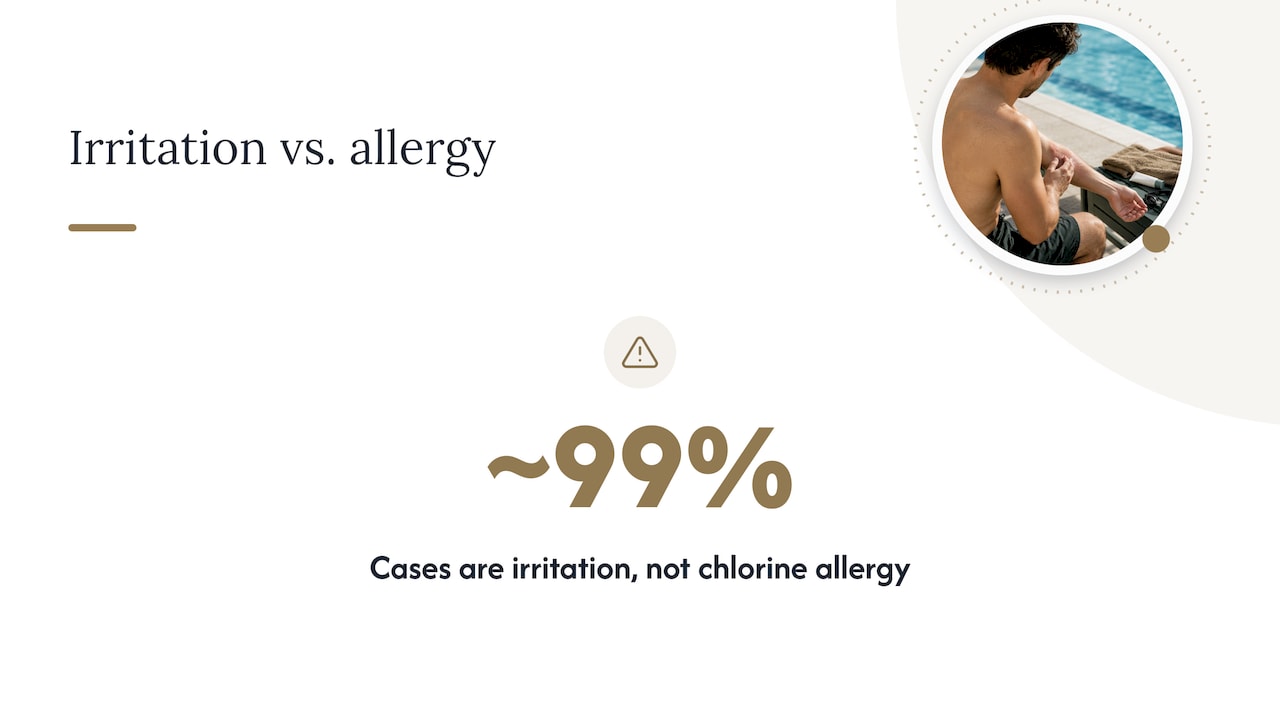
Most men who say they are allergic to chlorine are not. Cleveland Clinic’s Dr. Purcell says true chlorine allergies are extremely rare, and that irritant dermatitis accounts for about 99% of cases. The American College of Allergy, Asthma & Immunology puts it the same way: you cannot be allergic to chlorine, but you can be sensitive to it, and the reaction resembles a chemical burn.
This is good news. Irritation is a barrier problem, and a barrier can be rebuilt. The ACAAI also advises finding and treating the cause of the sensitivity, such as a pool with raised chlorine levels, instead of simply giving up swimming.
How to calm a chlorine rash
Start with the basics. Get out of the water, wash the area with clean water, and stay out of the pool until the skin settles. The ACAAI names washing with clean water as the first treatment step.
For itching and redness, Cleveland Clinic lists these over-the-counter options:
- Hydrocortisone cream to relieve the itch.
- Aloe vera or calamine lotion to soothe.
- A colloidal oatmeal bath instead of more pool time.
- A non-drowsy antihistamine (cetirizine, loratadine or fexofenadine) by day, or diphenhydramine at night, when there are hives. Read the label for the dose, and ask a pharmacist if you take other medicines.
Medical News Today notes that a doctor can prescribe a stronger steroid cream if over-the-counter treatments fail.
When to see a dermatologist
Home care is for mild cases. UAB News says a dermatologist visit is warranted for swim-related irritation with redness, scaling, burning, persistent stinging or itching, or blistering and painful skin. If you have eczema, rosacea or diabetes, bring it up with your doctor before you swim regularly. The ACAAI says an allergist can diagnose the problem and help.
The routine that protects your skin around a swim
The dermatology sources agree on a simple routine. Our notes on each step show where the usual mistakes happen.
1. Rinse before you get in
Affiliated Dermatology advises rinsing with fresh water before you enter the pool, so your skin cells are already saturated. Cleveland Clinic gives a second reason: a pre-swim shower washes off the sweat and oils that form irritating compounds, and your skin absorbs less chlorinated water.
The common mistake is skipping this step because you are about to get wet anyway. Dr. Jennifer Lucas, quoted in the Cleveland Clinic newsroom, recommends wetting skin and hair before swimming, and applying plenty of sunscreen before you swim as a barrier against chlorine.
2. Shower right after
Do not sit poolside for an hour. Chlorine keeps working on your skin until you wash it off. UAB Medicine recommends rinsing immediately, using lukewarm water and a gentle cleanser. Avoid exfoliants and lactic, salicylic or glycolic acids at this point. Cleveland Clinic also advises against over-scrubbing.
The common mistake is hot water and a harsh body wash, which strips what the chlorine left behind. Lukewarm and mild is the rule. UCLA Health gives the same advice: rinse thoroughly with cool-to-warm water and gentle soap.
3. Pat dry and moisturize while skin is damp
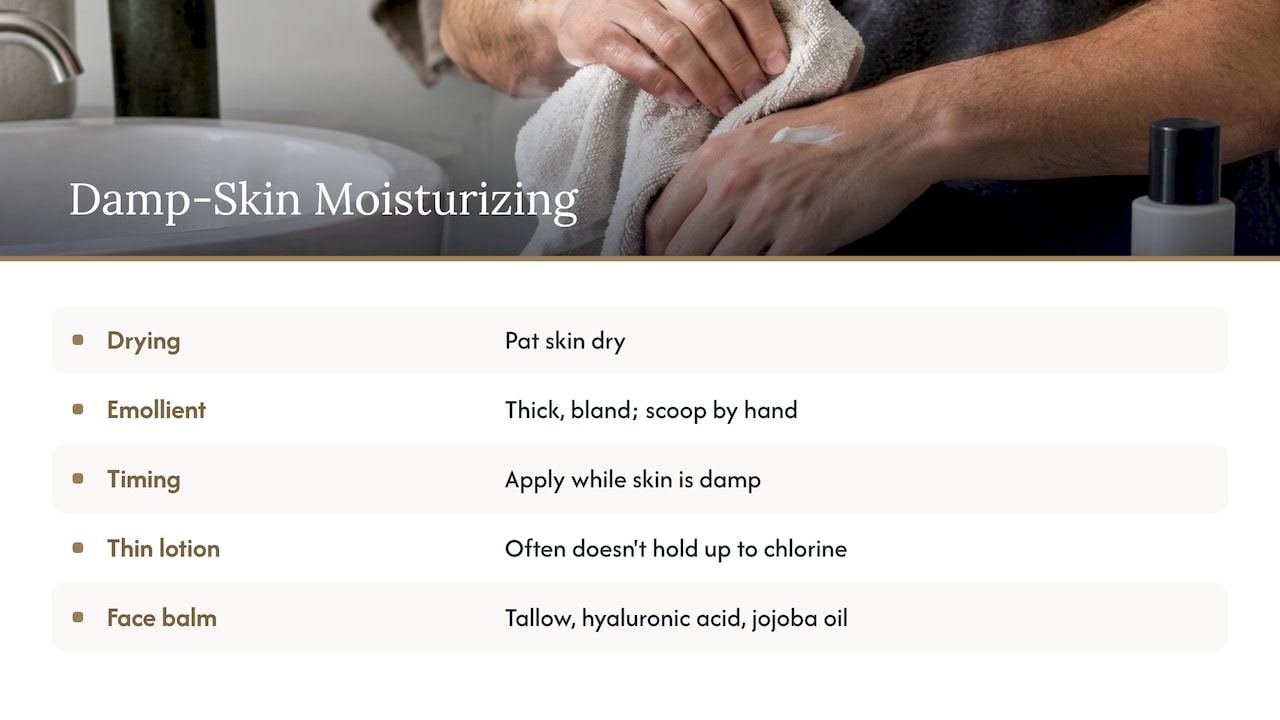
This is the step that decides how your skin feels the next day. UAB Medicine says to pat dry and apply a thick, bland emollient, thick enough that you scoop it out by hand. Affiliated Dermatology says to apply the moisturizer while the skin is still damp.
A thin lotion often does not hold up against chlorine. A balm sits in a different category. Our face balm combines grass-fed Alberta tallow, hyaluronic acid and jojoba oil, and it is designed to hydrate deeply and repair without a greasy residue. That matters for a man who goes from the pool straight to work or a meeting. For more on how tallow works as a moisturizer, see our guide to beef tallow for skin.
4. Treat the sun separately
Pool days are also sun days. UAB Medicine gives the typical adult sunscreen dose as 30 mL, about one shot glass, reapplied at least every two hours. Our Sun Balm is a tallow-based mineral formula with zinc oxide. If you want the comparison with ordinary sunscreen, read sun balm vs sunscreen.
5. Slow down if your skin is already irritated
Medical News Today lists a few habits for frequent swimmers: rinse your swimsuit right away, space out your chlorine exposure, limit time in the pool, and avoid overly chlorinated pools. If the pool smells strongly of chemicals, that usually points to chloramines and not to a clean pool. Cleveland Clinic suggests monitoring pool chemistry. At home, that means asking the operator, and if the pool is yours, testing the water.
A simple schedule you can keep
| When | What to do | Why |
|---|---|---|
| Before the pool | Rinse with fresh water; apply sun protection outdoors | Skin absorbs less chlorinated water; creates a barrier |
| Straight after | Lukewarm shower with a mild cleanser, no scrubbing | Removes chlorine and chloramines before they keep drying skin |
| Within minutes | Pat dry, then apply a rich moisturizer to damp skin | Seals in water while the barrier recovers |
| Every morning and night | Moisturize face and any dry areas | Rebuilds the barrier between swims |
| If a rash appears | Wash with clean water, soothe, pause swimming | Gives the skin time to recover |
Why daily barrier care matters more than the post-swim fix
One good shower does not repair a barrier that has been stripped for weeks. Dr. Purcell’s point, that healthy skin withstands irritants better, means the work happens on the days you are not swimming. A man who swims three mornings a week and has dry, flaky skin the other four days is starting every swim with a weakened barrier.
If your skin is already dry and flaky, our guide to dry, flaky skin in men lays out a routine. If it is red and reactive, read about a face balm for irritated skin. A simple setup is also easy to keep up, and our minimalist skincare routine for men shows how few steps you need.
Our view: skin that has to handle chlorine needs simplicity
We make skincare for men who do not want a twelve-step routine. When we look at what the dermatology sources describe, the pattern is clear: chlorine dries out skin by breaking down its barrier, so the answer is to hydrate and repair.
That is what we built Iron Bull Tallow to do. It uses three key ingredients: grass-fed Alberta tallow, hyaluronic acid and jojoba oil. The formula is non-toxic and hypoallergenic, and it is made to hydrate deeply and repair skin without a greasy feel. Fewer ingredients mean fewer things that can irritate skin already stressed by the pool.
The routine works because it is short. Rinse, cleanse gently, balm on damp skin, and repeat each day. Customers tell us they notice better texture and hydration within weeks of regular use. We also stand behind it with a 60-day money-back guarantee.
Blaine
Iron Bull Tallow for post-pool skin
If chlorine has left your face tight, dry or reactive, our face balm gives you a simple way to restore hydration. It is made with grass-fed Alberta tallow, hyaluronic acid and jojoba oil, and it suits sensitive and all skin types. Keep a tin in your gym bag and apply it after your shower. Our Sun Balm covers the days you swim outdoors.

Browse both in our shop. Orders come with a 60-day money-back guarantee.
FAQ
Is pool chlorine bad for your skin?
It can be, especially with frequent exposure. Chlorine removes the skin’s natural oils, which leads to dryness, tightness and irritation, and sometimes a rash. Rinsing before and after swimming and moisturizing right away keep most of this in check.
How do you get rid of chlorine burn on skin?
Wash the area with clean water and stay out of the pool until it calms. Hydrocortisone cream can relieve itching, and aloe or calamine lotion can soothe. If you see blistering, burning, or irritation that does not go away, see a dermatologist.
Can chlorine cause dry skin?
Yes. UAB Medicine says chlorine breaks down the skin’s protective barrier and causes excessive moisture loss, which leads to dryness (xerosis). Repeated exposure can also cause itching and irritation, so a daily moisturizer helps between swims.
Am I allergic to chlorine?
Probably not. Cleveland Clinic’s Dr. Purcell says true chlorine allergy is extremely rare, and about 99% of reactions are irritant dermatitis. That means your skin is irritated, and the barrier can be rebuilt with gentle care.
Sources
- Cleveland Clinic: Chlorine Rash: Why It Happens and How To Treat It
- UAB Medicine: Summer skincare: protect your skin and hair from chlorine and salt water
- Health.com: How Chlorine Affects Your Skin, Eyes, and Hair
- Healthline: Chlorine Rash: Treatment and Prevention
- ACAAI: Chlorine Allergy
- Medical News Today: Chlorine rash: Appearance, treatment, prevention
- Affiliated Dermatology: Is Chlorine Bad for Your Skin?
- Cleveland Clinic newsroom: Does pool water affect your skin and hair
- UCLA Health: Summer skin safety tips
- UAB News: How to protect skin and hair from chlorine and salt water