


A fast absorbing face balm is a solid or semi-solid moisturizer that melts on contact with your skin and sinks in within a minute or two, without leaving a slick film. You get that result from three things: a short, well-chosen ingredient list, a thin layer, and applying it at the right moment, ideally on slightly damp skin. This guide covers what a face balm is, what the research says about hydration speed, how to apply one, and when to hold back.
TL;DR
- A face balm is an oil-and-butter-based moisturizer. It is not the same product as a cleansing balm, which is made to dissolve dirt and rinse off.
- Dermatologists describe a good moisturizer as one that combines humectants, occlusives and emollients. Look for all three jobs covered in one short ingredient list.
- Apply a small amount within three minutes of showering. Thin layers absorb faster and feel lighter than thick ones.
- Oily or acne-prone skin needs a lighter hand. Use less, apply less often, and keep other heavy products out of the routine.
- Our Iron Bull Tallow balm is built on grass-fed Alberta tallow with hyaluronic acid, designed to absorb without a greasy feel.
Table of Contents
- What a fast absorbing face balm actually is
- Why some balms absorb fast and others sit on top
- How to apply a face balm so it absorbs quickly
- Balm or cream: which should you use?
- Who should use a face balm, and how to use it well
- Face slugging: when a balm is used as the last step
- A quick checklist for choosing a fast absorbing face balm
- Why we make Iron Bull Tallow the way we do
- Try the balm built for men’s skin
- A note on making face balm at home
- FAQ
- Sources
What a fast absorbing face balm actually is
The word “balm” covers two very different products, and the search results show it. Some of the pages ranking for this keyword are about cleansing balms, which are makeup removers that you massage on and wash off. Others are about hydrating balms, which stay on your skin. Only the second kind is what you want if the goal is comfort and hydration.
A hydrating face balm is made from oils, butters and waxes with little or no water. That is why it feels richer than a gel or lotion. It is also why the “fast absorbing” part matters: a balm that sits on top of your skin for twenty minutes is a balm you stop using.
How it differs from the products around it:
| Product | What it is for | Stays on skin? | Typical feel |
|---|---|---|---|
| Hydrating face balm | Softening, comfort, sealing in moisture | Yes | Rich but melts in |
| Lotion or gel | Light daily hydration | Yes | Light, watery |
| Cream | Everyday moisture for normal to dry skin | Yes | Medium |
| Cleansing balm | Dissolving sunscreen, sweat and dirt | No, rinsed off | Oily until emulsified |
| Ointment | Maximum sealing for very dry patches | Yes | Heavy, greasy |
The DermNet overview of emollients and moisturizers explains the texture ladder well: ointments give the most occlusion and suit dry, thick, scaly areas, while creams are lighter, absorb more quickly and need more frequent reapplication. A balm sits between the two. That middle position is the reason formulation matters so much.
Why some balms absorb fast and others sit on top
Absorption speed is not magic. It comes down to how much of the product you use, what the oils are, and how the formula is built.
The three jobs a moisturizer has to do
Cleveland Clinic’s guidance on choosing a moisturizer for dry skin says a good one should include ingredients from three classes:
- Humectants attract water to the skin. Hyaluronic acid and glycerin are the familiar examples.
- Occlusives form a layer that slows water loss.
- Emollients soften and smooth the surface. Plant oils and ceramides fall here.
A balm made mostly of waxes and butters is strong on the occlusive side. What makes it feel fast is having the other two jobs handled too, so the skin feels hydrated and smooth rather than coated. A dermatologist quoted by Wirecutter makes the same distinction: occlusives are an ingredient type, not a complete moisturizer, because they do not add hydration the way humectants do and do not soften the way emollients do.
That is the practical lesson for buyers. When you shop for a face balm, check that the ingredient list does more than seal. A humectant plus a lightweight oil plus a skin-compatible fat gives you a balm that feels finished within a minute or two.
Ingredient length matters too
The more ingredients a product carries, the more chances there are for something to sting, clog or sit heavy on your skin. A short list is easier to judge and easier to tolerate. Our own approach at Iron Bull Naturals is to keep the formula simple: grass-fed Alberta beef tallow, hyaluronic acid and jojoba oil, with essential oils. We designed it so the hyaluronic acid handles the water-attracting job while the tallow and jojoba do the softening and sealing.
If you want the background on the fats themselves, our write-up on what the science says about tallow for the face goes into it, and our piece on stearic acid and barrier repair explains why one lipid is rarely enough.
How fast is fast?
There is no honest universal number of seconds. What the research does say is useful: the benefits of a moisturizer are greatest in the first six hours after you apply it, per DermNet. Very dry skin may need reapplication every few hours, and regular use two to three times a day can help maximize the effect.
So “fast absorbing” has two meanings. One is how quickly it disappears into the skin so you can get dressed and leave. The other is how soon your skin feels better. You control the first with technique. You control the second with consistency.
How to apply a face balm so it absorbs quickly
Most greasy-balm complaints are application mistakes. Here is the routine we recommend.
- Cleanse and pat, don’t rub dry. Leave your face slightly damp.
- Move quickly. Cleveland Clinic’s dermatologist advises applying moisturizer within three minutes of showering to help trap moisture on the skin. We cover the reasoning in our guide to applying moisturizer on damp skin.
- Start with a pea-sized amount. Add more only if your skin still feels tight after a minute.
- Warm it first. Rub the balm between your fingertips until it softens and turns glossy. A warm balm spreads thinner, and a thin layer absorbs faster.
- Press and smooth. Press it into your cheeks and forehead, then smooth outward. Go lighter around the nose and T-zone.
- Wait a minute before the next step. If you use sun protection in the morning, let the balm settle first.
If your balm is your only moisturizer, twice a day is a sensible pattern. Our guide on how often to moisturize your face lays out the morning and night routine in detail.
A simple example
Say you shave at 6:45 a.m., shower, and need to be out the door at 7:15. Pat your face until it is no longer dripping, warm a pea-sized dab between your fingers, and press it in. It should feel hydrated and smooth by the time you have brushed your teeth. Then apply sun protection. If you are working in a cold office or outdoors in winter, add a second thin layer in the evening rather than a thick one in the morning.
Balm or cream: which should you use?
If you are choosing between the two, the deciding factor is how dry your skin is and what the weather is doing.
Cleveland Clinic notes that for facial use a gel or lotion is generally better unless you have very dry skin. That is the honest framing: a balm earns its place when your skin needs more than a lightweight lotion gives. Think of cold-weather skin, skin that feels tight after shaving, or skin that flakes around the nose and cheeks even after you moisturize.
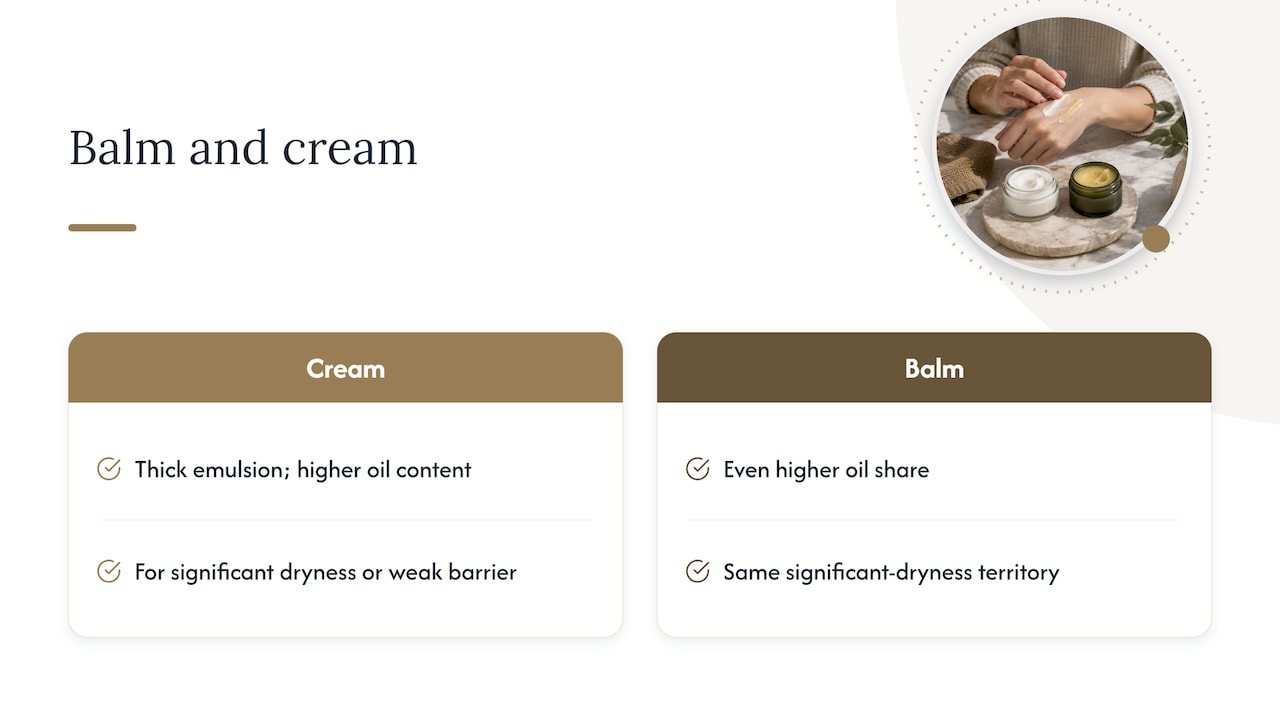
A review of facial moisturizer types in the IJMPS Journal describes creams as thick emulsions with higher oil content, suited to significant dryness or a compromised barrier. A balm works in the same territory with an even higher oil share, so it fits the same needs.
We have a longer comparison in our guide to choosing between a balm and a cream, including the three-minute rule.
Who should use a face balm, and how to use it well
A face balm works best when it is matched to the right skin and the right amount. Here is how to adjust.
Dry or tight skin
This is the ideal case. Use the routine above, twice a day, and reapply a thin layer when your skin feels tight. If you are in a low-humidity climate or heated indoor air for most of the day, you may need the midday touch-up.
Irritated or sensitive skin
Fragrances and botanicals are common allergens that can cause redness, flaking and itching, according to the dermatologist quoted by Cleveland Clinic. If your skin reacts easily, patch-test any new product on a small area for a few days first. Our guide to choosing a sensitive skin balm explains how to read a label with that in mind, and the difference between fragrance-free and unscented is worth knowing. The same logic applies to everything that touches your skin, down to the laundry ingredients to avoid for sensitive skin that wash into your pillowcases and towels.
Oily or acne-prone skin
This group needs the most care. Wirecutter’s dermatologist notes that sealing layers can lock in sweat, sebum and bacteria on oily or acne-prone skin. The fix is technique, not abandoning moisture:
- Use a smaller amount, about half a pea.
- Apply it once a day, at night, and see how your skin responds.
- Cleanse properly before applying.
- Keep the rest of the routine simple.
Our guide to a non-comedogenic balm that rinses clean covers that approach in detail. If breakouts persist, see a dermatologist.
Skin that is already very dry
Wirecutter’s expert gives a vivid image: adding a sealing layer to skin that is already parched is like putting a lid on an empty container. The point is that sealing works best when there is water to seal in. That is why we put hyaluronic acid in our formula and why we tell you to apply on damp skin. Hydrate first, seal second.
Face slugging: when a balm is used as the last step
Slugging means applying a thick, occlusive layer as the final step of your night routine. The American Academy of Dermatology’s page on skin flooding and slugging describes it as a largely social media-driven practice with limited clinical evidence on its efficacy or safety. It also notes that heavy layering may worsen acne in acne-prone patients.
A few practical rules from dermatologists:
- Cleveland Clinic’s guidance on slugging says to do it only on clean skin and rarely every night.
- The same source advises skipping it if you have oily skin, acne-prone skin or open wounds.
- It also says not to put alpha hydroxy acids, beta hydroxy acids or retinoids under the seal, because trapped actives can irritate.
- According to Dermascope, slugging can be especially helpful for dry or sensitized skin in cold, low-humidity weather, and it should be used selectively rather than universally.
For a fast-absorbing balm, the sensible version is a thin, even layer, not a thick mask. If you want that extra seal, do it on the nights your skin feels desert-dry, not as a nightly habit.
Some men reach for petroleum jelly instead. It has its place for cracked cuticles, lips and small dry patches, and we compare the two in our guide on petroleum jelly versus moisturizer.
A quick checklist for choosing a fast absorbing face balm
Use this when you are comparing labels:
- A humectant is on the list. Hyaluronic acid or glycerin means the balm adds water-binding power, not only a seal.
- A softening oil or lipid is present. Plant oils such as jojoba help the skin feel smooth.
- The list is short. Fewer ingredients make reactions easier to trace.
- The texture melts. A good balm softens from the warmth of your fingers.
- It suits your skin type. Dry skin can take a richer balm. Oily skin needs a lighter hand.
- It has a fair return policy. You should be able to try it with confidence.
Why we make Iron Bull Tallow the way we do
We started Iron Bull Naturals because most men’s skincare is either an afterthought or a long list of ingredients nobody can pronounce. We wanted a balm that does the job and gets out of the way.
Our approach is to build around a short list. Grass-fed Alberta tallow gives the formula a rich base, hyaluronic acid brings water to the skin, and jojoba oil keeps the finish smooth rather than slick. Our formula is designed to hydrate deeply without the greasy feel that makes men quit a moisturizer after a week.
We also think technique matters as much as the jar. A thin layer, warmed in your fingers and pressed onto slightly damp skin, is how we use it ourselves. Done that way, a balm is not a heavy product. It is a simple, one-step answer for dry, tight, irritated skin.
Customers tell us they notice better hydration and skin texture within weeks, and we back every order with a 60-day money-back guarantee.
Blaine
Try the balm built for men’s skin
If you want a face balm designed to absorb without the heavy residue, our Iron Bull Beef Tallow Face Moisturizer for Men combines grass-fed Alberta tallow, hyaluronic acid and jojoba oil in a simple formula made for men. It is suitable for sensitive and all skin types, and our 60-day money-back guarantee backs every order. For daytime protection, our Sun Balm follows the same minimal approach. You can see everything in the shop.

If you are building a short routine around it, our guide to a simple skincare routine for men shows how it fits in three steps.
A note on making face balm at home
People searching for this topic often wonder about DIY versions. Dermatologist Lauren Fine, MD, told HealthyWomen that products made in regulated facilities follow standards that limit bacteria, while mixing tools and containers at home can harbor fungi and other microorganisms. She also cautions that natural does not mean safe, since essential oils are a common cause of allergies and contact dermatitis. A professionally made balm removes those variables, and that is a good reason to buy a finished product made under proper manufacturing conditions.
FAQ
Does a fast absorbing face balm feel greasy?
It should not, if you use a small amount. Warm a pea-sized dab between your fingers, then press it into slightly damp skin. Too much product is the usual cause of a greasy feel. Our formula is designed to absorb without a heavy residue.
Can I use a face balm every day?
Yes, for most dry or normal skin, once or twice daily is a sensible pattern. Dermatologists note that moisturizer benefits are strongest in the first six hours, so morning and night application keeps skin covered. If your skin is oily or acne-prone, start with once a day at night and use less.
What is the difference between a face balm and a cleansing balm?
A face balm is a leave-on moisturizer that hydrates and softens. A cleansing balm is designed to melt away sunscreen, sweat and dirt and is then rinsed off. Do not swap one for the other.
When should I apply face balm for the best results?
Apply it within three minutes of washing your face or showering, while your skin is still slightly damp. That timing helps trap moisture on the skin, as Cleveland Clinic’s dermatologist recommends.
Sources
- Choosing the Best Moisturizer for Dry Skin, Cleveland Clinic
- Emollients and Moisturizers, DermNet
- Repeat After Me: Aquaphor Is Not a Moisturizer, Wirecutter
- A Systematic Review of Facial Moisturizer, IJMPS Journal
- Skin flooding, American Academy of Dermatology
- Slugging: Does This Skin Care Trend Work?, Cleveland Clinic
- Slugging, Ceramides and Skin Flooding, Dermascope
- The Facts About Homemade Skincare Products, HealthyWomen
- Laundry Ingredients to Avoid for Sensitive Skin