
The simplest way to cut microplastics from your skincare is to use fewer products with shorter ingredient lists, then check the few names that matter. Plastic particles turn up in a large share of cosmetics, and the US law that bans them covers only rinse-off products, so leave-on creams and sunscreens are where your own label reading counts. A short, simple routine gives you less to check. Iron Bull Naturals makes a face balm and a sun balm for men with only three key ingredients, which is what a short routine looks like in practice.
TL;DR
- A 2026 dermatology review reports that over 90% of commercial skin care and cosmetic products contain polyethylene and PMMA, two common plastic polymers.
- US law bans plastic microbeads in rinse-off products only. Face creams, serums and sunscreens are not covered.
- Labels cannot prove a product is plastic-free, but a handful of specific names are worth checking. Do not treat the prefix “poly” as a verdict.
- Research so far finds most particles stay in the outer skin layers, and the science on deeper effects is still developing.
- The practical move: three products or fewer, short ingredient lists, and a quick label check before you buy.
Table of Contents
- What “microplastic-free” actually means
- Where US law stops
- How to read a label in two minutes
- What research says about plastics and your skin
- Packaging counts too
- A short routine that keeps the label list small
- Why a short ingredient list is the practical answer
- Our balm and sun balm
- FAQ
- Sources
What “microplastic-free” actually means
Microplastics are tiny solid plastic particles. In skincare they show up in two ways. Some are added on purpose, as scrubbing beads or texture agents. Others come from polymers used for film-forming, thickening or bulking.
There is no single legal definition of “microplastic-free” on a US label. One commonly cited expert definition, from the founder of a sustainable beauty brand quoted in POPSUGAR, is no plastics in either the ingredients or the packaging, with an ingredient list to back it up. She also points to third-party marks such as the Plastic Soup Foundation’s “Look For the Zero” certification.
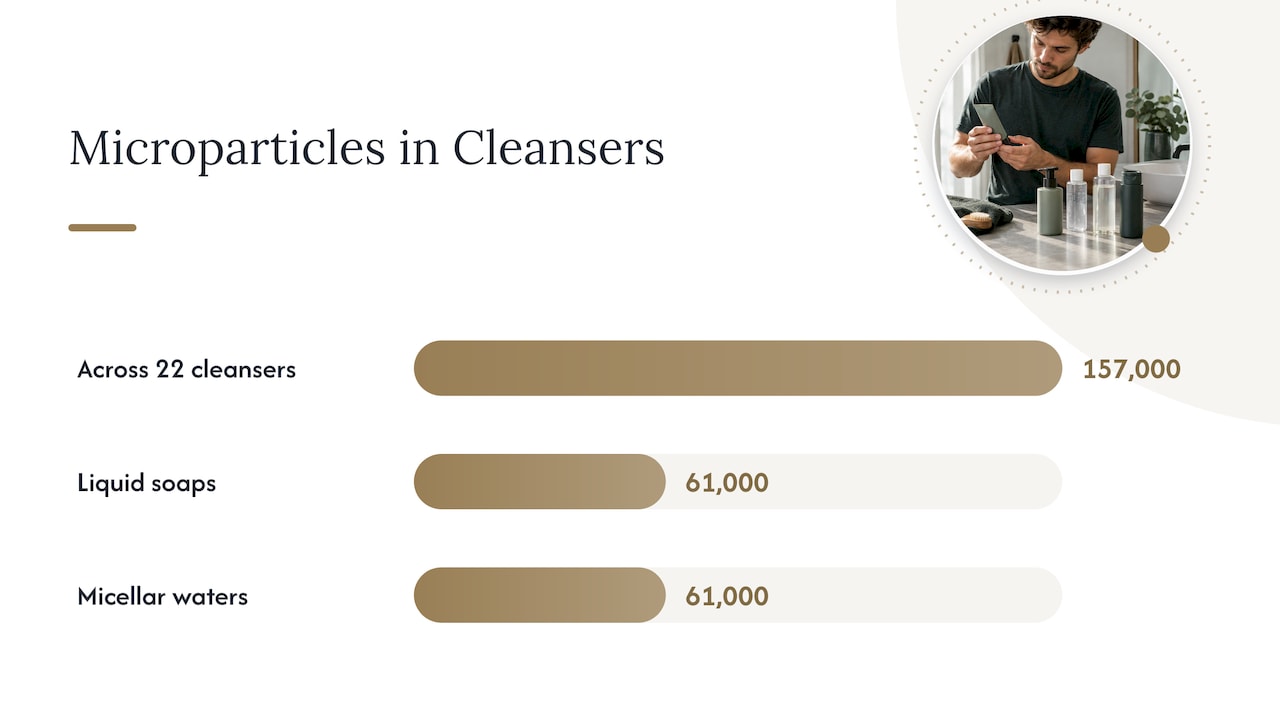
The scale of the issue explains why men are searching for this. The same 2026 review in the American Journal of Clinical Dermatology reports that a 2025 study found 157,000 microparticles across 22 commercial cleansers, including 61,000 each in liquid soaps and micellar waters.
Where US law stops
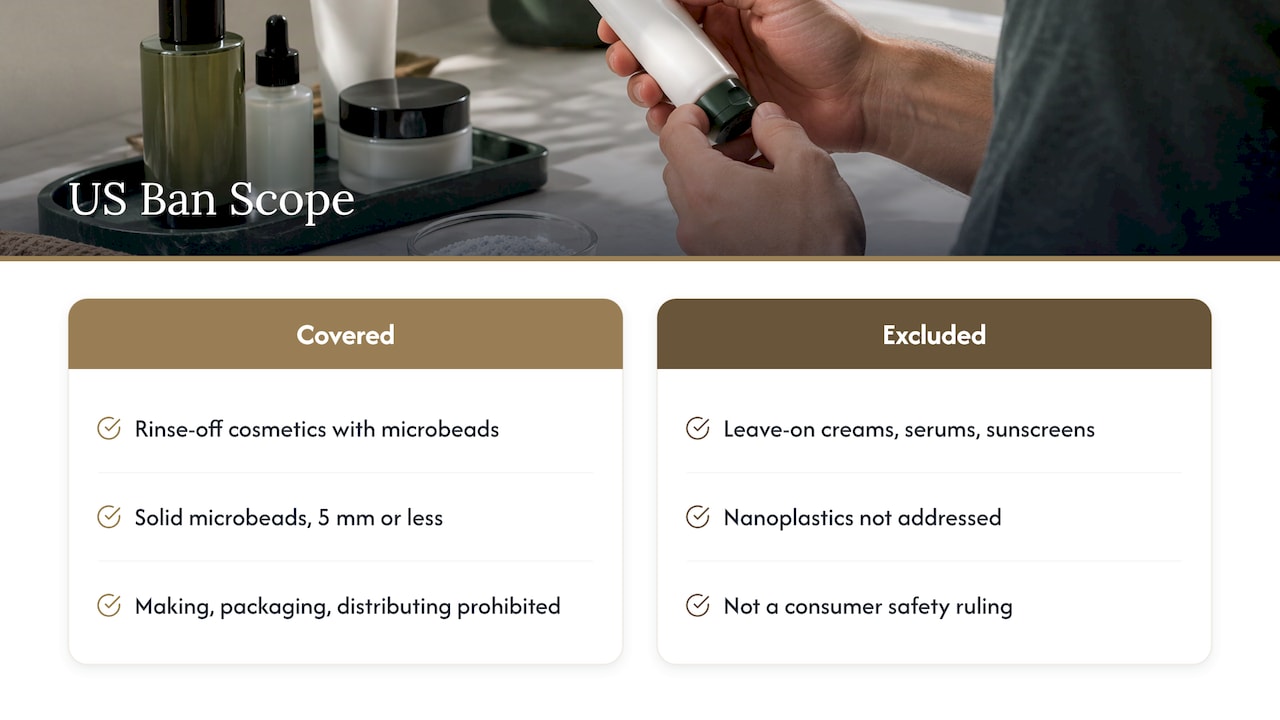
The Microbead-Free Waters Act of 2015 prohibits making, packaging and distributing rinse-off cosmetics that contain plastic microbeads. The FDA’s FAQ page defines them as solid plastic particles 5 mm or less in size, intended to exfoliate or cleanse. It also notes the law is not a consumer safety ruling.
The gap that matters for you: the 2026 dermatology review notes the act excludes leave-on formulations such as facial creams, serums and sunscreens, and does not address nanoplastics. Those are the products that sit on your face all day.
Ingredient lists don’t close the gap either. The same review explains that INCI labeling (the standard ingredient naming system) does not say particle size or whether a polymer exists as a microplastic. Confirming it takes laboratory analysis. You can’t get certainty from a label, but you can lower the odds.
How to read a label in two minutes
Start with the ingredient list on the box or product page. Look for these names, which come up repeatedly in consumer guides from Beat the Microbead and a 2026 label-checking guide:
- Polyethylene (PE), the classic scrub bead and bulking polymer.
- Polymethyl methacrylate (PMMA), often used for texture and a smooth, blurring feel.
- Polypropylene (PP) and polystyrene.
- Polyethylene terephthalate (PET) and polylactic acid (PLA).
- Nylon, also listed as PA, and styrene copolymer.
The Beat the Microbead guide also flags a broader group of polymers, including acrylates copolymer, carbomer, dimethicone and PVP. Those are more debated. The company Lubrizol, citing the INCI naming committee, argues that “poly” or “polymer” in a name does not automatically mean a microplastic, and that acrylate polymers, for example, are often used as gels or thickeners. So use the specific names above rather than the prefix alone.
If you want a second check, a 2025 review of plastics in dermatology recommends verifying formulations with consumer tools such as the UNEP-backed Beat the Microbead app and product lists.
Two habits make this faster:
- Check the leave-on products first. Moisturizer, sunscreen and anything you wear for hours matter more than a cleanser you rinse in seconds.
- Count ingredients. A 40-ingredient jar means 40 names to check. A three-ingredient balm means three. That is the real advantage of a minimalist routine for men.
Plastic exposure isn’t limited to the bathroom shelf, either. Fabrics shed fibers too, and a guide to microplastics in clothing covers that other side of the picture.
What research says about plastics and your skin
The honest summary is that studies are still building. A December 2025 review of 46 dermal uptake studies, published in Microplastics and Nanoplastics, found particles are mostly retained in the outer skin layers, meaning the stratum corneum and hair follicles. Some isolated studies suggest particles under 2 micrometers may go deeper, but the authors could not set a size threshold.
A February 2026 study in Toxics analyzed 21 skincare creams, including men’s products, and found 109 microplastics, including polyethylene and polyester. Its estimate for a 2.25 g application to face, neck and hands was about 1,642 particles absorbed per year. That is a modeled estimate, not a measured health outcome.
On skin disease, a February 2026 review says the effects on skin damage and gut-skin crosstalk are still poorly understood, though microplastics may also act directly on skin.
What does that mean for you? Many men prefer to keep unneeded polymers off their face while the research develops. It is a reasonable preference and an easy one to act on, since a simpler routine is also quicker.
Packaging counts too
A brand can be free of intentionally added plastic beads and still sell in plastic. A sustainability expert quoted by POPSUGAR explains that plastic packaging that is not properly recycled can break down into secondary microplastics. Her practical advice is to stop buying products with primary microbeads and to use less single-use plastic overall. Buying fewer products, and not replacing them every month, does both.
A short routine that keeps the label list small
Most men with dry or irritated skin do not need a shelf of products. Here is a three-step structure, adjusted for dryness, irritation and early lines:
- Morning: rinse or gentle wash, then moisturize. Apply a hydrating balm to slightly damp skin so it seals in water. A balm that absorbs without a greasy film suits a busy morning.
- Daytime: sun protection. Daily SPF does the most to slow visible aging. Choose a mineral formula and run the same label check on it, since sunscreens are among the leave-on products the law does not cover.
- Night: wash off the day, moisturize again. Skip scrubs. Physical exfoliants are the category where plastic beads used to live, and dry or irritated skin rarely needs them.
For more detail on building this out, see our simple skincare routine for men, the 3-step non-toxic routine, and our guide to which petrochemicals are safe if you also want to understand other label names.
A few rules that keep it easy:
- Add one product at a time, so you know what your skin is reacting to.
- Read the INCI list before the front label. “Natural” on the front is not a regulated promise.
- Prefer products where you can recognize every ingredient. Fewer unknowns is the whole goal.
Why a short ingredient list is the practical answer
No label can prove a product contains zero plastic particles. What you can control is how many ingredients you have to take on trust. The fewer there are, the easier it is to look each one up.
That is the logic behind how Iron Bull Naturals formulates. Our face balm uses only three key ingredients, all designed to be non-toxic and hypoallergenic, with grass-fed Alberta tallow as the base and hyaluronic acid for hydration. You can see the full list on the product page and check every name yourself in a couple of minutes. For more on why we keep it this short, read about the 3-ingredient tallow balm.
Our view
We build skincare for men who do not want a 12-step routine and do not want to decode a paragraph of chemical names on the back of a jar. When we started Iron Bull Naturals, the principle was simple: if a formula needs a long list to work, we should ask why.
Tallow is a natural fit for that thinking. Grass-fed Alberta tallow is close to the lipids already in skin, so it can hydrate and help repair dryness and irritation without a greasy finish. Hyaluronic acid adds water-binding hydration. Three key ingredients, hypoallergenic and non-toxic, means you can read the whole label before you buy.
The microplastic conversation is a good reminder of why simple matters. You cannot verify what you cannot read. Every extra ingredient is one more name to look up, and most men do not have time for that. We would rather give you a short list, a face balm that absorbs quickly, and a routine you will actually keep up.
Blaine
Our balm and sun balm
If you want the short-list approach without assembling it yourself, the Iron Bull Beef Tallow Face Moisturizer for Men is made with grass-fed Alberta tallow and hyaluronic acid. It is designed to hydrate deeply and reduce the look of fine lines and irritation, and it suits sensitive and all skin types. For daytime, the mineral Sun Balm with zinc oxide covers the leave-on step that matters most for your skin.

Both sit on our shop page, and every order comes with a 60-day money-back guarantee. Multi-packs and an optional subscription are available for recurring shipments.
FAQ
Do cosmetics have microplastics?
Many do. A 2026 dermatology review reports that studies found over 90% of commercial skin care and cosmetic products contain polyethylene and PMMA. US law bans plastic microbeads in rinse-off products, but leave-on items such as facial creams and sunscreens are not covered.
How can I tell if my skincare has microplastics?
Read the INCI ingredient list for names like polyethylene, polypropylene, PMMA, nylon, PET and polystyrene. Labels do not give particle size, so they cannot give a final answer, and “poly” in a name alone does not mean a microplastic. Apps like Beat the Microbead can help you cross-check.
What is the best natural skincare for men?
The best choice is one you can read and keep using: a moisturizer with a short, recognizable ingredient list, plus a daily mineral sunscreen. Our tallow face balm is built around three key ingredients for exactly that reason, and is designed for dryness, irritation and fine lines.
Does microplastic-free mean plastic-free packaging?
Not necessarily. Some definitions cover both ingredients and packaging, but there is no single US standard. Check the ingredient list first, then look at how the product is packaged and how often you will need to replace it.
Sources
- Small Plastic Particles and the Skin: Microplastics (American Journal of Clinical Dermatology, 2026)
- The Microbead-Free Waters Act: FAQs (FDA)
- Are “Free From Microplastics” Beauty Products A Scam? (POPSUGAR)
- Guide to Microplastics (Beat the Microbead)
- How to Check Cosmetic Ingredients for Microplastics
- Ingredient names on labels do not accurately identify microplastics (Lubrizol)
- Plastics in dermatology: A review and solutions (PMC)
- Dermal exposure, review of current knowledge on the uptake of micro- and nanoplastics
- Identification, Quantification, and Characterization of Microplastics in Skincare Creams (Toxics, PMC)
- Emerging mechanisms of microplastic-induced skin diseases (PMC)
- Microplastics in clothing (Breevar)