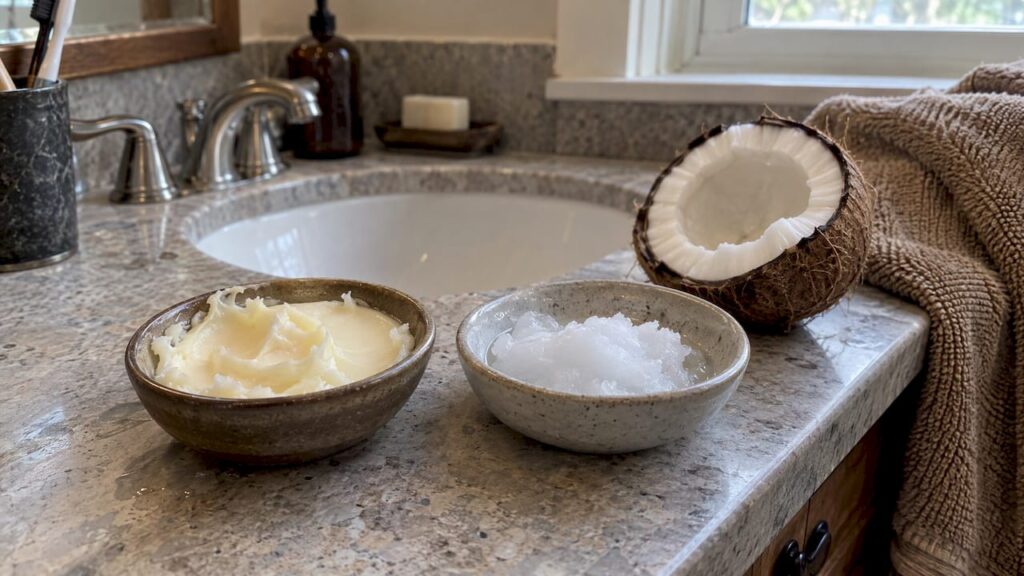

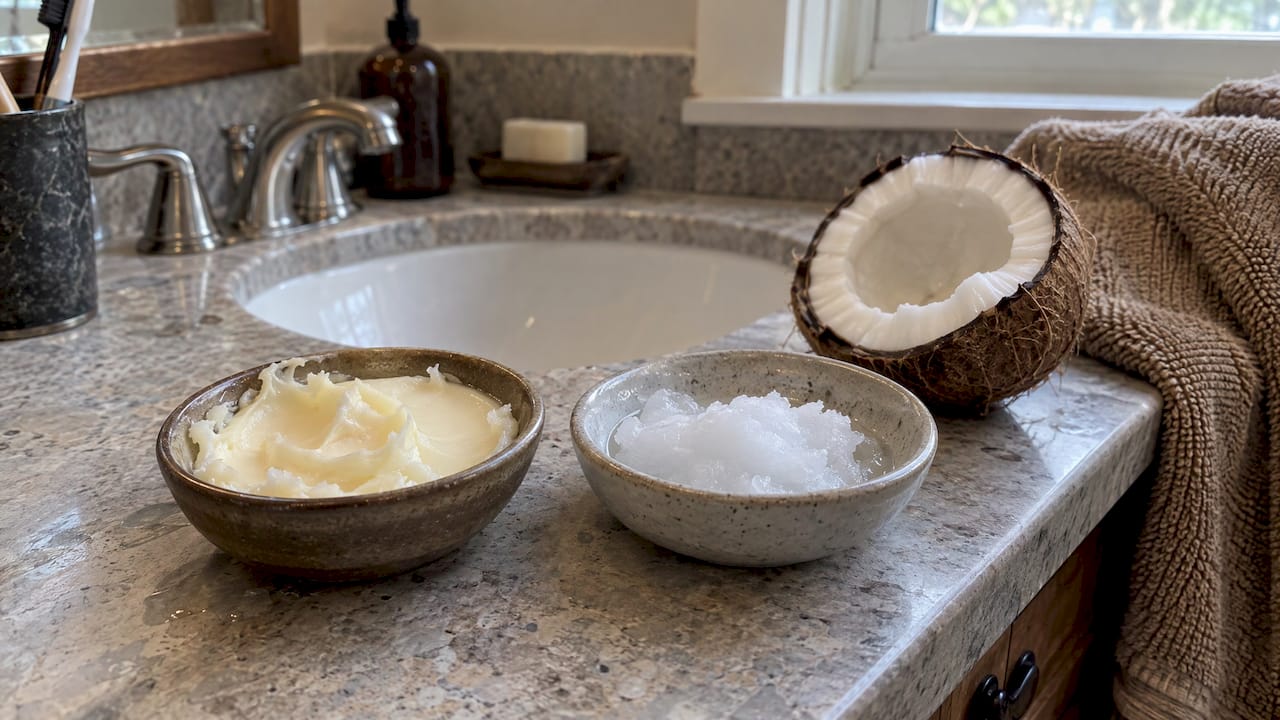
For your face, tallow is the better fit. Coconut oil is a decent body moisturizer, but dermatologists generally steer men away from putting it on the face because it clogs pores. Tallow is built from the same fatty acids that make up your skin’s own barrier lipids, so it sits on the skin the way a moisturizer should. Paired with hyaluronic acid, it gives dry, irritated or aging skin water and a seal to hold it in. That is the idea behind our Iron Bull Beef Tallow Face Moisturizer for Men, and the rest of this article shows the evidence and the reasoning so you can judge it yourself.
TL;DR
- Tallow is made mostly of oleic, palmitic and stearic acids, the same family of fats found in the outer layer of human skin. Coconut oil is mostly medium-chain fatty acids, led by lauric acid.
- Coconut oil does hydrate dry skin in trials, but Cleveland Clinic’s dermatologist generally does not recommend it on the face because it is highly comedogenic (pore-clogging).
- Hydration lasts longest when a water-binding ingredient like hyaluronic acid is layered under an oil-based seal, which is how our balm is formulated.
- Whichever you choose, patch-test first: a quarter-sized spot for 7 to 10 days.
Table of Contents
- What each one is made of
- How they feel and absorb on your face
- What the hydration evidence shows
- Pores, breakouts and sensitive skin
- Fine lines: what an oil can and cannot do
- Why hyaluronic acid changes the comparison
- When coconut oil still makes sense
- Try the balm built for men’s faces
- How to patch-test and use any new face product
- Our view
- FAQ
- Sources
What each one is made of
Tallow is rendered beef fat. A 2024 scoping review of the research describes it as primarily oleic, palmitic and stearic acids, with hydrating and moisturizing properties. A 2026 review adds that tallow carries vitamins A, D, K, E and B12 plus antioxidants. The reason these fats matter for skin is simple. A literature review on bovine tallow in cosmetics notes that oleic, palmitic and stearic acids also make up the lipid fraction of the human stratum corneum, the outermost layer of skin that keeps water in and irritants out. A fat that resembles what your skin already uses is a natural fit for a barrier repair job.
Coconut oil is a different animal. Cleveland Clinic explains that about 65% of it is medium-chain fatty acids, with lauric acid making up 49%. Lauric acid has antimicrobial properties, which is why coconut oil has a loyal following. It is also why the oil behaves differently on skin: it melts almost instantly, spreads thin and leaves a slippery, shiny layer.
In plain terms:
| Tallow | Coconut oil | |
|---|---|---|
| Main fats | Oleic, palmitic, stearic acids | Lauric and other medium-chain fatty acids |
| Resemblance to skin’s own lipids | High | Lower |
| Feel | Rich, then melts in | Light, slippery, can look shiny |
| Best use | Face and body, dry or weathered skin | Body, rough patches like elbows and knees |
How they feel and absorb on your face
If you shave, you know the problem: you want moisture without a layer that feels like you rubbed a candle on your cheeks. Coconut oil melts on contact and many people find it slippery. A tallow balm feels richer at first, and a whipped one spreads easily and settles into the skin as it warms.
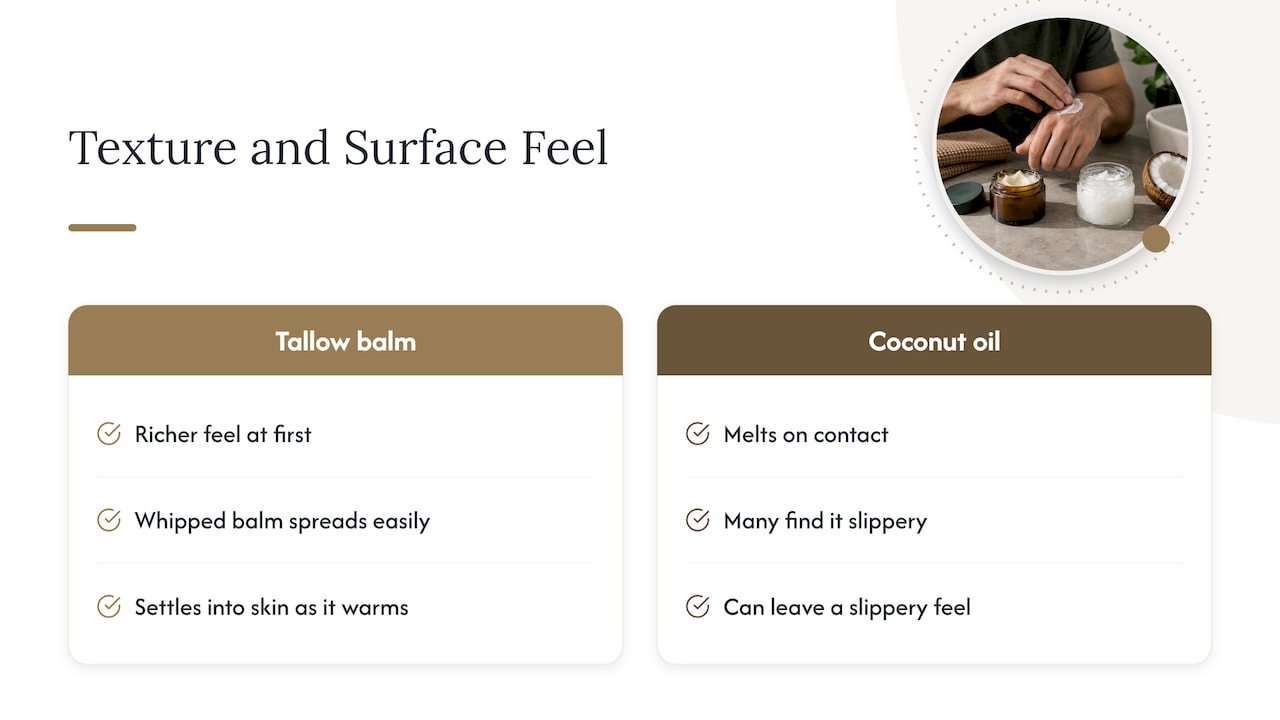
A word on “absorbs deeply.” Nobody has directly established how far tallow travels into the skin, and the same is true for most oils. What a good balm does is form a lipid film on the surface. An NPR report quoting a Society of Cosmetic Chemists expert says this film can leave skin looking plump and dewy. That film is the point. It slows water loss from the skin, which is what dry, tight, windburned skin needs.
The practical difference for a busy morning is how much is left on the surface after a few minutes. Our balm is designed to hydrate and repair without the greasy residue typical of many moisturizers, so you can apply it and get dressed.
What the hydration evidence shows
Coconut oil has real trial data behind it, and it is worth knowing:
- A 2004 double-blind trial in 34 patients with mild to moderate dry skin found that extra virgin coconut oil on the legs twice daily for two weeks improved hydration and skin surface lipids as well as mineral oil did.
- A 2018 randomized study of 32 participants found coconut oil, almond oil, jojoba oil and petrolatum all significantly raised hydration after two weeks.
Those trials tested dry body skin, mostly legs and arms. They tell you coconut oil is a fair body moisturizer. They do not tell you it belongs on your face, where pores, stubble and sebum glands change the picture.
For tallow, the research reviewed in 2026 includes a study in which tallow and walnut oil emulsions improved skin hydration in 78 patients with atopic dermatitis or psoriasis, and an animal study in which a beef tallow mixture improved itching and barrier function. Tallow’s case rests on that skin-matching fatty acid profile and on how it behaves as a rich, protective emollient.
Pores, breakouts and sensitive skin
This is where the two split most clearly for men’s faces.
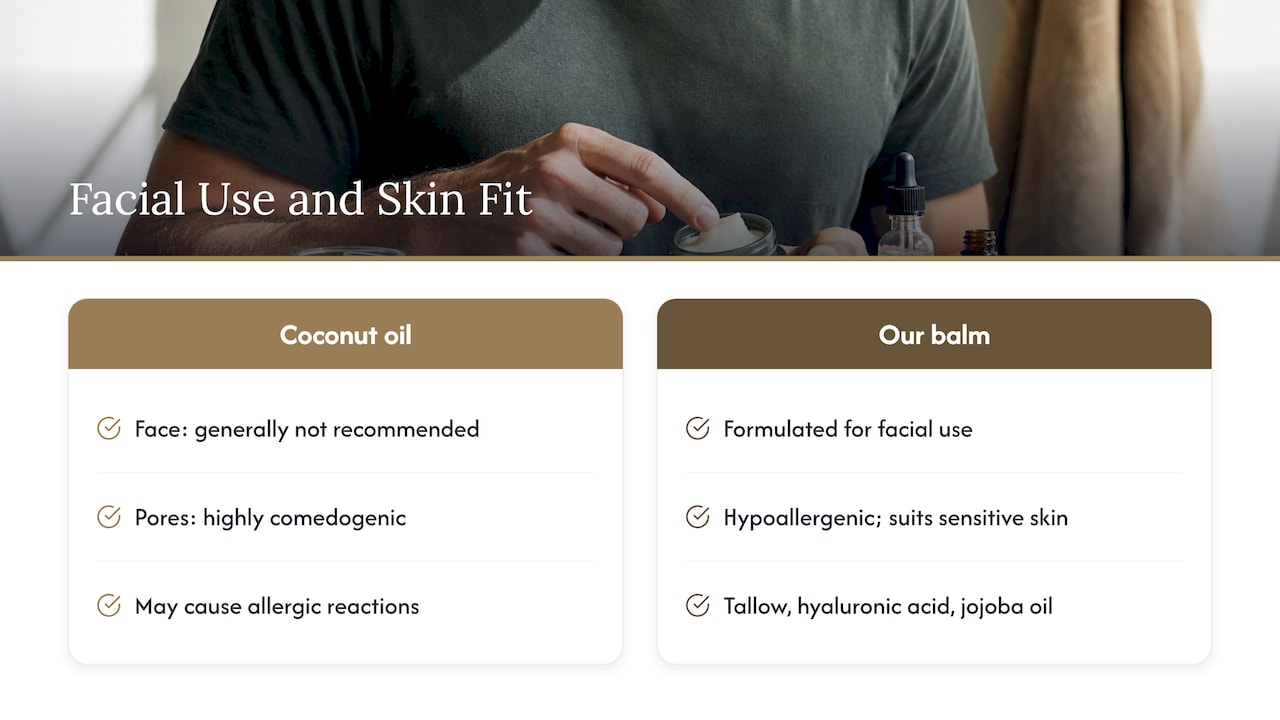
Cleveland Clinic’s dermatologist notes coconut oil can lower water loss through the skin, but she generally does not recommend it on the face because it is highly comedogenic and may cause blackheads, whiteheads or milia, especially under the eyes. Two dermatologists interviewed by Glamour say the same thing: one advises reserving coconut oil for the driest skin and not applying it pure to the face, and the other calls it a moisturizer for the trunk and limbs. The 2026 review also flags that coconut oil can cause allergic reactions in some people.
If you are prone to clogged pores along the jaw or in the beard area, that matters. A face product has to sit on skin all day under sun, sweat and a razor’s aftermath.
Our balm is made for that job. It is built around three key ingredients, grass-fed Alberta tallow, hyaluronic acid and jojoba oil, which we formulate to be non-toxic and hypoallergenic and suitable for sensitive and all skin types. A short ingredient list also means fewer things for irritated skin to react to. Read more on our page about what tallow does for the face.
Fine lines: what an oil can and cannot do
No oil erases wrinkles, and you should be wary of anyone who says otherwise. What a good moisturizer does is plump the surface with water and reduce the dryness that makes fine lines look deeper. Tallow brings vitamins and antioxidants to that job, and the 2026 review notes antioxidants are associated with preventing aging by reducing oxidative stress.
Coconut oil gives you a slick surface layer but no water-binding partner, which brings us to the part most comparisons skip.
Why hyaluronic acid changes the comparison
An oil on its own seals. It does not add water. Hyaluronic acid does the opposite: it is a humectant that pulls water into the skin. A 2026 study of 123 volunteers found that over eight hours only a hyaluronic acid serum layered with a moisturizing cream kept hydration significantly higher than the cleanser control, while the serum alone lost significance by hour eight. Water-binding plus a seal beats either one alone.
That is why our tallow balm includes hyaluronic acid in the same jar: one step, both jobs. If you want to see what it does for men’s skin specifically, we cover it in our hyaluronic acid guide for men. The American Academy of Dermatology also lists hyaluronic acid among the ingredients to look for in a dry-skin moisturizer, and advises applying moisturizer while the skin is still damp.
When coconut oil still makes sense
For elbows, knees, heels and rough forearms, coconut oil is a reasonable pick. The dermatologists above agree it is a good body moisturizer. If you keep a jar in the bathroom, keep it for below the neck and use a dedicated face product above it.
For the face, choose something designed for it. Our tallow for skin guide explains what to look for in a face balm, from sourcing to texture.
Try the balm built for men’s faces
Iron Bull Beef Tallow Face Moisturizer for Men is made from grass-fed Alberta tallow with hyaluronic acid and jojoba oil, designed to hydrate deeply, repair and soften the look of fine lines and irritation without a greasy finish. Customers report visible improvements in texture and hydration within weeks, and every order is backed by a 60-day money-back guarantee. You can see the balm and our sun balm in the Iron Bull shop, or go straight to the face moisturizer page.

If you want the routine laid out, our guide to grass-fed tallow skincare for minimalists walks through a four-week plan.
How to patch-test and use any new face product
New products can irritate, whether the main ingredient is tallow, coconut oil or a cream. The American Academy of Dermatology recommends a simple test:
- Apply the product to a quarter-sized spot, such as the inner forearm or beside the ear.
- Use it as you normally would, twice daily, for 7 to 10 days.
- If you see redness, itching or swelling, wash it off and stop using it. If the reaction is strong or lingers, see a dermatologist.
Once the spot stays calm:
- Wash your face and leave it slightly damp.
- Warm a pea-sized amount between your fingertips.
- Press it over the cheeks, forehead and neck, with a little extra on dry or windburned patches.
- Use it after shaving, when skin is most exposed, and again at night if skin is very dry.
Give it a few weeks. Skin barrier changes build with consistent use, not in one application. If you are going out in the sun, apply it first and then your sun protection; our sun balm is made for that step.
Our view
We started Iron Bull because most men’s skincare is either a drugstore lotion full of ingredients nobody can pronounce, or a ten-step routine nobody sticks to. Men want something that works and goes on in thirty seconds.
That is why we chose tallow. It is made of the same kinds of fats your skin barrier is made of, and when it is grass-fed and sourced from Alberta, it is about as simple as skincare gets. We add hyaluronic acid so the balm brings water as well as a seal, and jojoba oil to keep the texture light. Three key ingredients, non-toxic, hypoallergenic, and suitable for sensitive skin.
Coconut oil has its place on elbows and heels. For the face, we think a balm designed around skin-matching fats and hydration is the better call, and we back it with a 60-day money-back guarantee so you can see how your own skin responds.
Blaine
FAQ
Is tallow better than coconut oil for dry skin?
For facial dryness, tallow is the better fit. Its fatty acids resemble those in the skin’s outer barrier, and it feels rich but melts in. Coconut oil also hydrates in trials, but dermatologists generally keep it off the face because of pore-clogging risk and use it on the body.
Does coconut oil clog pores on the face?
It can. Cleveland Clinic’s dermatologist describes coconut oil as highly comedogenic, linked with blackheads, whiteheads and milia, especially around the eyes. If you are prone to breakouts or have a beard, a purpose-made face balm is the safer choice.
Can I use tallow and coconut oil together?
There is no need. A formulated tallow balm with hyaluronic acid already covers water-binding and sealing in one step. If you like coconut oil on your body, keep it there and use the face balm above the neck.
How long until I see results from a tallow balm?
Skin barrier improvement builds with regular use. Customers report visible improvements in texture and hydration within weeks, so apply it consistently after washing or shaving for a few weeks before you judge it. Our 60-day money-back guarantee covers that window.
Is tallow safe for sensitive skin?
Our balm is formulated to be hypoallergenic and suitable for sensitive skin. As with any new product, do a patch test for 7 to 10 days first. If you have eczema, rosacea or another skin condition, ask your dermatologist before adding a new product.
Sources
- Tallow, Rendered Animal Fat, and Its Biocompatibility With Human Skin (scoping review, 2024)
- From the Kitchen to Your Skin: A Review of Nontraditional Topical Agents (2026)
- Bovine tallow in cosmetic formulations: moisturizing properties
- Cleveland Clinic: Is Coconut Oil Good For Your Skin?
- NPR: What’s the deal with the beef tallow skincare trend?
- Randomized double-blind trial of extra virgin coconut oil vs mineral oil (2004)
- Multi-Center Randomized Clinical Study of oils and petrolatum for xerosis (2018)
- Glamour: Is Coconut Oil Good for Your Skin? Dermatologists Weigh In
- A serum and cream moisturization regimen study (2026)
- AAD: Dermatologists’ top tips for relieving dry skin
- AAD: How to test skin care products