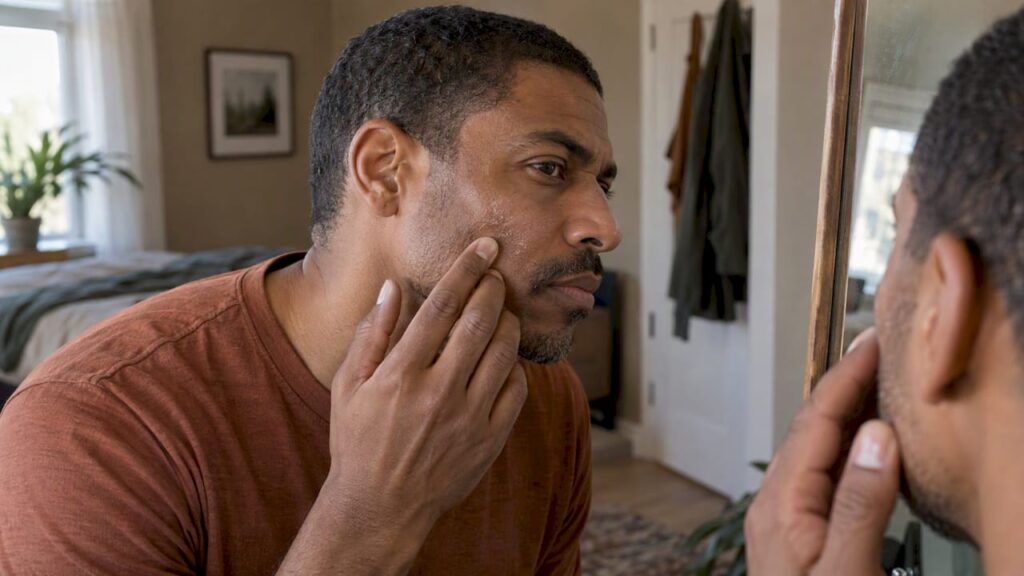


Yes, men get perioral dermatitis, even though it is often described as a condition that mostly affects young women. If you have red bumps clustered around your mouth or nose, stop applying any steroid cream to that skin, strip your routine down to the basics, and book a dermatologist visit if the rash is spreading or won’t quit. Most cases clear up over several weeks to a few months once the right trigger gets removed and treatment starts.
TL;DR:
- Men with perioral dermatitis should avoid topical steroids, especially around the mouth, to prevent worsening of the condition.
- Most cases respond to removing triggers and may take several weeks to a few months to fully resolve, depending on severity.
- Diagnosis relies mainly on visual pattern recognition and product history, with urgent consultation needed if the rash spreads or worsens.
- Mild cases often improve with topical antibiotics like metronidazole or erythromycin, while moderate to severe cases may require oral tetracyclines.
- Avoid heavy, occlusive products and use a simple, fragrance-free skincare routine during recovery to support the skin barrier.
Table of Contents
- Perioral Dermatitis Symptoms in Men: What It Actually Looks Like
- What Causes Perioral Dermatitis and Common Triggers in Men
- How Doctors Diagnose Perioral Dermatitis and When to See a Dermatologist
- Treatment for Perioral Dermatitis: From Steroid Withdrawal to Antibiotics
- Building a Beard-Friendly Skincare Routine During Treatment
- Long-Term Outlook: Will Perioral Dermatitis Come Back?
- How Iron Bull Naturals Approaches Men’s Skin Barrier Support
- Living With Perioral Dermatitis: An Editorial Take
- Adjunctive Skin Support From Iron Bull Naturals
- Sources
- FAQ
Perioral Dermatitis Symptoms in Men: What It Actually Looks Like
The rash shows up as small, dome-shaped papules and pustules clustered around the mouth, and it frequently spreads to the nose or lower eyelids too. One detail trips up a lot of guys: there’s usually a narrow strip of clear skin right along the lip border, called peri-vermillion sparing. Acne doesn’t do that. Underneath the bumps you’ll often see redness and a dry, slightly scaly texture that can look like it’s flaking even when the rest of your face is fine.
Symptoms vary in feel as much as look:
- A burning or stinging sensation, especially after applying anything to the skin
- Occasional itch, though it’s usually milder than the burning
- Tightness or a raw feeling that gets worse with washing
- Bumps that stay small and uniform rather than forming the deeper cysts typical of acne
Beards complicate the picture. Stubble and thicker facial hair can hide early papules until they’re already inflamed, and shaving irritation sometimes gets blamed for what’s actually perioral dermatitis, a condition that shows up in men, women, and children alike even though it’s more common in young women. On darker skin tones, the redness can look more brown or violet than pink, which is one reason it gets missed or misdiagnosed more often in men with deeper complexions.
What Causes Perioral Dermatitis and Common Triggers in Men
The single most common trigger is topical corticosteroid use on the face, and this includes potent steroid creams borrowed from a partner’s medicine cabinet or leftover prescriptions for eczema elsewhere on the body. Nasal steroid sprays and inhaled steroids for asthma count too. Enough of the spray drifts backward onto the skin around the nose and mouth to set off a reaction, a pattern dermatologists sometimes call “steroid back spray.”
Other common contributors include:
- Heavy, occlusive moisturizers and thick balms not suited to reactive skin
- Certain sunscreens, particularly some chemical formulas
- Fluoride toothpaste in a subset of sensitive individuals
- Cosmetics or grooming products with fragrance or heavy emollients
- Friction from face masks or aggressive beard grooming tools
Roughly one in three primary care visits for skin complaints touches on a condition in this same inflammatory family, which is why misdiagnosis as acne is so common. Harvard Health points to steroids, cosmetics, moisturizers, and toothpaste ingredients as the most frequent culprits worth reviewing first.
Here’s the frustrating part: nobody has fully nailed down the exact mechanism. The current thinking treats it as a follicular inflammatory reaction rather than classic eczema, which explains why steroid creams often make it look better for a week or two before making it worse. DermNet NZ identifies topical corticosteroid exposure as the most consistent precipitant across cases.
How Doctors Diagnose Perioral Dermatitis and When to See a Dermatologist
Diagnosis is almost entirely visual. A dermatologist looks at the pattern, distribution, and that telltale sparing along the lip line, then asks about your product history and any steroid exposure. Lab tests or skin scrapings usually only come into play if there’s a suspicion of a secondary infection or a look-alike condition like fungal folliculitis.
Get in to see someone sooner rather than later if:
- The rash is spreading toward your eyes or eyelids
- You’re dealing with significant pain, swelling, or warmth in the area
- You notice fever or other signs the reaction has gone systemic
- Two to three weeks of stripping back your routine hasn’t slowed things down
Bring a full list of everything that’s touched your face in the last two months, including old prescriptions, and a photo timeline if you have one. Mention any inhalers or nasal sprays specifically. A lot of men forget to mention those because they don’t think of them as “skincare.”
Treatment for Perioral Dermatitis: From Steroid Withdrawal to Antibiotics
The first move is almost always stopping any topical steroid on the affected skin, but this should be done with medical guidance rather than abruptly on your own. Steroid withdrawal can trigger a rebound flare that looks worse before it gets better, and many dermatologists manage that transition with supportive topical care and, often, an anti-inflammatory antibiotic rather than having a patient white-knuckle it alone. If you’ve been using a prescription steroid cream, talk to a clinician about tapering rather than quitting overnight.
For mild cases, topical options often do the job on their own:
- Topical metronidazole, applied once or twice daily
- Topical erythromycin for milder inflammation
- Topical calcineurin inhibitors as a steroid-sparing option once a diagnosis is confirmed
Moderate to more stubborn cases usually call for oral tetracyclines, doxycycline or minocycline, most often for somewhere between four and eight weeks, sometimes extended for persistent presentations. The American Academy of Dermatology notes that improvement with oral tetracyclines typically unfolds over weeks to months rather than days. If tetracyclines aren’t an option, erythromycin serves as the standard alternative. Clinical follow-up data backs this up: cohorts treated with oral tetracyclines have shown measurable drops in objective severity scores over the treatment course.
Pro Tip: Track your skin day by day in your phone’s notes app, product changes, flare severity, anything new you touched your face with. When you see your dermatologist, that log is worth more than a vague “it’s been about a month.”

Building a Beard-Friendly Skincare Routine During Treatment
While you’re clearing this up, less is genuinely more. A simple skincare routine helps avoid adding new irritants to a face that’s already inflamed.
- Wash with a gentle, fragrance-free cleanser, lukewarm water only, no scrubbing
- Apply a lightweight, fragrance-free moisturizer or balm to support the skin barrier
- Use mineral sunscreen if you’re reactive to chemical filters, since zinc oxide tends to sit better on inflamed skin
Beard care needs its own adjustments. Skip exfoliating beard washes and stiff-bristled brushes until things settle down. If you’re mid-flare, trimming rather than a close razor shave reduces friction on inflamed follicles. If you’re also seeing flaking or dandruff-like buildup at the beard line, that can be a separate, treatable fungal issue worth addressing alongside the dermatitis rather than instead of it.
Products to shelve entirely during a flare: heavy occlusive balms with fragrance, physical exfoliants, retinoids, and anything marketed as “anti-aging” with active acids. Once your skin has been clear for two to three weeks, reintroduce one product at a time, waiting several days between each addition so you can actually tell what’s working. A simple three-step routine built for men makes that reintroduction easier to manage without overcomplicating things.
Long-Term Outlook: Will Perioral Dermatitis Come Back?
Most men see meaningful improvement within several weeks of proper treatment, though full resolution can stretch to a few months. Some people, however, deal with a chronic relapsing pattern where the rash returns months or years later, usually after reintroducing a trigger without realizing it.
Reducing that risk comes down to a few habits:
- Keep facial steroids off your radar entirely unless a dermatologist specifically prescribes one for something else
- Stick with the gentle, fragrance-free routine even after your skin clears
- Log any new product for a few weeks before deciding it’s safe
- Address small flares immediately with the same low-intervention approach rather than waiting
If you’ve had two or more flares in a year, it’s worth setting up a standing relationship with a dermatologist rather than treating each episode as a one-off emergency.
How Iron Bull Naturals Approaches Men’s Skin Barrier Support
Iron Bull Naturals builds products around the same principle dermatologists recommend for reactive skin: fewer ingredients, less fragrance, less friction. That philosophy shapes how we think about supportive care for men managing skin barrier issues, including during perioral dermatitis recovery.
A few things worth knowing if you’re rebuilding your routine post-flare:
- A minimal, hypoallergenic balm can help support hydration once active treatment has calmed the inflammation
- Apply with clean hands and avoid rubbing directly over beard follicles that are still healing
- Any product like this works alongside medical treatment, never as a replacement for it
Living With Perioral Dermatitis: An Editorial Take
Nobody warns men that a rash around the mouth can mess with your confidence in ways that feel disproportionate to how minor it looks in the mirror. It’s not vanity to be bothered by it. What actually helps is treating this like a slow burn instead of an emergency: log what you’re using, give each change two to three weeks before judging it, and stay in touch with a dermatologist instead of chasing a new product every time patience runs out.
— Blaine
Adjunctive Skin Support From Iron Bull Naturals
Iron Bull Naturals doesn’t treat perioral dermatitis, and nothing here replaces a dermatologist’s care. What it offers is a genuinely minimal option for the barrier support phase that follows medical treatment, when your skin is calm enough to handle a moisturizer again but still too reactive for anything complicated. The Iron Bull Beef Tallow Face Moisturizer uses three ingredients total, grass-fed tallow, hyaluronic acid, and jojoba oil, with no fragrance and no filler to second-guess while your skin heals.

For sun protection during recovery, when reactive skin often can’t tolerate chemical filters, the Sun Balm sits in the same three-ingredient category. Browse both at the Iron Bull Naturals shop. If your rash is active, spreading, or not improving, see a dermatologist first. These balms are a supporting step for the skin barrier phase, not a substitute for a diagnosis.
Sources
- Perioral Dermatitis – StatPearls – NCBI Bookshelf
- Perioral dermatitis — American Academy of Dermatology (AAD)
- Periorificial dermatitis — DermNet NZ
- Perioral dermatitis — Harvard Health
FAQ
Can Guys Get Perioral Dermatitis?
Yes. It’s more common in young women, but men, teenagers, and children all get it too, according to StatPearls. Men sometimes get misdiagnosed longer because the condition isn’t the first thing a clinician expects to see in a male patient.
Why Did I Suddenly Get Perioral Dermatitis?
The most common trigger is a topical steroid cream applied to the face, even one used for an unrelated issue like eczema on your hands that migrated to your face. Nasal sprays, inhalers, heavy moisturizers, and certain cosmetics or toothpaste ingredients can also set it off, per Harvard Health.
Can I Kiss Someone With Perioral Dermatitis?
Perioral dermatitis is not contagious, so there’s no infection risk to a partner from close contact. It’s an inflammatory skin reaction, not a bacterial or viral condition that spreads between people.
What Can Be Mistaken for Perioral Dermatitis?
Acne, rosacea, contact dermatitis, and folliculitis all get confused with it regularly. The key difference is the absence of blackheads or deep cysts and that narrow strip of clear skin right along the lip border, which DermNet NZ flags as one of the most reliable distinguishing features.